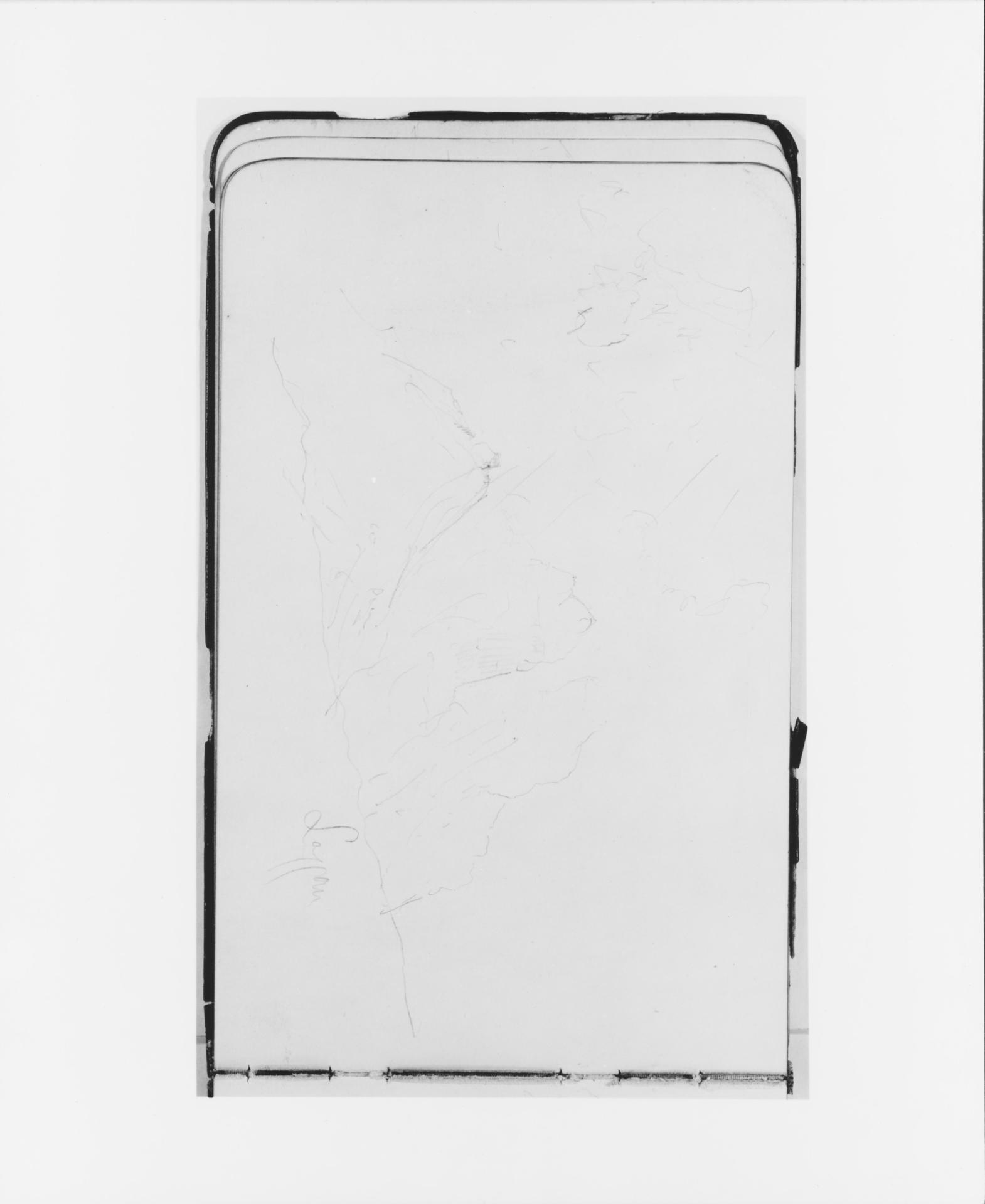
Sketch of Mountains (from Sketchbook) (1890, Met-Objekt 2630)
Original title: Sketch of Mountains (from Sketchbook)
kurzbeschreibung
Albert Bierstadt drew this mountain sketch in 1890 in graphite on wove paper. The sheet comes from a sketchbook and records a passing observation of nature: mountains and a river course, with no details worked out.
Description
On the left a river runs through the image, while mountains rise on the right. The line stays open and tentative, so the sheet reads as an unfinished study. There are no figures and no objects that can be identified precisely; the drawing remains entirely in graphite and therefore monochrome. Light is spread evenly, with no strong contrasts or special effects.
Context
Albert Bierstadt (1830–1902), a German-American painter, became known for large-format landscapes of the American West. In 1890, when this sketch was made, he turned increasingly to smaller studies after his famous expeditions. He kept his sketchbooks as a visual archive from which he later drew for paintings.
Impact
Because the drawing is reduced to essentials, it radiates calm and concentration. The loose line lets an immediate, almost intimate observation of nature come through—without pathos or drama.
Technique
Graphite on wove paper, whose even, fine surface suits quick, spontaneous sketches. The artist varies pressure to suggest tonal values and textures, as is typical of fleeting studies.
AI-generated description text
Source: Metropolitan Museum of Art · Public Domain (CC0 1.0)