Virgin and Child with Angels Dancing in a Landscape
Original title: Virgin and Child with Angels Dancing in a Landscape
kurzbeschreibung
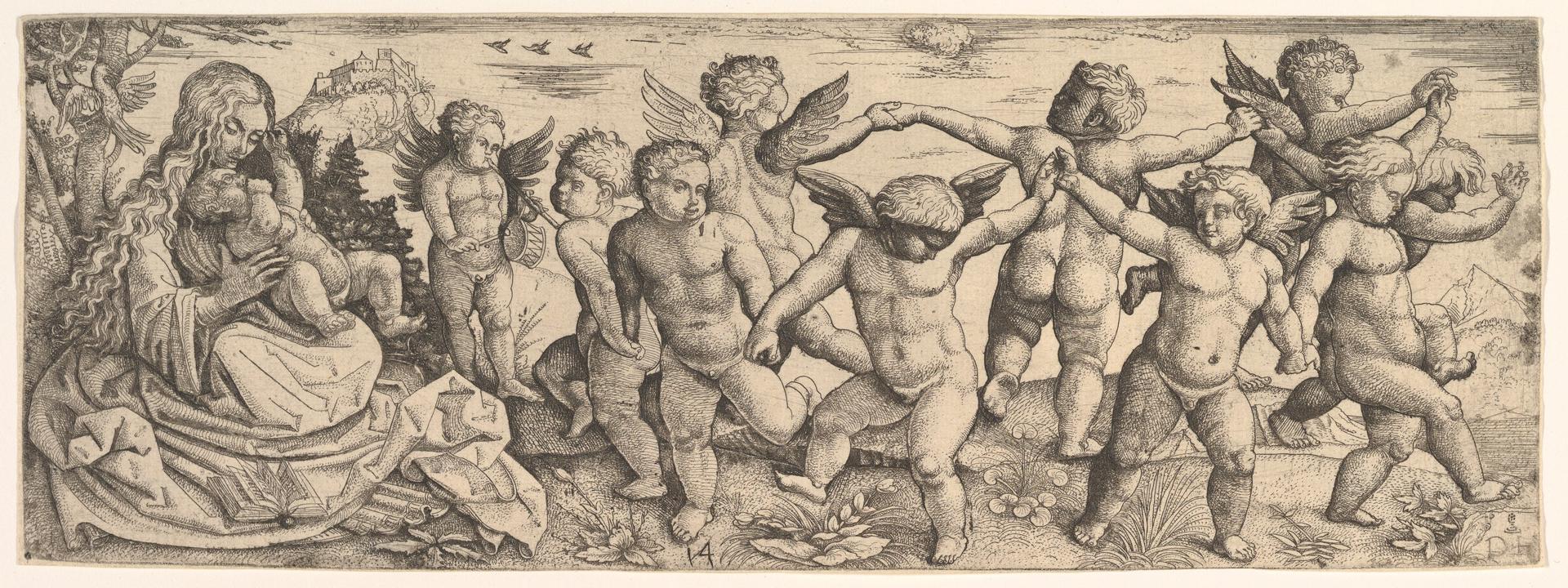
What sets this etching apart from related Madonnas by Daniel Hopfer is the ring of dancing angels beside the seated Mother of God. The Christ Child rests on Mary's lap while a lively band of angels unfolds around her. Made in the 1530s, this horizontal print is the second of two states and measures 12.4 by 34.1 cm, blending religious iconography with an idyllic landscape.
Description
Mary sits at the middle of the image, dressed in a long-sleeved robe, holding the Child on her lap. Several angels surround her in dancing motion, some with wings, some barefoot and clothed. Behind the figures a landscape opens up with trees, a river, and a castle. Delicate lines and shading give the figures and scenery a sculptural presence, all executed in monochrome etching.
Context
Daniel Hopfer, born around 1470 and dead by 1536, worked in Augsburg and is considered a pioneer of etching, which he helped advance decisively in the early sixteenth century. This horizontal print dates from the 1530s, when Hopfer focused mainly on printed graphics. Pairing the Madonna theme, popular in the Renaissance, with an arcadian landscape recalls Italian models.
Impact
The dancing angels give the image a lively, cheerful mood that contrasts with Mary's calm seated pose. Look closely, and the fine linework and detailed landscape reveal many small particulars. The result is an intimate atmosphere that invites devotion.
Technique
For this etching, the drawing was scratched into a metal plate coated with an acid-resistant ground and then bitten with acid. Hopfer used the method to achieve precise lines and subtle shading characteristic of his prints. That the sheet exists in a second state points to later reworking of the plate.
AI-generated description text
Source: Metropolitan Museum of Art · Public Domain (CC0 1.0)