Mountain Landscape (from Sketchbook)
Original title: Mountain Landscape (from Sketchbook)
kurzbeschreibung
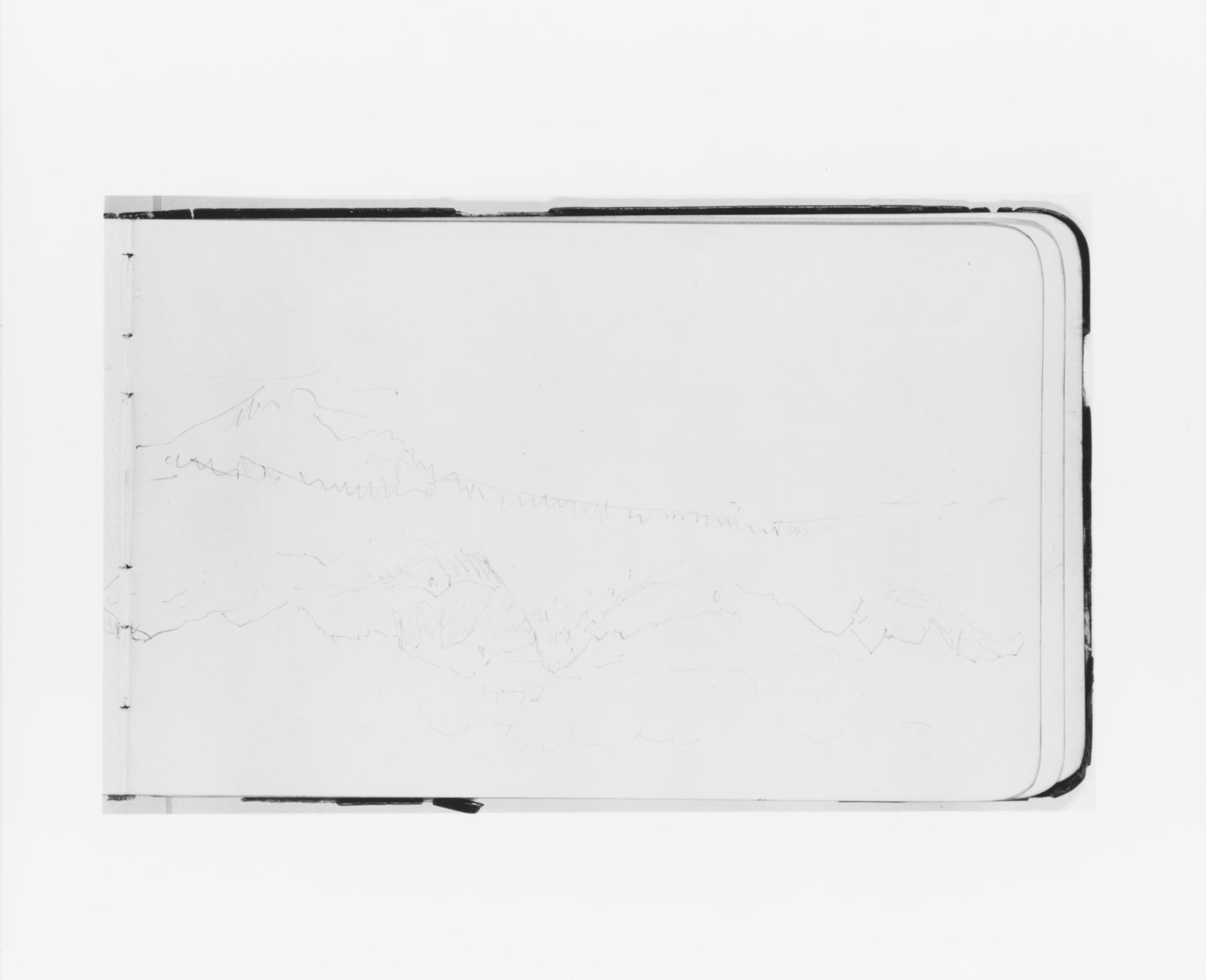
Albert Bierstadt made this graphite sketch on wove paper in 1890. Several mountain peaks rise above a wooded valley that extends into the foreground. The layout runs horizontally, with the mountain range stretching from left to right.
Description
A loose, spontaneous succession of mountain formations spreads across the entire width of the sheet. In the foreground, a wooded valley is suggested, its trees and vegetation outlined with fine lines. The peaks in the background are defined by bold, partly hatched lines that give them a sculptural presence. Shades of gray dominate the monochrome image, which is lit evenly without harsh shadows. There are no figures or other objects.
Context
Albert Bierstadt (1830–1902), a German-American painter of the Hudson River School, became known for monumental landscapes of the American West. The 1890 sketch dates from a period when Bierstadt was long established internationally and often drew while traveling to record motifs for later paintings. The sketchbook format allowed him to document natural scenes quickly, which he later developed in the studio. Graphite on wove paper was the usual technique for such studies.
Impact
The sketch feels immediate and authentic because it relies only on line and area. The impression is of rapid but precise observation of nature, without patina or idealization. The loose stroke invites the viewer to experience the landscape as a fleeting impression that captures the spontaneity of the moment.
Technique
Graphite on wove paper allows fine gradations from light to dark. The lines are sometimes delicate and sketchy, sometimes bolder and hatched to suggest shadows and textures. At about 12.1 x 19.7 cm, the sheet matches the format of a sketchbook and allows for quick, handy use.
AI-generated description text
Source: Metropolitan Museum of Art · Public Domain (CC0 1.0)