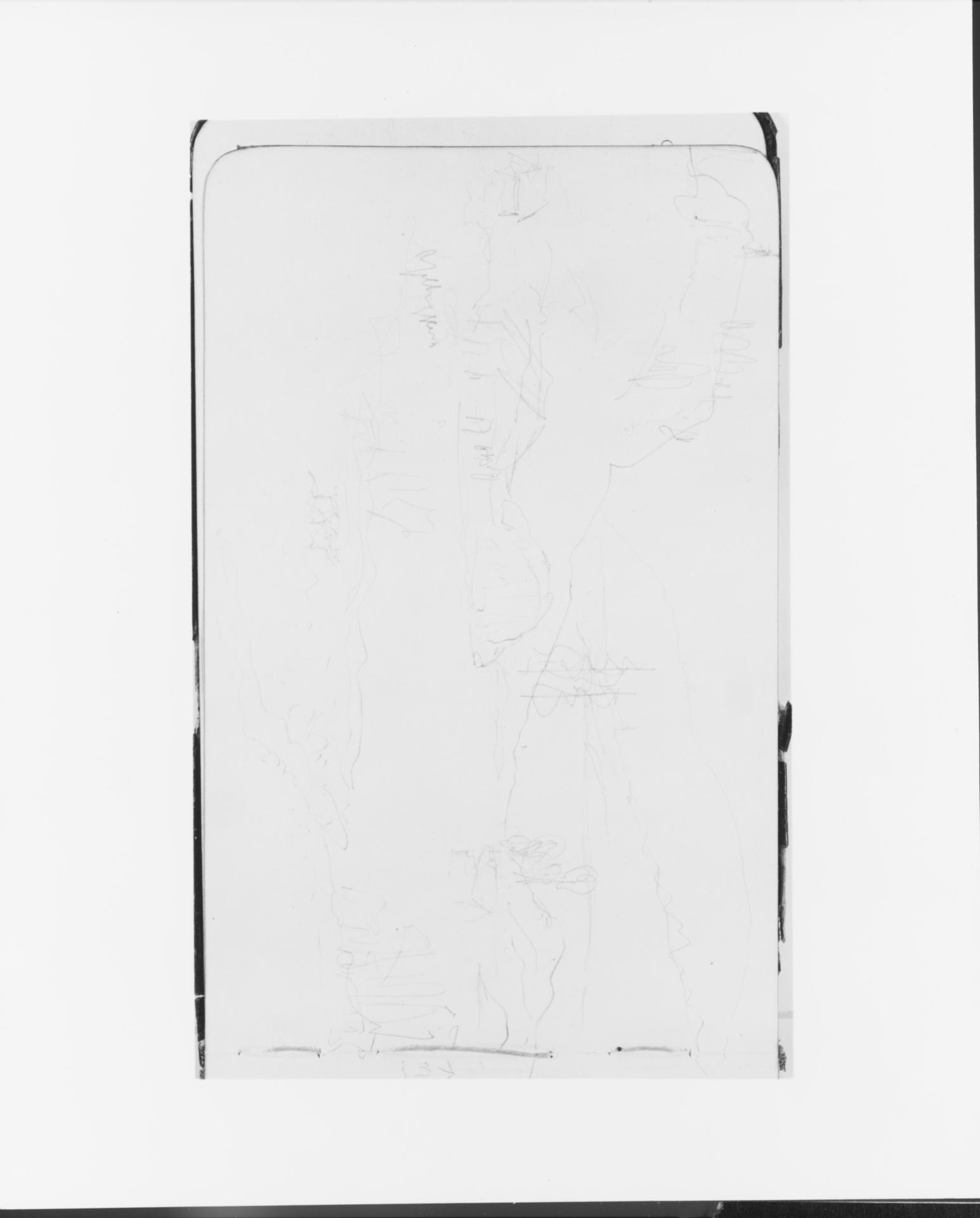
Bay Scene (from Sketchbook) (1890, Met-Objekt 2606)
Original title: Bay Scene (from Sketchbook)
kurzbeschreibung
Albert Bierstadt's 1890 drawing "Bucht-Szene (aus einem Skizzenbuch)" lays out a coastal setting with several figures and objects scattered across it. Executed in graphite on wove paper, the sheet measures 12.1 x 19.7 cm. What emerges is a loose beach or bay scene in which human silhouettes, and possibly animals, appear.
Description
Figures and objects are spread across the shoreline without a fixed focal point. Human silhouettes, perhaps animals too, show up in various poses and activities, suggesting a busy beach. The arrangement stays open and unresolved, as a sketch tends to be. Varying graphite pressure hints at light and shadow, while the drawing's sketchy manner stresses form and structure over finish.
Context
Albert Bierstadt (1830–1902), a German-American painter of the Hudson River School, became known for his landscapes of the American West. This drawing belongs to his later years, when he turned increasingly to sketches and studies. He used such sketchbooks as visual notebooks for later paintings. The sheet dates from 1890, when Bierstadt was living in New York and still traveling.
Impact
The loose, unforced linework gives the drawing an immediate, lively feel. It reads as a spontaneous observation and draws the viewer into the scene. Restricting himself to graphite directs attention to the shapes and movements of the figures.
Technique
Graphite on wove paper — a smooth, even support that permits fine lines — forms the basis of this drawing. Varying the hardness of the graphite produces tonal values and suggestions of light and shade. The approach is typical of Bierstadt's sketches, which he often made on the spot.
AI-generated description text
Source: Metropolitan Museum of Art · Public Domain (CC0 1.0)