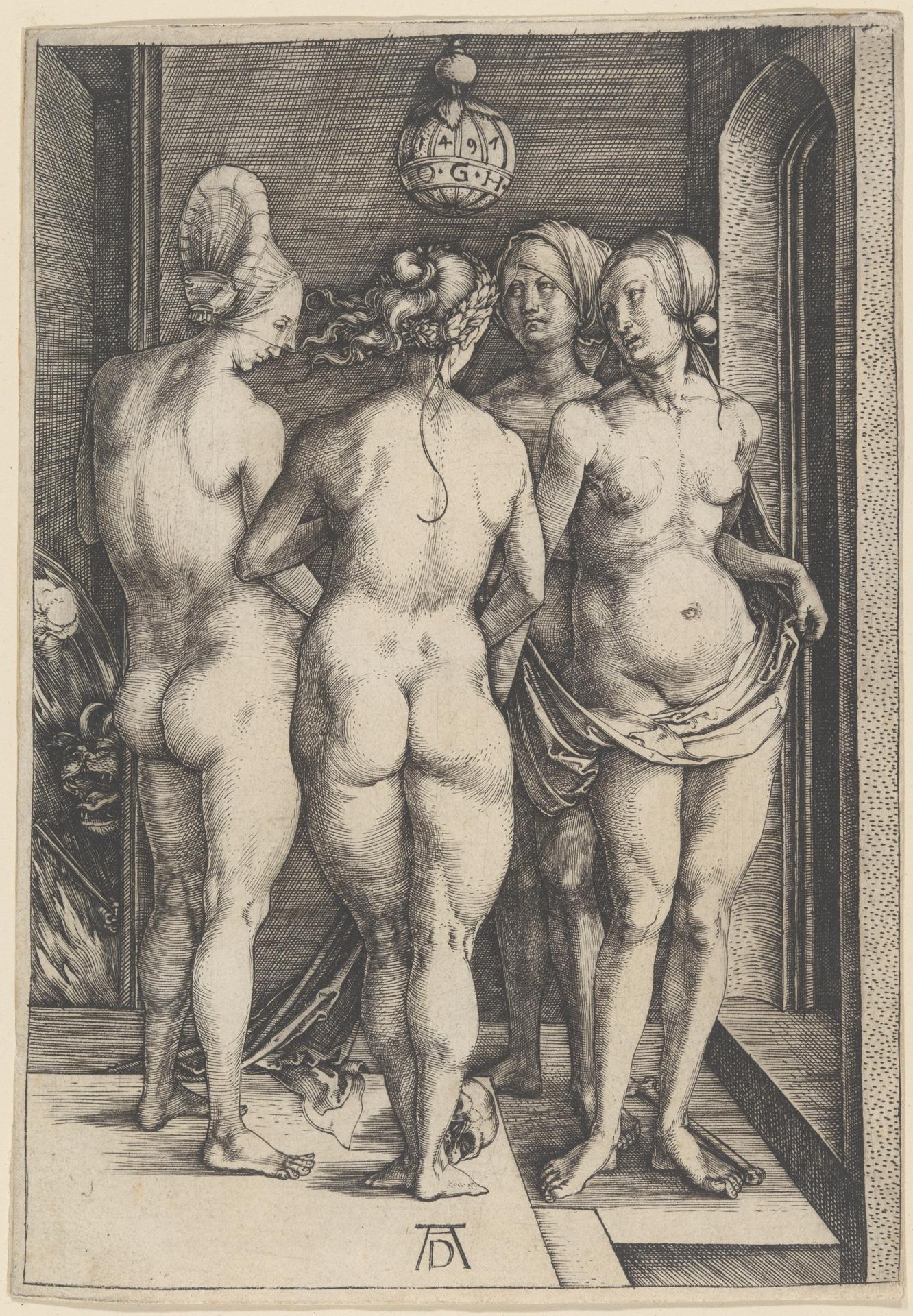
Four Naked Women
Original title: Four Naked Women
kurzbeschreibung
Four Naked Women is an engraving by Albrecht Dürer, dated 1497. The work depicts four nude female figures in a domestic interior with a mirror and a hanging lantern. It showcases Dürer's early mastery of the engraving medium.
Description
The scene shows four nude women in various poses, some wearing head coverings and one with a cloth wrapped around her waist. They are arranged around a mirror, with some figures looking into it while others gaze in different directions. A lantern hangs from the ceiling, bearing an inscription with the letters 'A' and 'H'. The background includes a simple wall and a door, and the entire composition is rendered in black and white with detailed shading that emphasizes the forms of the figures and the space.
Context
Dürer created this engraving in 1497, during a period when he was influenced by Italian Renaissance art, particularly the works of Andrea Mantegna. The subject of four nude women was unconventional for Northern European art of the time, which typically focused on religious or allegorical themes. The mirror and lantern may carry symbolic meanings, possibly related to vanity or the senses, though their exact interpretation remains debated. This work is one of Dürer's earliest attempts at depicting the nude figure, a theme he would explore further in his later career.
Impact
The engraving has a striking, almost theatrical quality, with the figures arranged in a way that invites the viewer to contemplate their interactions. The detailed shading and careful attention to the female form demonstrate Dürer's technical skill and his interest in classical ideals of beauty. The dim, intimate setting creates a sense of mystery, leaving the viewer to wonder about the narrative behind the scene.
Technique
This is a copperplate engraving, a technique that involves cutting lines into a metal plate with a burin. Dürer used cross-hatching and parallel lines to create gradations of light and shadow, giving the figures a sculptural solidity. The precision of the lines reflects his meticulous approach and his ability to achieve a wide tonal range in black and white.
AI-generated description text
Source: Metropolitan Museum of Art · Public domain (CC0)