Nevada Falls, Yosemite
Original title: Nevada Falls, Yosemite
kurzbeschreibung
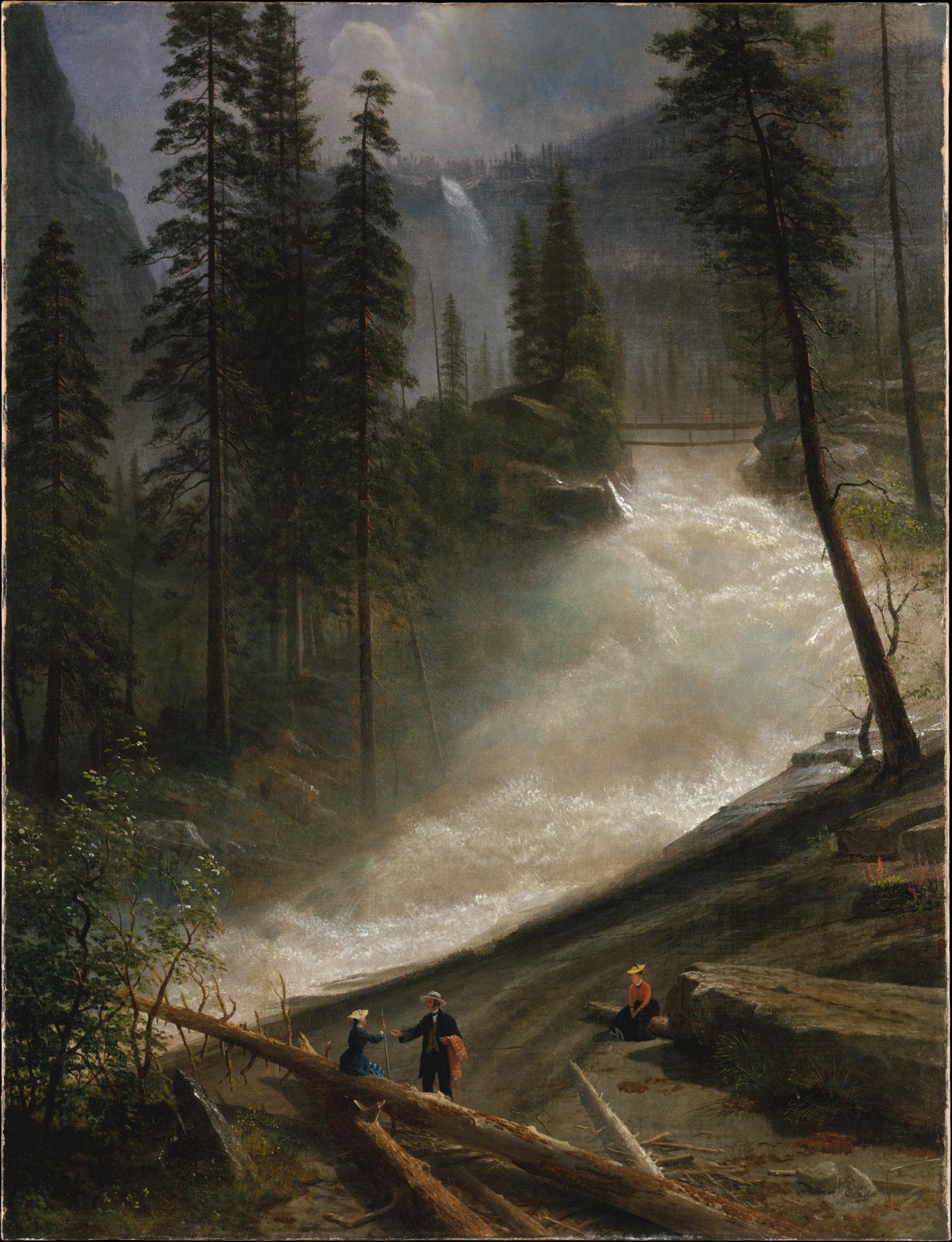
In 1872 or 1873, Albert Bierstadt painted 'Nevada Falls, Yosemite' as a large-scale oil study from nature. On a canvas of 99.1 by 76.2 cm, he conveys the force of the waterfall plunging from a dizzying height, while tiny figures in the foreground establish the scale.
Description
Three people animate the foreground: two have taken seats on a fallen tree trunk, and a third sits on the ground, all dressed in late 19th-century attire. Behind them, Nevada Fall drops over a steep rock face, surrounded by dense coniferous forest with massive trunks. Warm daylight filters down from above, sharply separating the dark silhouettes of the trees from the brightly foaming water. The layout feels balanced: the fall forms the center, and the figures are attached to it.
Context
Bierstadt knew the West from his own travels in the 1860s. Yosemite Valley was then among the favored destinations of the Hudson River School, to which Bierstadt is also counted. Around 1870, American landscape painting emphasized the sublime in nature and thus helped shape a national visual language.
Impact
The image conveys a sublime natural scene: the monumental setting and warm light draw the viewer's gaze. The small figures bring out the grandeur of the landscape and create a calm, contemplative mood.
Technique
Oil on canvas—a common method for landscape painting of the period. The brushwork is precise and allows a realistic rendering of light and surface texture. Warm earth tones predominate, with the water providing bright accents.
AI-generated description text
Source: Metropolitan Museum of Art · Public Domain (CC0 1.0)