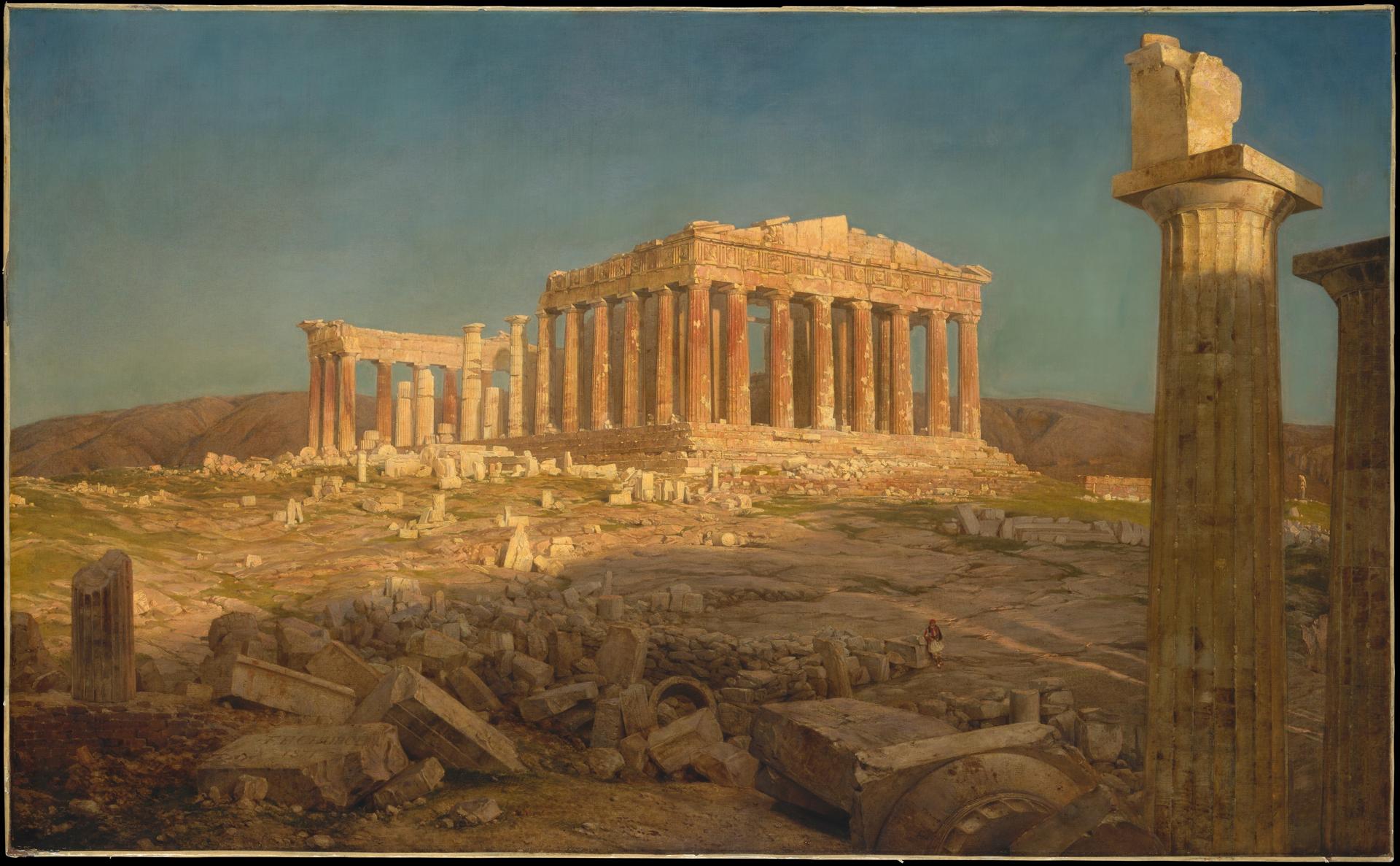
The Parthenon
Original title: The Parthenon
kurzbeschreibung
In 1871 Frederic Edwin Church turned to oil on canvas to depict the remains of the Parthenon on the Acropolis in Athens. The painting joins a faithful rendering of the landscape with the ancient structure as its dominant subject.
Description
Scattered fragments of columns and entablature lie in the foreground, while behind them the temple rises with its Ionic columns. Light falling from the left picks out the details of the ruin and sets them against a muted blue sky that suggests cloud cover or late afternoon. The layout is symmetrical: the Parthenon forms the vanishing point, and the debris in front draws the eye into depth.
Context
The painting was made in 1871 following a trip to Greece that Church had undertaken in 1869. By presenting the Parthenon as a ruin, he takes up the contemporary interest in antiquity and its decay. Church was known as a painter of landscapes who often placed historical or natural monuments in striking light.
Impact
Careful observation and a calm, balanced arrangement shape the impression of the image. The ruins evoke a wistful mood and encourage reflection on transience and history.
Technique
Oil on canvas, executed with fine brushstrokes and carefully graded tones. The lifelike treatment of light and shadow demonstrates Church's skill in nineteenth-century landscape painting.
AI-generated description text
Source: Metropolitan Museum of Art · Public Domain (CC0 1.0)