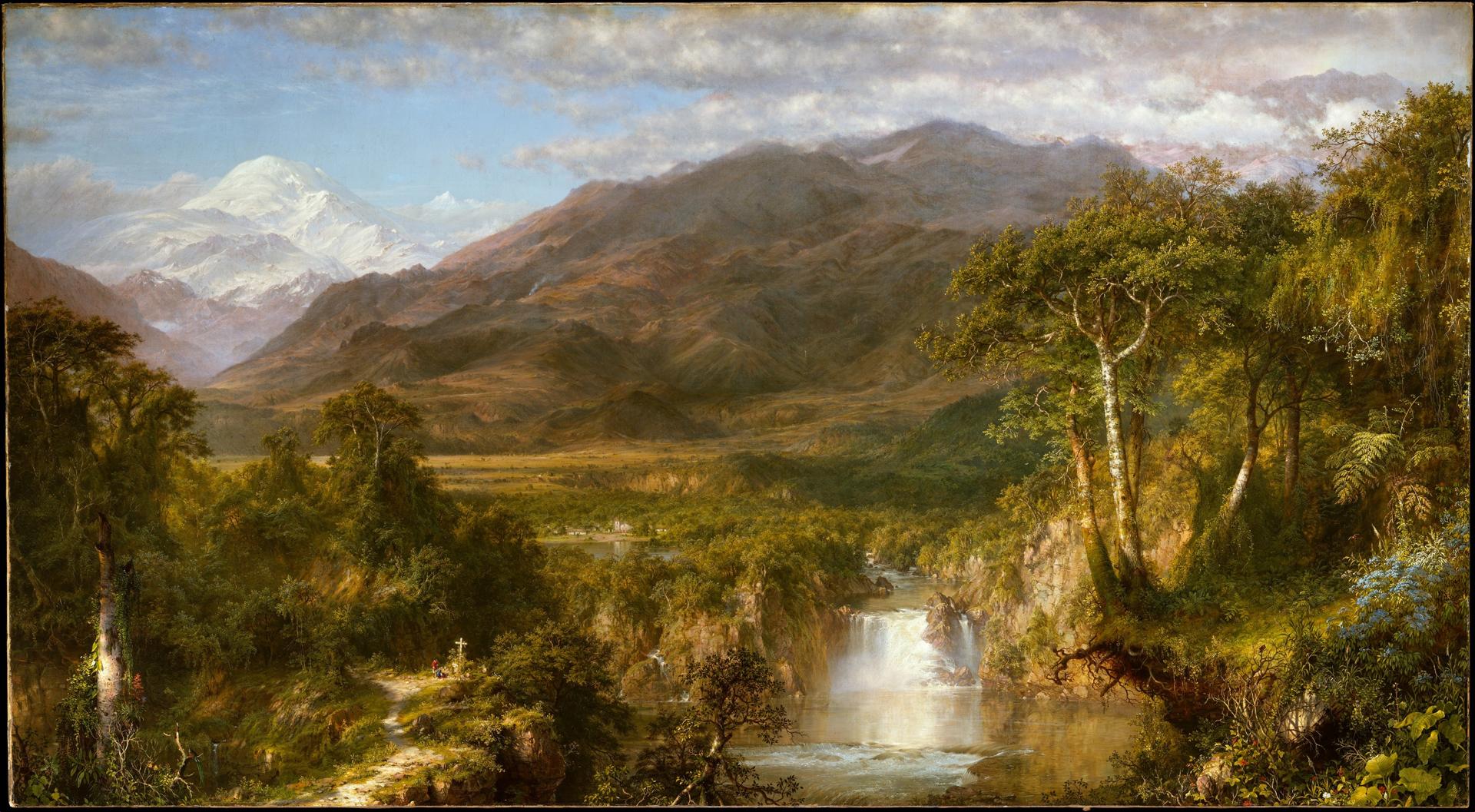
Heart of the Andes
Original title: Heart of the Andes
kurzbeschreibung
Frederic Edwin Church painted Heart of the Andes in 1859 in oil on canvas. The painting brings together a river, a waterfall, and snow-capped mountains into a panoramic Andean landscape conceived as an idealized vision of nature.
Description
A river winds through a wooded gorge and plunges into a waterfall. Behind it, snow-covered peaks rise. Light falls from the left, lifting shadows and colors. Muted greens and browns dominate the palette. The waterfall acts as a central anchor, while the mountains divide the surface symmetrically.
Context
The work was based on journeys through South America in 1853 and 1857, during which Church made sketches of the Andes. Exhibited in New York in 1859, it caused a great sensation and captured the era's fascination with the untouched nature of America. Church belonged to the Hudson River School, known for romanticized landscapes. The painting was sold for $10,000—a considerable sum for the time.
Impact
A sublime mood runs through the picture, transporting the viewer to the vastness of the Andes. The precise rendering of nature and the interplay of light and shadow create an almost meditative calm. One is invited to admire the beauty of the landscape and to feel the grandeur of nature.
Technique
Church worked with oil paint on canvas, using fine brushstrokes for vegetation and water. The light entering from the left creates realistic shadows and emphasizes the texture of the mountains. The large-format canvas (168 x 302.9 cm) allowed for a detailed and monumental rendering.
AI-generated description text
Source: Metropolitan Museum of Art · Public Domain (CC0 1.0)