The Aegean Sea
Original title: The Aegean Sea
kurzbeschreibung
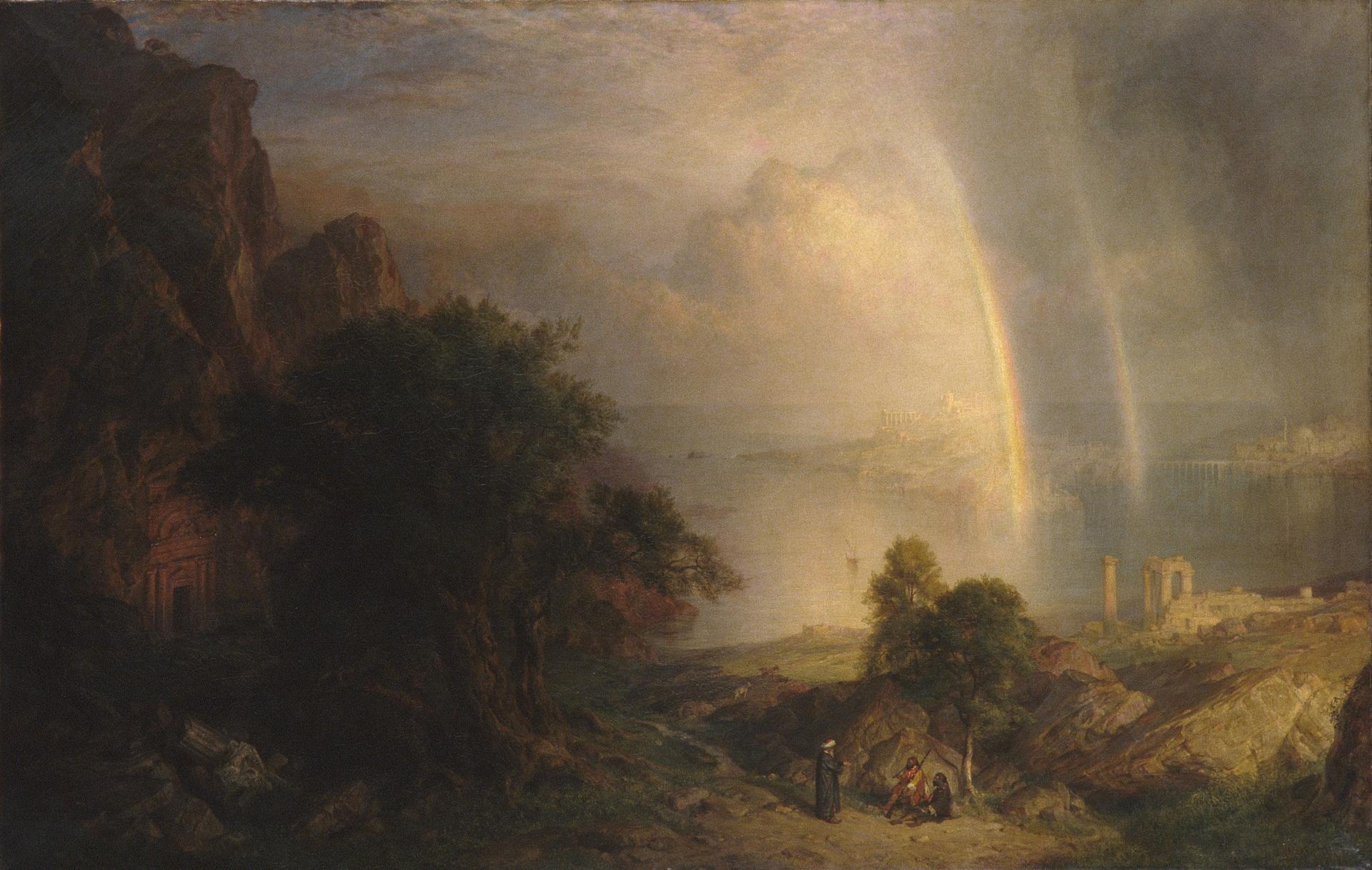
Two figures rest beneath a tree, while to the left a rock face rises with a cave-like opening and to the right the remnants of masonry recall ancient buildings. In this oil painting from around 1877, Frederic Edwin Church combined a meticulously observed coastal landscape with a rainbow that bathes the entire scene in golden light.
Description
Under the canopy of leaves in the foreground, two figures are present; on the left a rock wall opens into a cave-like niche, on the right the remains of ancient architecture jut up. A coastline with trees and buildings stretches through the middle ground, above which a cloud-rich sky arches. A rainbow spans from the left and casts warm, golden light over the picture. Muted browns, green and blue dominate the palette; the arrangement feels balanced, with the rainbow serving as a unifying element.
Context
After his travels through Greece and the Near East, Church created this work in a later phase of his career, when ancient sites increasingly fascinated him. The Aegean was associated for him with historical and mythological significance—a connection made vivid in the juxtaposition of nature and ruins. During this time he turned increasingly to idealized landscapes.
Impact
Carried by the warm light of the rainbow, a calm, contemplative mood sets in. The balanced layout and the coordinated colors give the view a solemn, almost romantic aura that draws the viewer into the landscape.
Technique
Working in oil on canvas, Church employed a detailed, realistic style. Light and shadow are carefully modeled, textures of rock, foliage and clouds precisely rendered—evidence of his technical mastery. The large canvas (137.2 × 214 cm) makes the landscape appear monumental.
AI-generated description text
Source: Metropolitan Museum of Art · Public Domain (CC0 1.0)