Worthington Whittredge
Original title: Worthington Whittredge
kurzbeschreibung
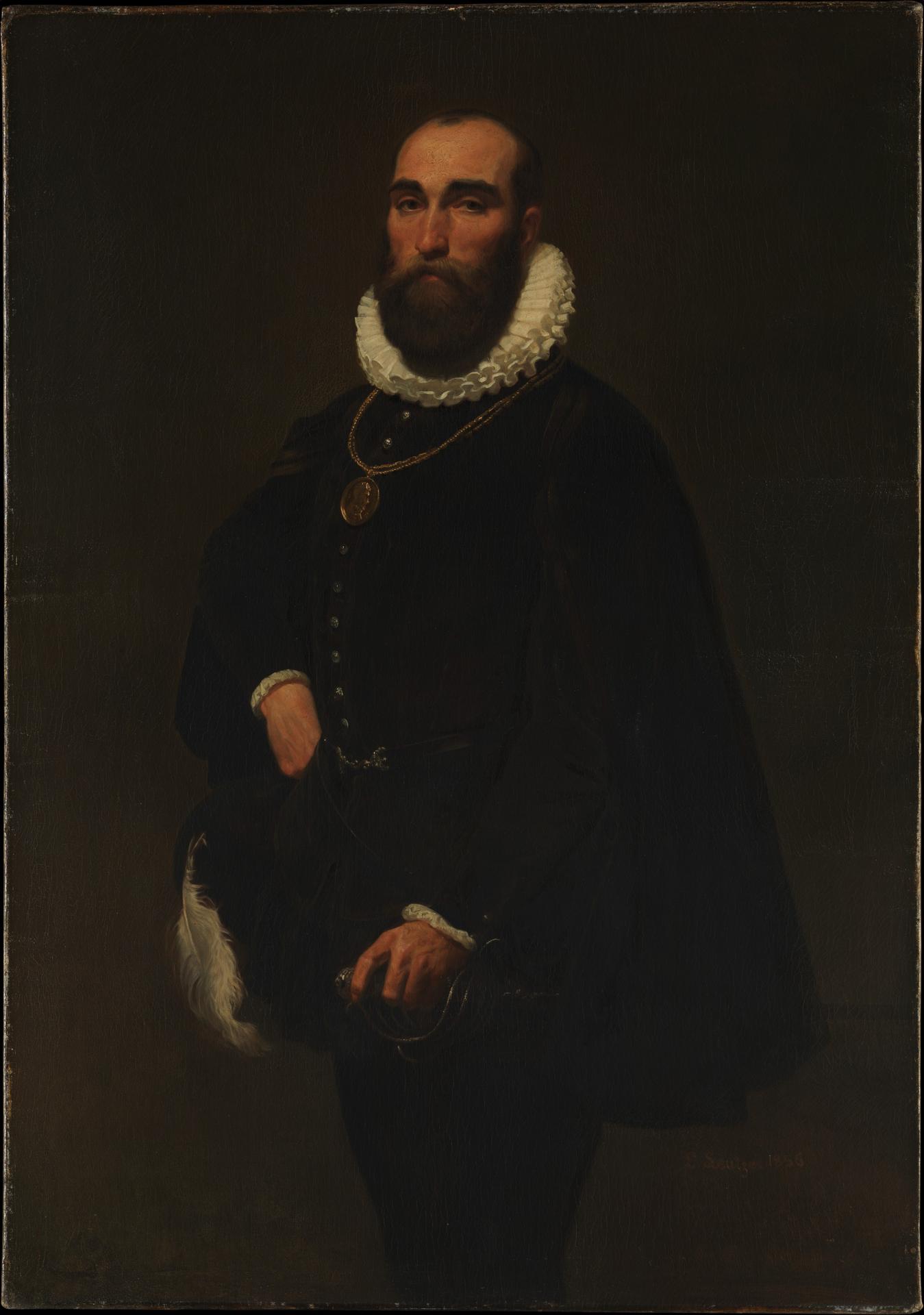
Unlike many portraits of its day, Emanuel Leutze's 1856 likeness of the American painter Worthington Whittredge does not present its sitter in contemporary dress. Whittredge appears instead in historicizing costume, furnished with a sword and a medal and set against a dark ground. The work is an oil painting on canvas.
Description
A man stands before us in a dark, buttoned jacket, a white ruffled collar at his throat and a chain with a medal hanging from it. His right hand holds a sword, and a feather is tucked into the scabbard. The uniform dark background lets the face and hands come forward. Carefully placed highlights create a grave, dramatic mood, while the palette as a whole stays muted and realistic.
Context
Leutze painted the portrait in 1856 in Düsseldorf, where he had met Whittredge. Both belonged to the Düsseldorf school, known for its precise rendering of detail. The historicizing dress reflects the period's interest in the Renaissance and the Baroque. Leutze was then chiefly known for "Washington Crossing the Delaware," which he had completed in 1851.
Impact
The dark, focused lighting and the sitter's serious expression give the portrait a solemn, dignified tone. Through its historicizing accessories the image gains a timeless, almost heroic presence, one that makes Whittredge appear a figure of consequence.
Technique
Oil paint on canvas allowed Leutze a rich modeling of light and shadow. Fine brushwork shows in the exact rendering of fabric, ruffles and metal. The dark, monochrome background follows nineteenth-century portrait practice and draws the eye to the sitter.
AI-generated description text
Source: Metropolitan Museum of Art · Public Domain (CC0 1.0)