Rhinoceros
Original title: Rhinoceros
kurzbeschreibung
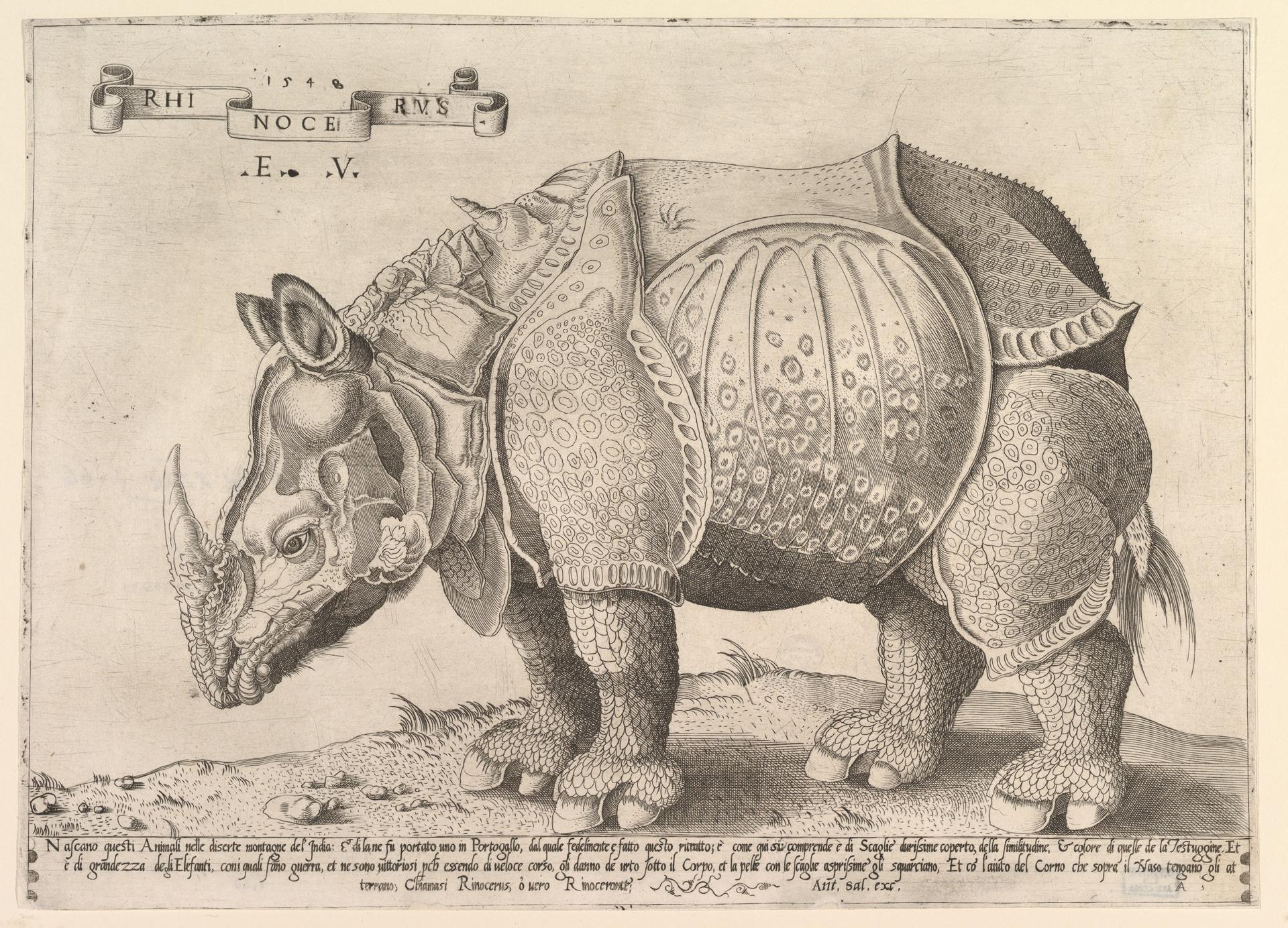
Enea Vico's engraving "Rhinoceros" bears the date 1548 and presents a rhinoceros in profile. The image combines close observation of an exotic animal with the ornamental forms of the Renaissance, making it a fine example of printmaking from that era.
Description
Facing right, the rhinoceros stands on a grassy, stone-strewn ground. Its body is covered in a pattern of scales and diamonds that resembles armor. Wrinkles and a flower-like ornament are etched into its face, and a long horn sits on its nose. A band with the inscription "RHI NOCE RVS" floats above the animal, with the initials "E.V." below. Latin text fills the lower half of the sheet, describing the creature's origin and characteristics.
Context
Originally created in 1542, the engraving was later redated to 1548. Enea Vico, an Italian Renaissance engraver, worked in an age when exotic animals like the rhinoceros caused a sensation in Europe. The model was likely the famous rhinoceros that arrived in Lisbon in 1515 and became widely known through Albrecht Dürer's woodcut. Vico, however, developed the motif into an independent, distinctly more ornamental version.
Impact
Even lighting and a balanced arrangement give the image a calm appearance. The eye is drawn to the centrally placed animal, whose detailed armor and decorative forms lend it an almost sculptural weight. This combination of foreign appearance and clear form awakens curiosity and wonder at the exotic creature.
Technique
For the print, a copper plate was incised with fine lines into which the artist engraved the drawing. Hatching and stippling create graduated gray values and reproduce the surface texture of the rhinoceros's skin. The paper is trimmed just within the plate edge, suggesting a deliberate presentation of the impression.
AI-generated description text
Source: Metropolitan Museum of Art · Public Domain (CC0 1.0)