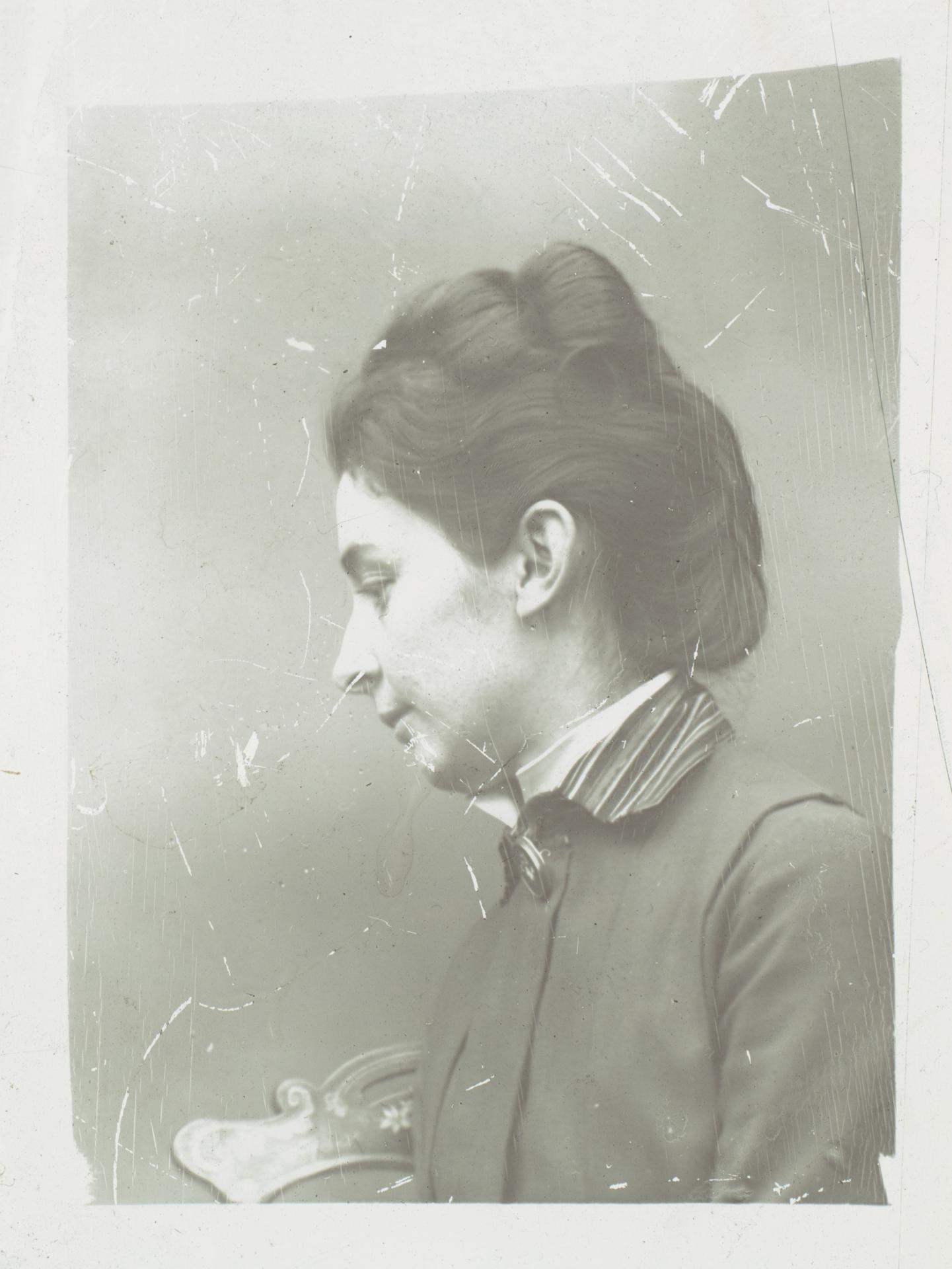
Female portrait
Original title: [Female portrait]
kurzbeschreibung
Unlike many contemporary portraits of women, this glass positive by Thomas Eakins from the 1880s relies on a strict profile pose: a woman with upswept hair appears in side view, wearing a shirt whose striking collar and bow structure the upper body. The background remains largely neutral, with only a hint of a piece of furniture visible.
Description
The image shows the woman's head from the side, her hair gathered into a knot. A shirt with a prominent collar and bow defines her attire. At the edge of the background, part of an ornate piece of furniture can be made out; the rest of the area stays plain and empty. Black and white dominates the photograph, whose surface bears scratches and faded areas—traces that stem from the glass positive material.
Context
Eakins ranks among the most important representatives of nineteenth-century American Realism and in the 1880s engaged intensively with photography as an artistic means of expression. Glass positives served at the time both as preparatory studies for paintings and as independent works. The camera allowed movement and anatomy to be captured precisely, a concern that is also palpable in this portrait.
Impact
Because the woman appears in profile and the background remains restrained, the gaze is directed entirely at her facial features and clothing. The signs of age on the glass plate lend the image a historical distance that makes the gap to its time of creation tangible. The arrangement feels quiet and collected, without distracting details.
Technique
The glass positive is a photographic process in which exposure occurs directly onto a glass plate. This material is sensitive to scratches and fading, which explains the visible signs of age. The black-and-white photograph was likely taken in a studio under controlled lighting conditions.
AI-generated description text
Source: Metropolitan Museum of Art · Public Domain (CC0 1.0)