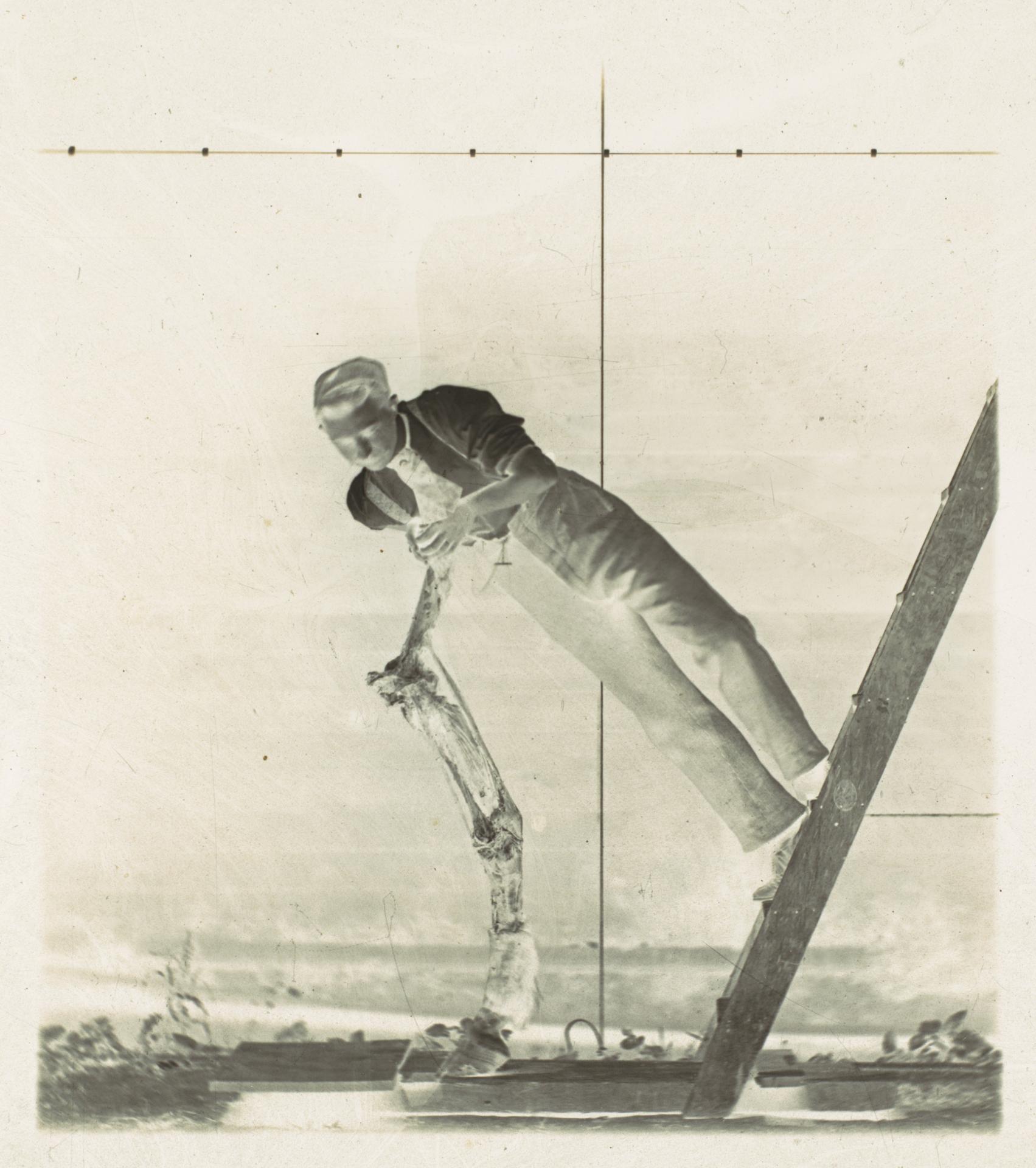
Man on a Ladder with Disected Horse's Leg
Original title: [Man on a Ladder with Disected Horse's Leg]
kurzbeschreibung
A glass negative from the 1880s by Thomas Eakins shows a person on a ladder holding a prepared horse leg. The shot comes from the context of anatomical studies and combines documentary precision with artistic observation.
Description
A person stands on a ladder, a dissected horse leg in their hands. They wear a shirt, trousers, and a cap, their gaze fixed on the object. The ladder leans against a wooden board lying on the ground; the background stays blurred and suggests a landscape. Black-and-white tonal values, scratches, and discoloration testify to age.
Context
Thomas Eakins, an American painter and photographer, was known for realistic depictions of the human and animal body. In the 1880s he used photography extensively to study movement and anatomical detail. This glass negative arose in that context and fed into his teaching at the Pennsylvania Academy of Fine Arts; such images served as references for paintings and as teaching material.
Impact
The black-and-white photograph feels matter-of-fact and focused, free of ornamental distraction. The unusual perspective and clear focus on the anatomical detail create a sober, investigative mood. Traces of age lend the image a historical aura that emphasizes its documentary character.
Technique
A light-sensitive emulsion on glass carries the information—the glass negative, a common process at the time. It was used to make prints and is distinguished by high detail resolution. A long exposure and precise arrangement of the subject were necessary, which explains the static layout of the image.
AI-generated description text
Source: Metropolitan Museum of Art · Public Domain (CC0 1.0)