Frank MacDowell
Original title: Frank MacDowell
kurzbeschreibung
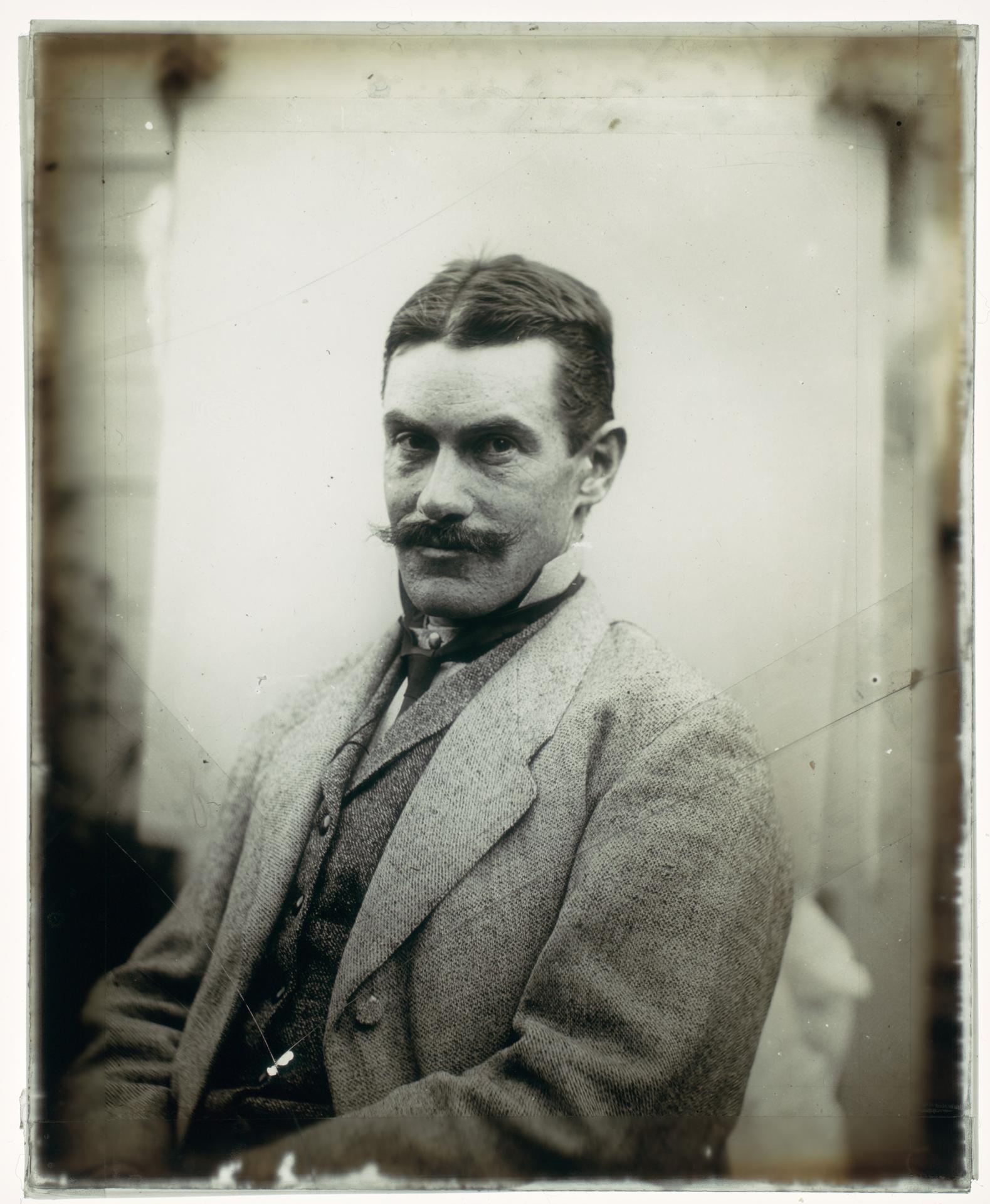
Thomas Eakins made this portrait of Frank MacDowell in the 1880s. The image survives as a glass positive, a process common in late nineteenth-century photography. It presents a man in formal dress who occupies the center of the frame.
Description
A man appears in a suit with jacket, shirt, and tie. His hair is combed back, and his mustache and full beard are carefully groomed. The background stays out of focus and without recognizable detail, so the person is emphasized. The layout is centered: the figure in the foreground, behind him a soft background that suggests spatial depth. The color is monochromatic, as is usual for glass positives of this era, with discoloration and edge marks along the borders.
Context
Eakins, a leading American painter and photographer, experimented with various media in the 1880s. Glass positives were often used for portrait making in early photography. Eakins employed photography as an aid for his paintings and recorded people from his circle. Frank MacDowell is documented as the sitter; further biographical information is lacking.
Impact
Even light and the clear rendering of the face give the portrait a formal, detailed character. Because the background recedes, attention goes to the person; the effect is calm and collected. Signs of age at the edges lend the sheet a historical aura.
Technique
In a glass positive, a light-sensitive layer is applied to a glass plate and exposed. The process produces a positive image directly on the glass, without a paper print. Monochrome rendering and even illumination are among the hallmarks of this method.
AI-generated description text
Source: Metropolitan Museum of Art · Public Domain (CC0 1.0)