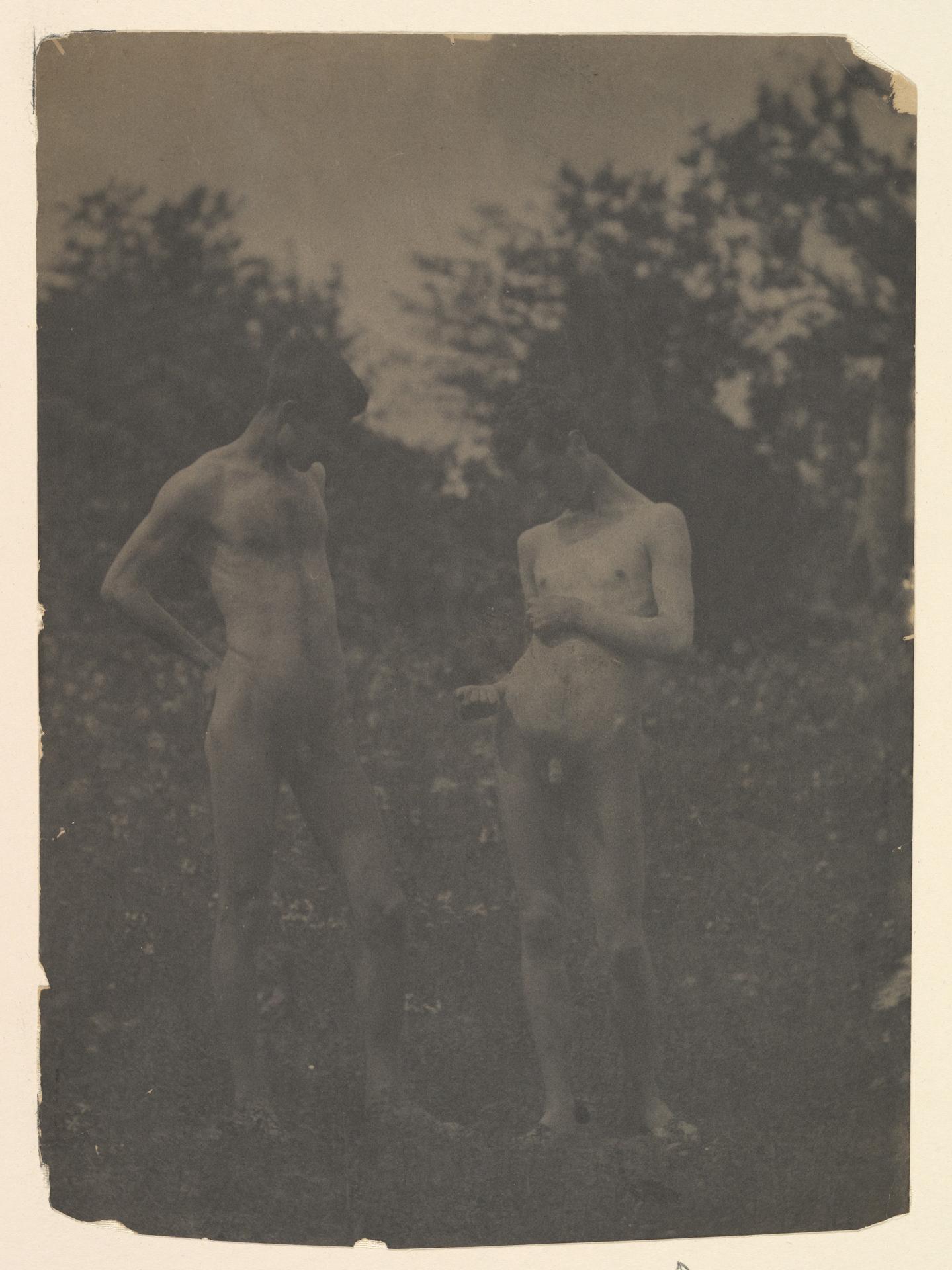
Nude Men in the Garden
Original title: [Nude Men in the Garden]
kurzbeschreibung
Unlike many nineteenth-century nude studies that isolate the body, Thomas Eakins's Nude Men in the Garden from the 1870s places two unclothed men within a natural setting. This platinum print presents the figures standing upright and unposed, while leaves and branches blur in the background.
Description
Two naked men stand side by side at the center of the image. The one on the left keeps his arms relaxed at his sides; the one on the right has crossed them over his chest. Behind them, leaves and twigs dissolve into softness, suggesting a rural environment. The black-and-white photograph appears symmetrically arranged, with even lighting and no strong shadows or highlights.
Context
Thomas Eakins, who both painted and photographed, used the medium in the 1870s as an aid for his paintings. He experimented with various printing processes, including platinum, valued for its nuanced gray tones. The photograph was likely made in his circle in Philadelphia, where he taught at the Pennsylvania Academy of Fine Arts. Such nude studies served him to capture anatomy precisely for his painting.
Impact
The figures feel calm and statuesque, reinforced by the symmetrical arrangement and soft light. Because the surroundings remain out of focus, attention goes to posture and anatomical details. The result is a factual, almost scientific aesthetic.
Technique
The sheet is a platinum print, a process known for its matte surface and high tonal range. The platinum paper is exposed to UV light and then developed, which makes the image especially durable and rich in detail. A large-format camera was probably used, as was customary for such studies.
AI-generated description text
Source: Metropolitan Museum of Art · Public Domain (CC0 1.0)