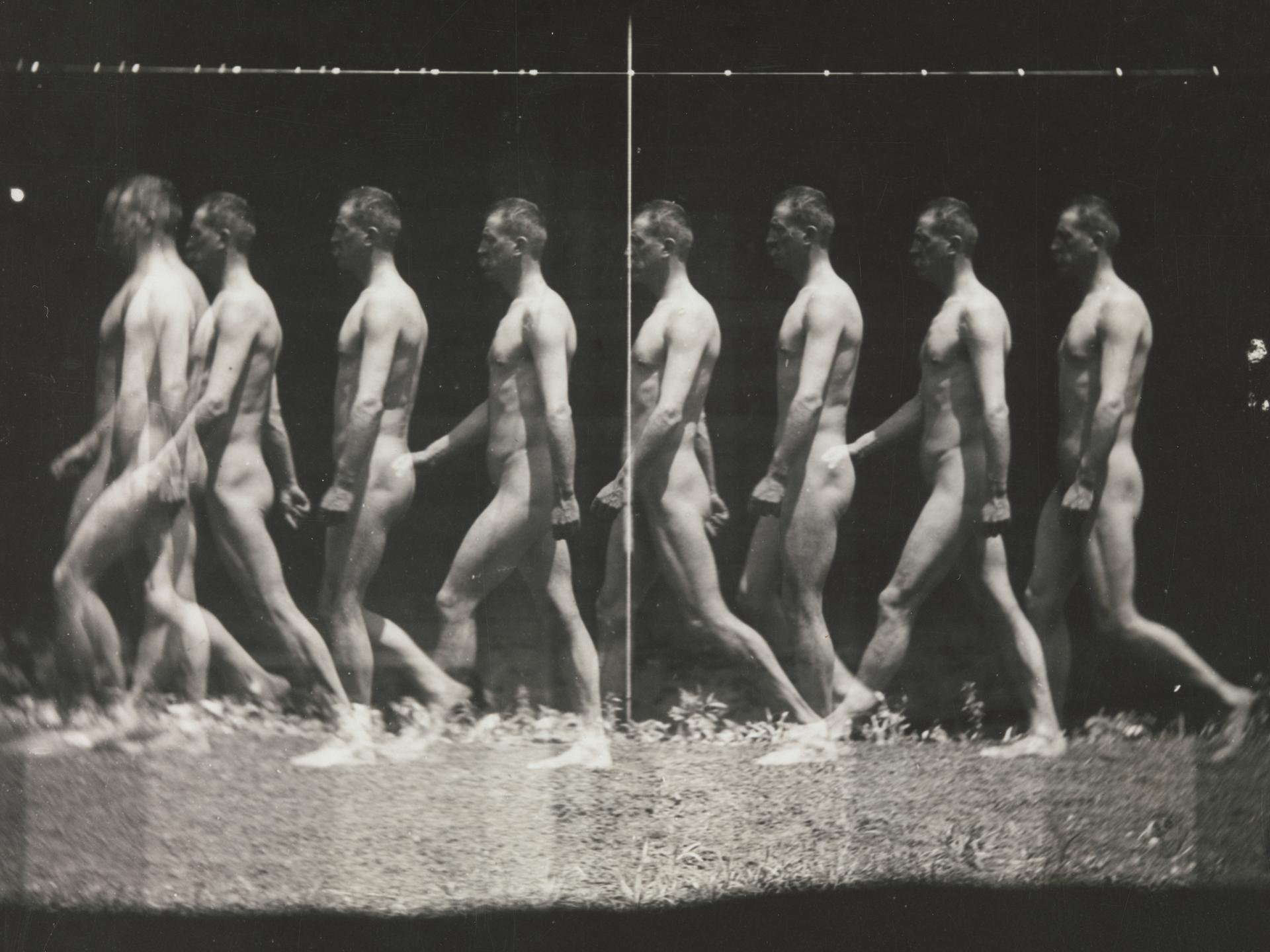
Man Walking, "Stroboscopic" Photograph
Original title: [Man Walking, "Stroboscopic" Photograph]
kurzbeschreibung
Thomas Eakins made this stroboscopic photograph in the 1880s; the present gelatin silver print dates from the 1930s–40s. Eight naked male figures appear at successive stages of walking, so that the image records a movement sequence from start to finish.
Description
Eight naked men, each caught in a different phase of the stride, are lined up side by side. They face forward, parallel to one another, against a dark and indistinct ground. The bodies are muscular and similarly proportioned. Grass covers the floor, and a vertical line runs through the middle of the picture. Everything is black and white.
Context
The American painter and photographer Thomas Eakins experimented with photography in the 1880s as a way of analyzing human movement. His work belongs alongside the contemporary studies of motion by Eadweard Muybridge and Étienne-Jules Marey. Eakins used the camera as a scientific instrument, but also as an artistic means to anatomical accuracy. This print from the 1930s–40s was probably made after his death, by his estate or by an institution.
Impact
The rowed figures produce a rhythmic, almost musical arrangement that draws the viewer into close study of each separate phase of the walk. Nudity and exact rendering give the sheet a scientific and at the same time aesthetic quality, presenting the moment of movement in its pure form.
Technique
In gelatin silver printing, silver halides suspended in a layer of gelatin on paper are made light-sensitive. The stroboscopic effect comes from multiple exposure or from placing single shots in sequence on one negative. The vertical line may be a seam or a mark left by the montage or by the original negative.
AI-generated description text
Source: Metropolitan Museum of Art · Public Domain (CC0 1.0)