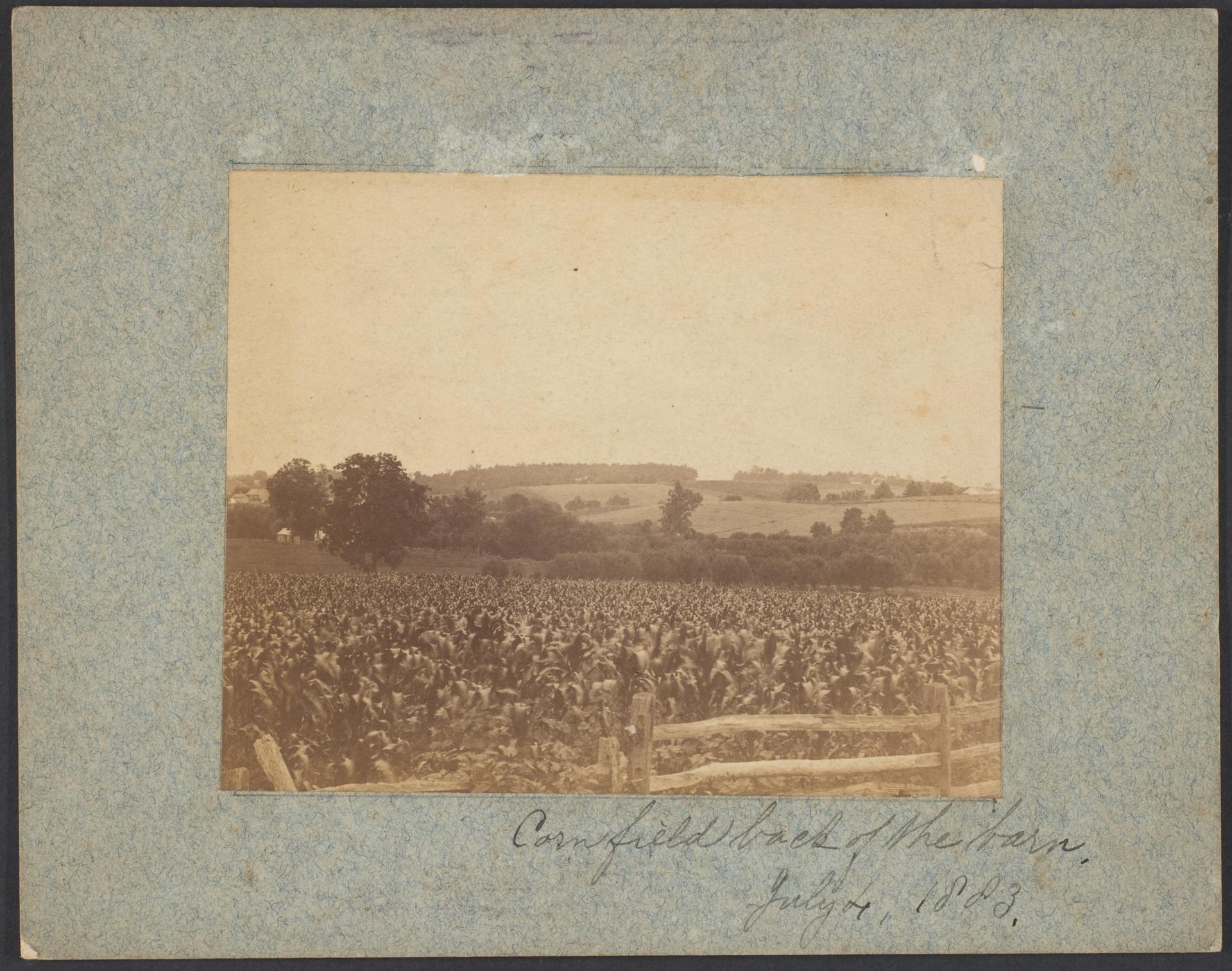
Cornfield in Back of the Barn
Original title: [Cornfield in Back of the Barn]
kurzbeschreibung
In 1883 Thomas Eakins made an albumen silver print of a cornfield stretching out behind a barn. This quiet rural view has no people or animals; cornstalks stand in the foreground, with trees beyond.
Description
A fence-bordered cornfield fills the foreground. Beyond it come bushes and several trees scattered across flat land. Farther back, more trees and structures suggest a patch of woods. No human activity or animals can be found. The muted colors recall the sepia tones typical of albumen silver prints.
Context
Eakins, known mainly as a painter and photographer, devoted himself intensively to photography in 1883 as an artistic and documentary medium. The shot belongs to a series of rural motifs often tied to his studies of movement and light. A handwritten note at the bottom dates the image to July 1, 1883, and places it behind a barn, presumably near his home in Pennsylvania.
Impact
The photo gives off a still, almost meditative mood and carries the viewer into the rural idyll of the 19th century. The sepia tones and clear layout lend it a timeless quality that brings out the simplicity and openness of the landscape.
Technique
In the albumen silver print process, a paper layer coated with egg white is made light-sensitive and treated with silver salts. This method, widespread in the second half of the 19th century, yields fine detail and a warm, brownish tone. A large-format camera was probably used, which explains the high sharpness and the detail-rich foreground.
AI-generated description text
Source: Metropolitan Museum of Art · Public Domain (CC0 1.0)