Martyrdom of the Ten Thousand
Original title: Martyrdom of the Ten Thousand
kurzbeschreibung
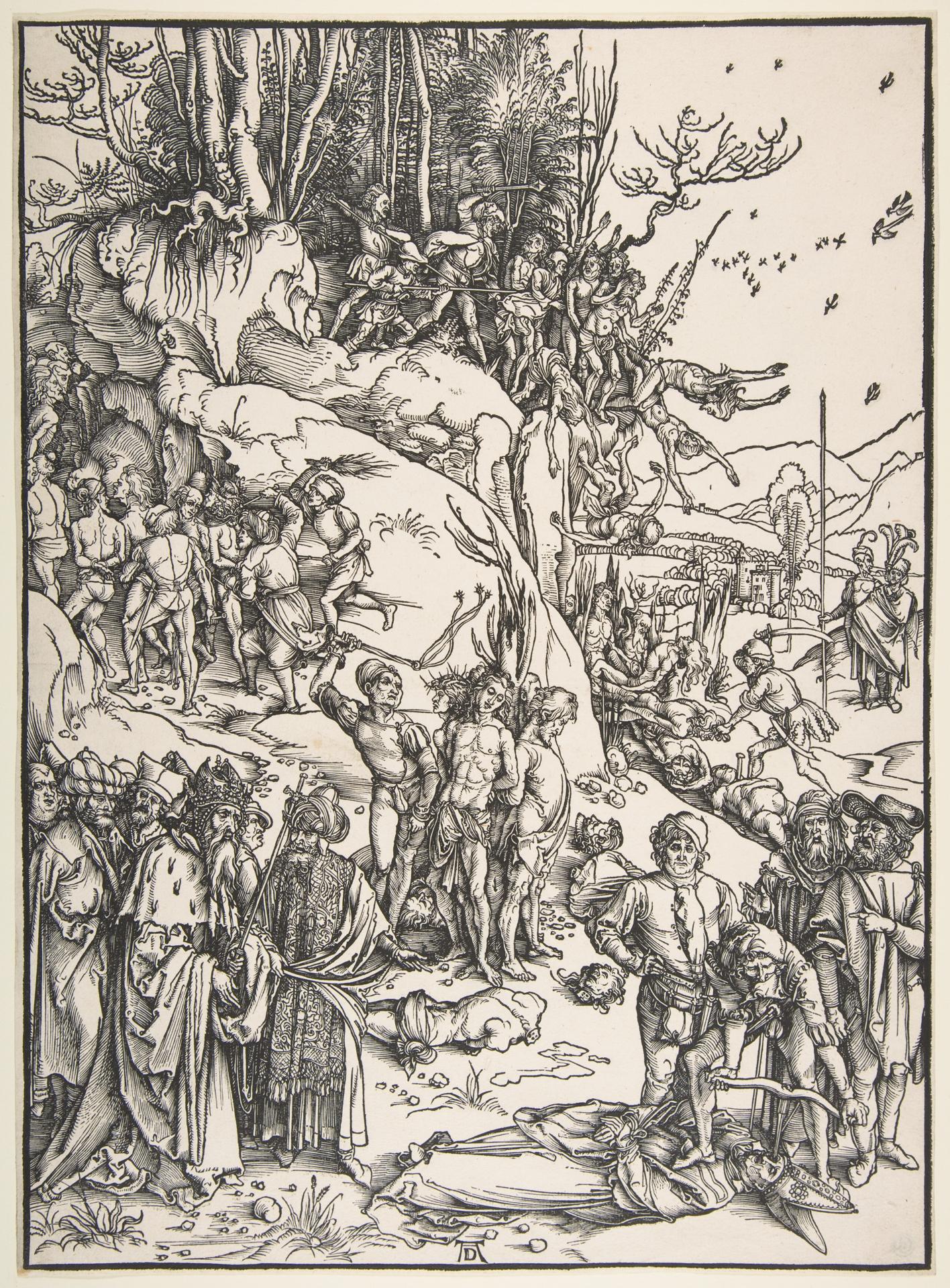
Albrecht Dürer's woodcut depicts the legendary martyrdom of ten thousand Christians on Mount Ararat. Created around 1496, this print is renowned for its intricate composition and dramatic intensity. The scene is a dense, chaotic tableau of suffering and violence, characteristic of Dürer's early graphic work.
Description
In the foreground, several figures lie on the ground, while others stand or sit in poses of injury and anguish. Some wear traditional garments; others are barefoot and clad in simple robes. The background shows more figures within a wooded landscape, some in motion as if in combat or flight. The composition is densely packed with activity, emphasizing the scene's chaos. Monochromatic, with even lighting typical of woodcuts.
Context
The subject derives from the legend of ten thousand Christians crucified on Mount Ararat under the Roman emperor Hadrian. Dürer created this woodcut during his early career, when he was establishing himself as a master printmaker in Nuremberg. The work reflects the late medieval fascination with martyrdom and the growing Renaissance interest in complex, multi-figure compositions.
Impact
The dense, intricate composition draws the eye across the scene, conveying overwhelming suffering and disorder. The stark black-and-white contrast heightens the dramatic tension, making the violence feel immediate and visceral. Dürer's meticulous detail invites close inspection, rewarding viewers with subtle narrative elements.
Technique
This is a woodcut, a relief printing technique where the image is carved into a wooden block, inked, and pressed onto paper. Dürer's skill in rendering fine lines and varied textures demonstrates his mastery of the medium. The even lighting and monochrome palette are inherent to the process, focusing attention on line and composition.
AI-generated description text
Source: Metropolitan Museum of Art · Public domain (CC0)