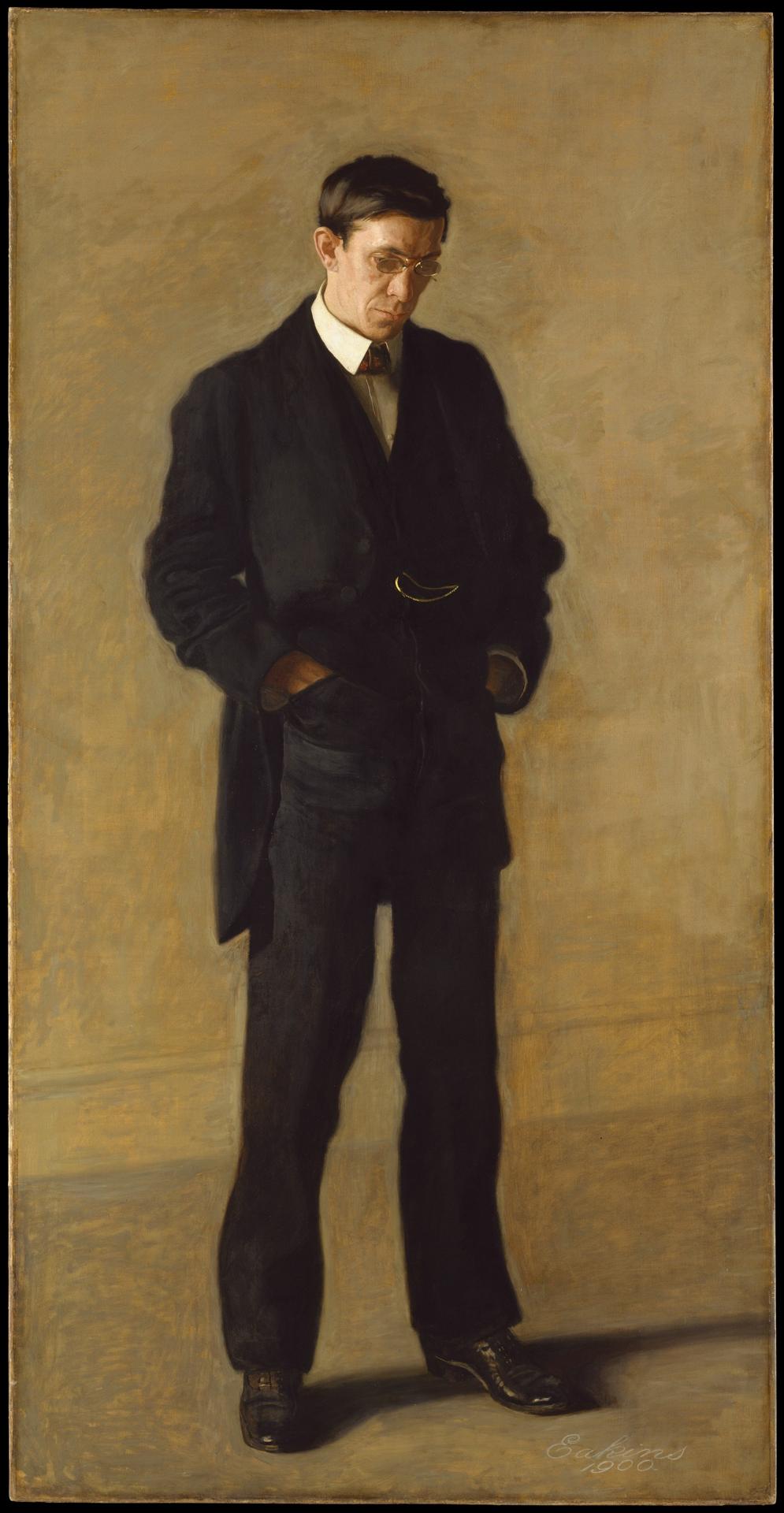
The Thinker: Portrait of Louis N. Kenton
Original title: The Thinker: Portrait of Louis N. Kenton
kurzbeschreibung
Unlike many contemporary portraits that present the sitter in a representative pose, Thomas Eakins’s “The Thinker: Portrait of Louis N. Kenton” from 1900 shows a man in a dark suit and glasses, combining a frontal stance with his hands buried in his trouser pockets. Executed in oil on canvas, the portrait is committed to realism and emphasizes the sitter’s quiet, contemplative presence.
Description
The sitter wears a dark suit, white shirt, and dark tie. He stands facing forward, his gaze slightly lowered, hands resting in his pockets. A plain, neutral background frames the figure and draws attention to him. Muted, realistic colors with a hint of sepia tones recall older photographic techniques. The lighting appears even, without harsh shadows or highlights; visible brushstrokes emphasize the materiality of clothing and background.
Context
Eakins painted the portrait in 1900 in Philadelphia. Louis N. Kenton, a friend of the artist, served as the model for this work. Eakins was known for his precise portraits, which often brought out the character and personality of the sitter. The painting was made at a time when Eakins was gaining growing recognition for his realistic approach.
Impact
The sitter’s calm, focused posture gives the picture a thoughtful, intimate mood. The restrained palette and even illumination create a quiet, almost meditative atmosphere. Through realistic rendering and detailed description of the clothing, the portrait gains an authentic, timeless quality.
Technique
Eakins worked with oil paint on canvas, a common method for portraits. The visible brushstrokes and muted colors with sepia tones suggest a careful, layered application of paint. The even lighting without strong contrasts points to Eakins’s interest in a naturalistic capture of the subject.
AI-generated description text
Source: Metropolitan Museum of Art · Public Domain (CC0 1.0)