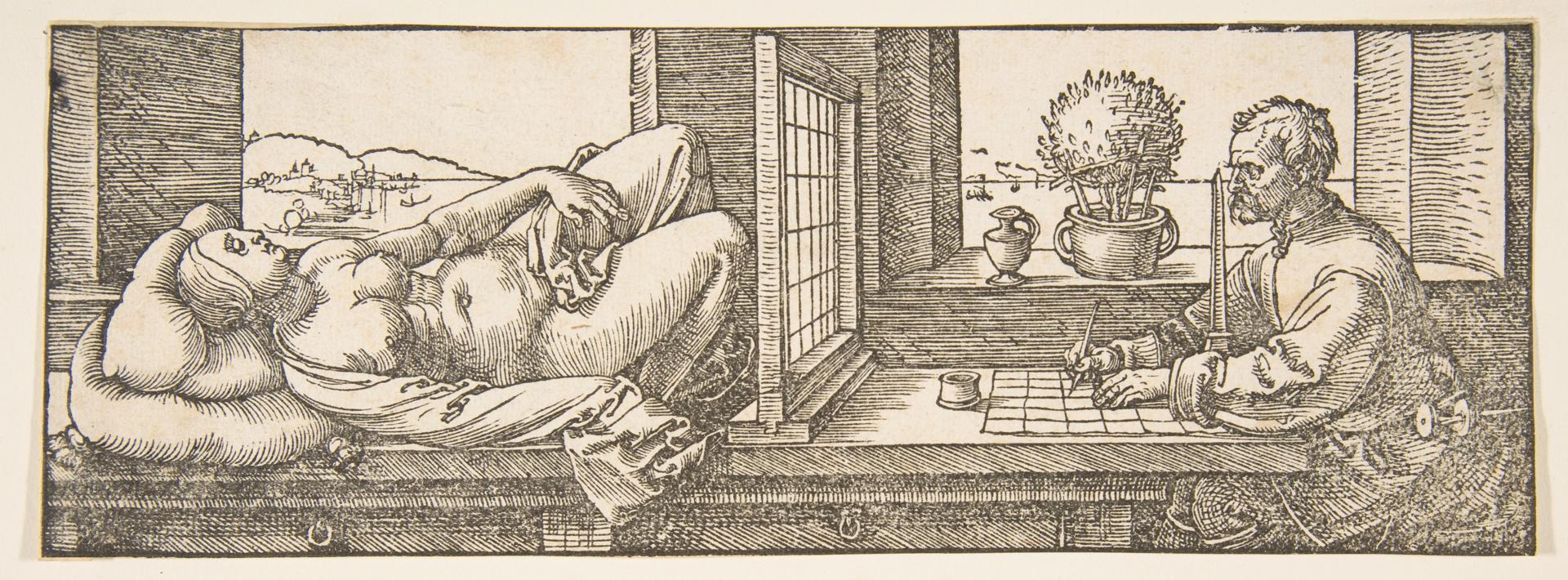
Draughtsman Making a Perspective Drawing of a Reclining Woman
Original title: Draughtsman Making a Perspective Drawing of a Reclining Woman
kurzbeschreibung
This woodcut by Albrecht Dürer, dated around 1600, depicts an artist drawing a reclining woman with the aid of a perspective device. The scene shows the draftsman at work on the right, while the model reclines on a cushion on the left. The composition highlights the intersection of art and geometry.
Description
The woodcut shows a draftsman seated on the right, holding a stylus to a sheet of paper on a table, while a reclining woman lies on a cushioned surface to the left. Two windows in the background reveal a landscape with buildings and a river, and on the sill sit a jug and a potted plant. The image is monochrome, rendered in black and white with fine lines and cross-hatching that define textures and forms. The horizontal composition separates the figures clearly, with the woman's relaxed pose contrasting with the focused posture of the artist.
Context
The work is attributed to Albrecht Dürer, a leading German Renaissance artist known for his prints and theoretical writings on perspective. Although dated around 1600, Dürer died in 1528, so this may be a later reproduction or a school work inspired by his original designs. Dürer's interest in perspective and measurement is well documented, and he produced a treatise on the subject, 'Underweysung der Messung' (1525), which included similar illustrations.
Impact
The stark black-and-white contrast and precise linework give the scene a scientific clarity, emphasizing the rational process of artistic creation. The viewer is invited to observe the act of seeing and translating three-dimensional reality onto a two-dimensional surface, creating a thoughtful, almost didactic atmosphere.
Technique
This is a woodcut, a relief printing technique where the image is carved into a wooden block, inked, and pressed onto paper. The artist used fine, controlled lines and cross-hatching to create tonal variation and depth. The lack of color focuses attention on the linear structure and the interplay of light and shadow.
AI-generated description text
Source: Metropolitan Museum of Art · Public domain (CC0)