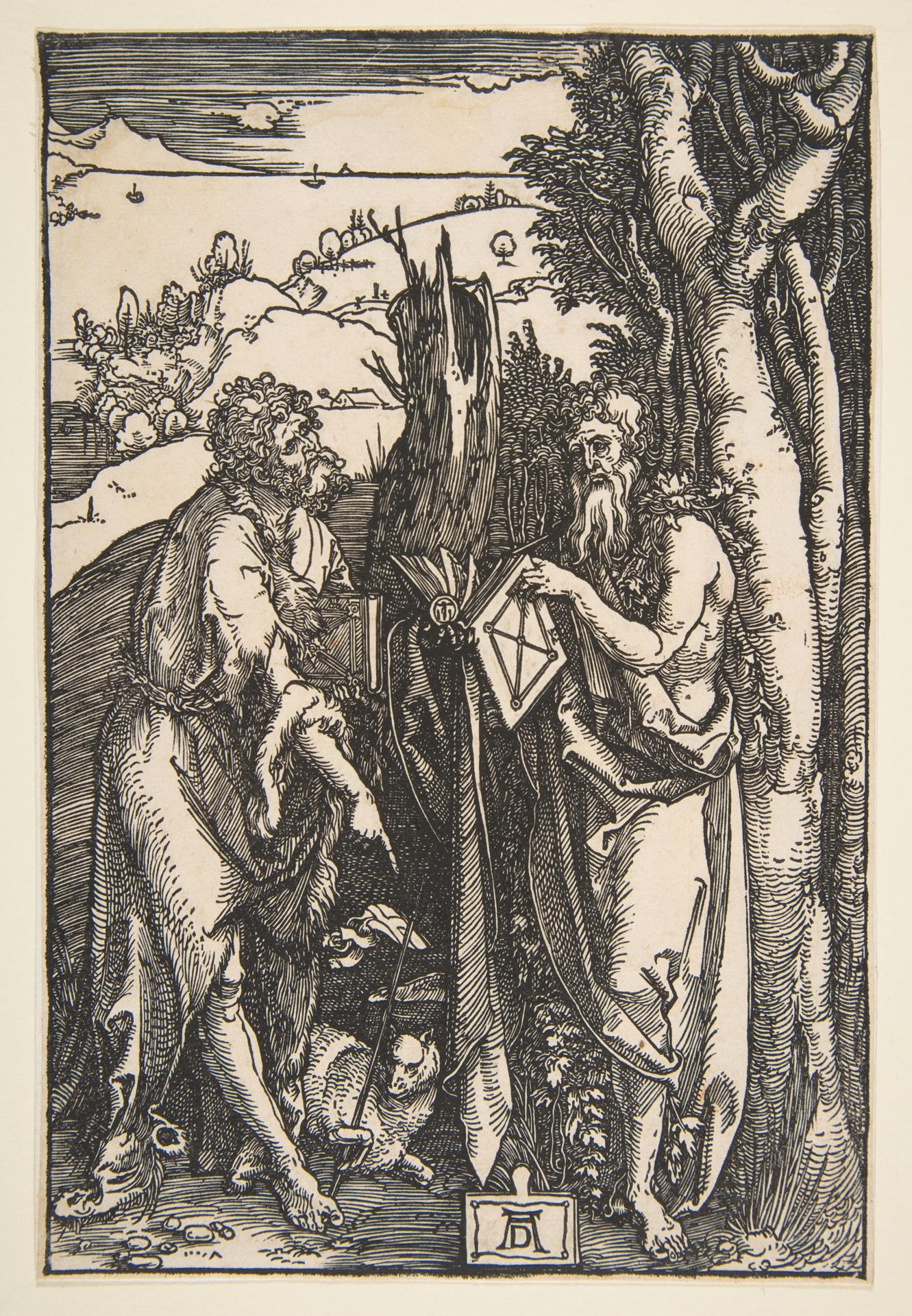
Saint John the Baptist and Saint Onuphrius
Original title: Saint John the Baptist and Saint Onuphrius
kurzbeschreibung
This woodcut by Albrecht Dürer, dating to around 1503, depicts two saints standing in a forest. Saint John the Baptist, on the left, holds a lamb, while Saint Onuphrius, on the right, appears barefoot and scantily clad. Both figures hold books or reliquaries, set against a detailed landscape.
Description
The composition places the two saints prominently in the foreground, framed by trees and a distant landscape. John the Baptist is depicted with a robe and a lamb, while Onuphrius wears only a simple loincloth, emphasizing his asceticism. The background features a river, a mountain, and dense foliage, all rendered in fine black-and-white linework typical of Dürer's woodcuts.
Context
Dürer created this woodcut during a period of intense artistic output in Nuremberg, where he was establishing his reputation as a master printmaker. The pairing of John the Baptist, a central figure in Christian iconography, with the less common Saint Onuphrius, a hermit saint, reflects the period's interest in eremitic spirituality. This work was likely intended for devotional use, as woodcuts were affordable and widely distributed.
Impact
The stark contrast of black and white, combined with the intricate detailing, gives the print a dramatic and contemplative quality. The juxtaposition of the two saints—one robed, the other nearly naked—creates a visual dialogue on piety and renunciation. Dürer's mastery of line work lends the scene a sense of depth and texture, drawing the viewer into the sacred wilderness.
Technique
Dürer employed the woodcut technique, carving the design into a wooden block, inking it, and pressing it onto paper. The fine cross-hatching and varied line weights demonstrate his skill in creating tonal variation without color. This medium allowed for multiple impressions, making the image widely accessible.
AI-generated description text
Source: Metropolitan Museum of Art · Public domain (CC0)