Reproduction of Sibylla of Cleves
Original title: Reproduction of Sibylla of Cleves
kurzbeschreibung
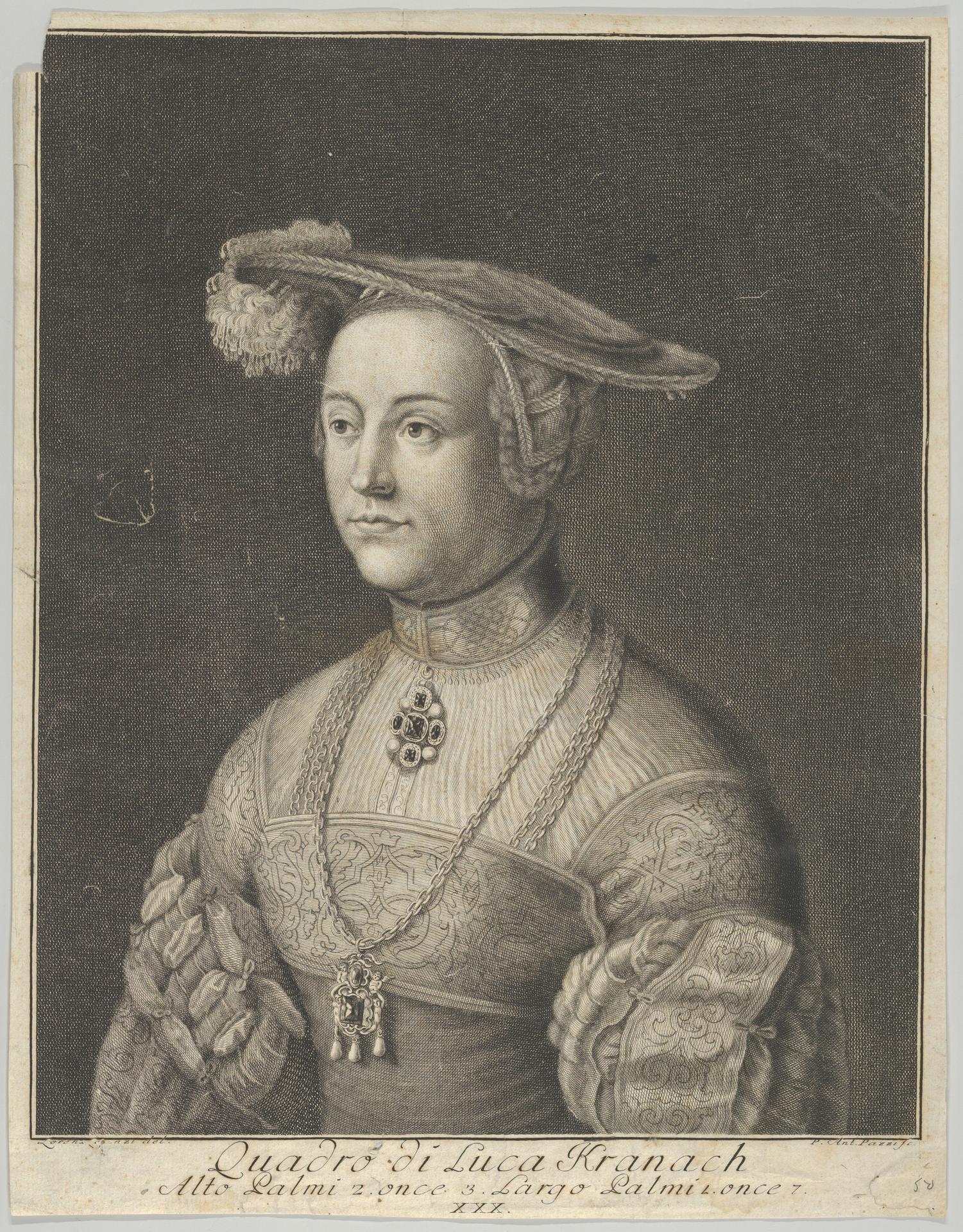
Sibylla von Kleve, a sixteenth-century noblewoman, appears in this print wearing a richly embroidered gown. The engraving by Lucas Cranach the Elder bears no date and served as a reproductive print, making Renaissance portraiture available to a wider audience. The work was executed as a copperplate engraving on paper.
Description
The woman's figure stands out against a dark ground. Her face is turned toward the viewer while her body occupies the center of the image. She wears an elaborately decorated gown with embroidery, along with a striking necklace and a large pendant. Her hair is arranged in an intricate braid adorned with a feather or plume. Light falling from the front picks out the contours and surfaces of the fabric and the hair ornament. Because of the engraving technique, the palette is limited to shades of gray.
Context
Lucas Cranach the Elder was among the leading painters and printmakers of the German Renaissance and served as court artist to the Saxon electors. Sibylla von Kleve was the wife of Elector Johann Friedrich I of Saxony, a direct link to Cranach's circle. The engraving reproduces a painting by Cranach, presumably, and helped spread the portrait. The exact date of the print is not recorded, but it belongs to the sixteenth century, an era in which portraits of the nobility were often reproduced.
Impact
The meticulous rendering of embroidery and jewelry gives the portrait something very precise and dignified. The dark background draws the eye to the face and clothing, creating a mood that is intimate and at the same time formal. The gray tones of the engraving lend the portrait a graphic elegance that feels timeless.
Technique
Copperplate engraving is an intaglio process: the lines are incised into a copper plate and inked. Fine hatching and cross-hatching produce nuanced tonal values and textures that convey the materiality of the gown and the details of the jewelry. At 37.8 × 29.5 cm, the format matches the conventions of reproductive prints of the period and suggests a medium to large edition.
AI-generated description text
Source: Metropolitan Museum of Art · Public Domain (CC0 1.0)