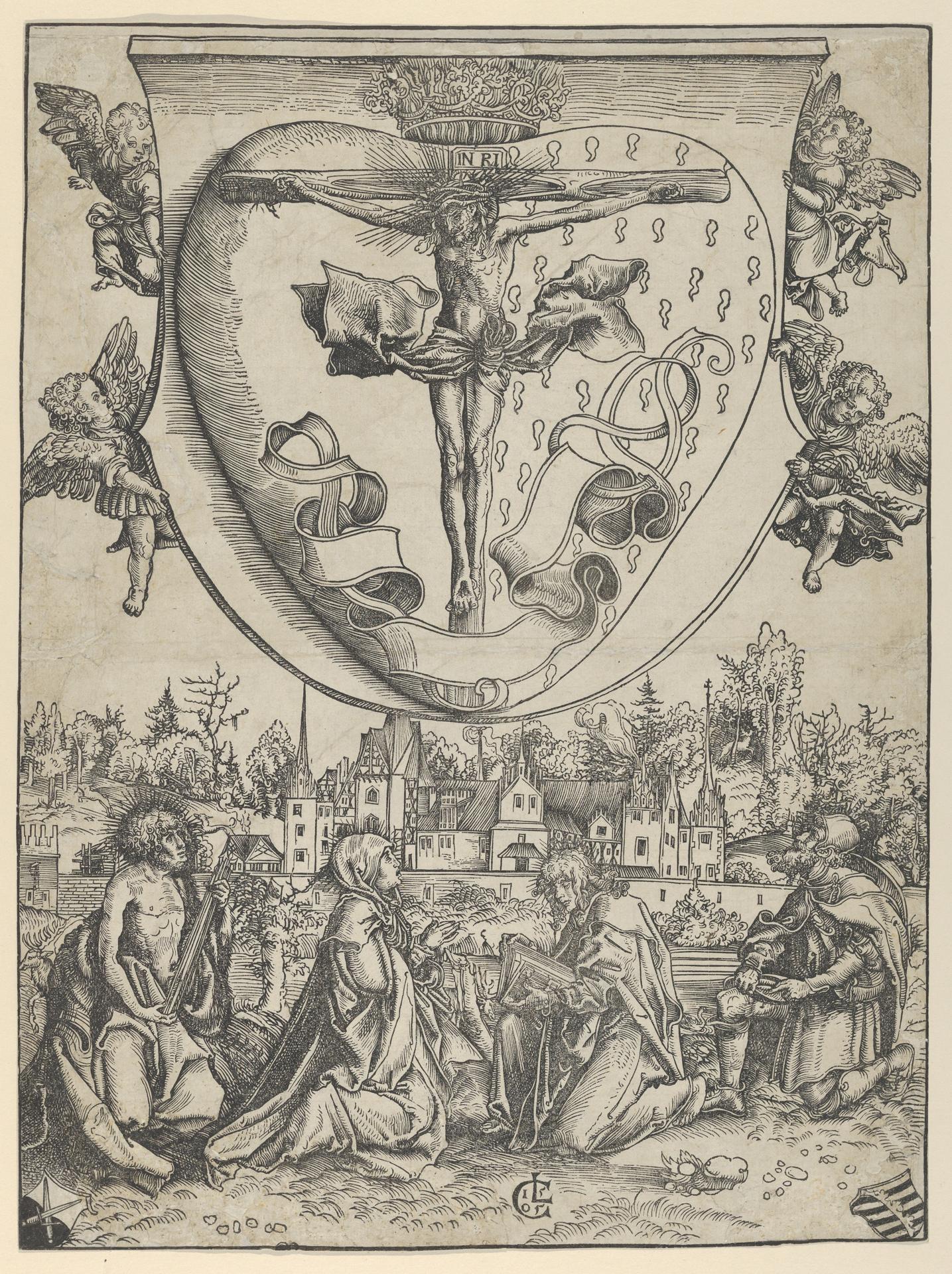
Four Saints Adoring Christ Crucified on the Sacred Heart (1505, Met-Objekt 2506)
Original title: Four Saints Adoring Christ Crucified on the Sacred Heart
kurzbeschreibung
A black-and-white print by Lucas Cranach the Elder from 1505: Christ on the cross holds the center while four saints in traditional dress pray before it. Trees and buildings frame the action. The sheet survives as the second state of two according to Hollstein.
Description
The eye goes first to the cross and the crucified Christ, which occupies the middle of the design. Four saints kneel in prayer in front of it, dressed in the garments tradition assigns them. A landscape of trees and structures surrounds the group, and further back a view of a town or village appears. Winged angels hover to either side of the cross in symmetrical order. Crisp lines and evenly balanced light and dark shape this monochrome, richly detailed sheet.
Context
Cranach made the woodcut in 1505, while he was working in Vienna and engaging with the printmaking of the Renaissance. Crucifixion images with saints belonged to late medieval devotion, and the emphasis on the Sacred Heart of Christ draws on a distinct form of worship. The work has come down to us as the second state of a woodcut, evidence of the mixture of detailed narrative and religious symbolism that marks Cranach's work.
Impact
The sheet feels calm and collected, owing to its clear linework and the mirrored placement of the angels. Because the cross rises above the praying saints, a stepped order emerges that invites lingering and reflection.
Technique
The print was made as a woodcut: the design was cut into a block of wood and then pulled onto paper. The lines are precise and finely detailed, as Renaissance printmaking allowed, making shadows and contours subtly gradable. The impression is monochrome black on paper, which brings out the graphic force of the lines.
AI-generated description text
Source: Metropolitan Museum of Art · Public Domain (CC0 1.0)