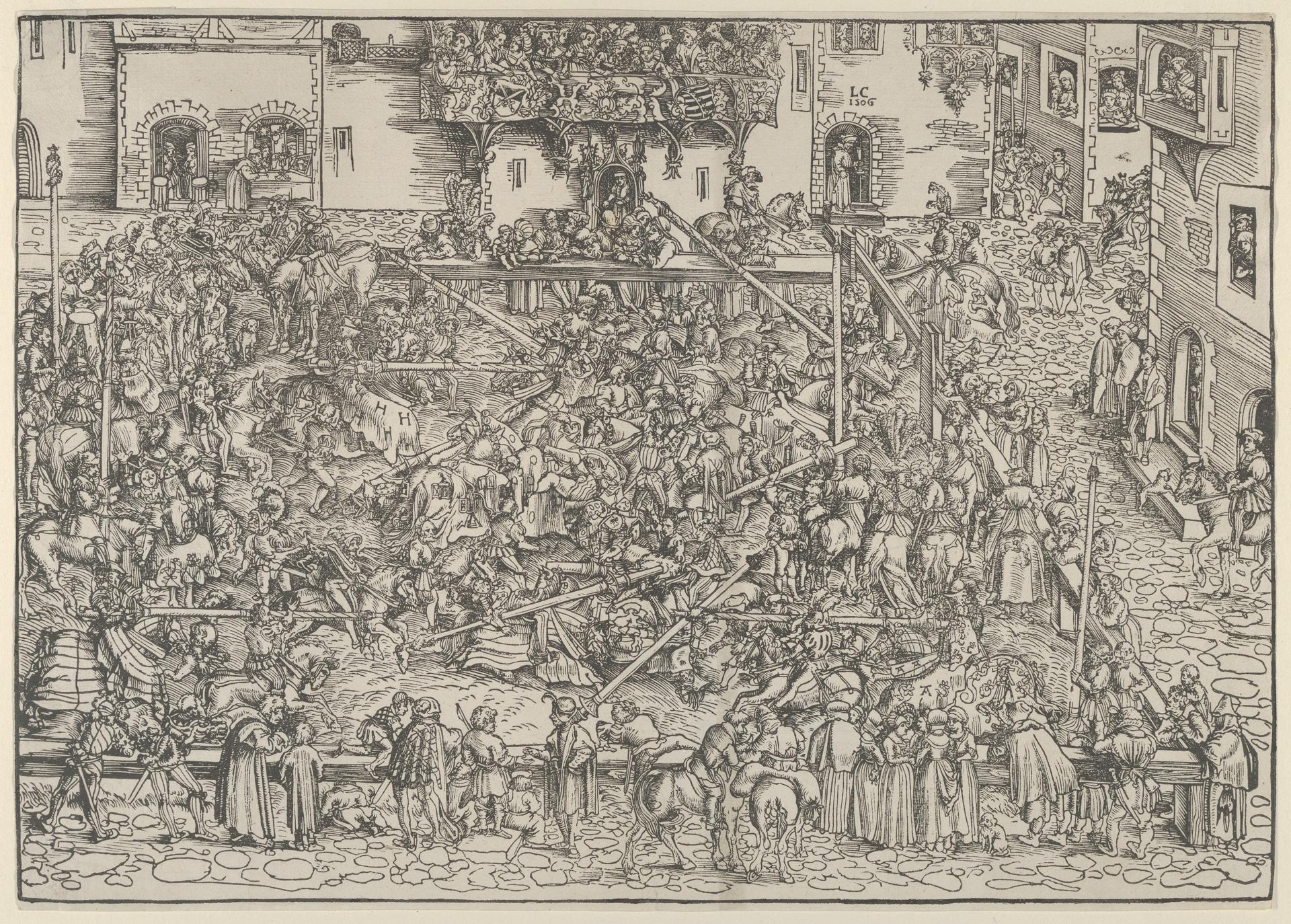
The First Tournament
Original title: The First Tournament
kurzbeschreibung
Lucas Cranach the Elder made this woodcut, Das erste Turnier, in 1506, at a time when he was working at the Saxon court in Wittenberg. It shows a medieval tournament ground with armoured riders before a dense crowd of onlookers. Two states of the print are recorded; this impression is the second (Hollstein).
Description
On the tournament field in the foreground, several riders in armour and helmets meet one another. Around the lists, spectators press together along the street and on the balconies of the adjoining buildings. The Gothic architecture filling the upper part of the sheet is worked out in many small details. The layout feels restless: the sheer number of figures and actions creates a tense atmosphere, and strong, clearly ordered lines shape the whole print.
Context
The woodcut dates from 1506, when tournaments and knightly virtues held a prominent place in the culture and art of the Holy Roman Empire. Cranach was then court painter in Wittenberg for Frederick the Wise, Elector of Saxony. Prints of this kind often helped spread courtly subjects and representational themes. Whether the tournament scene records a specific historical event or offers an idealised idea cannot be settled with certainty; the exact circumstances of its making are not documented.
Impact
Precise draughtsmanship and the close stacking of figures give the sheet a lively, almost agitated presence that captures the tension of the tournament. The Gothic architectural elements and the varied reactions of the spectators open up a narrative depth that draws the viewer into the medieval event.
Technique
This sheet is a woodcut, a relief process in which the drawing is cut into a wooden block and then printed onto paper. The sharp, clear lines and the careful arrangement of the figures attest to the high technical precision of Cranach and his workshop. The print is monochrome and works solely through the contrast of black and white.
AI-generated description text
Source: Metropolitan Museum of Art · Public Domain (CC0 1.0)