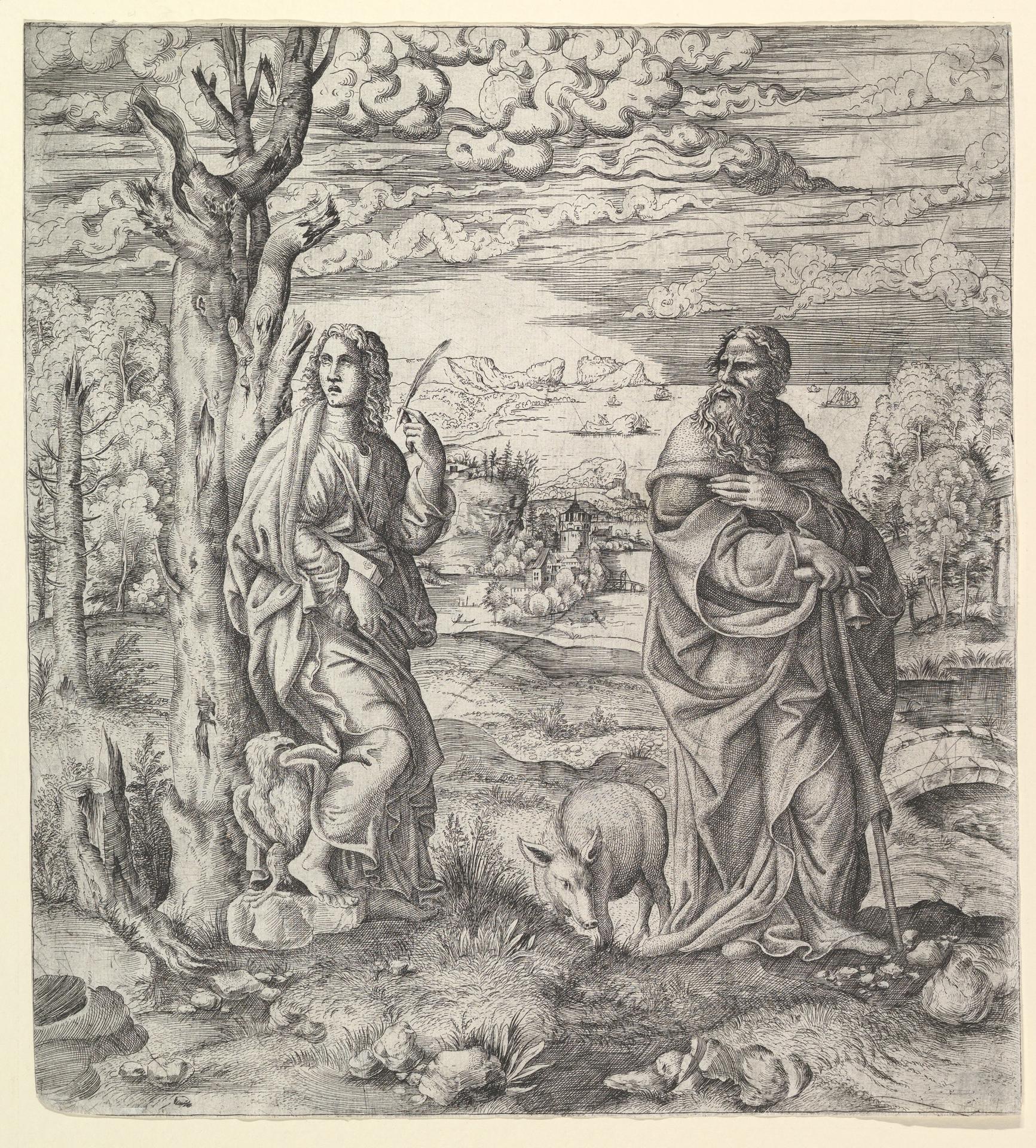
Saint John and Anthony in a Landscape
Original title: Saint John and Anthony in a Landscape
kurzbeschreibung
This etching, attributed to Master IQV, was made around 1544–45. It presents Saint John and Saint Anthony in an elaborately designed landscape; between the two men stands a pig, the traditional attribute of Saint Anthony. The image is in black and white and measures 36 × 32.9 cm.
Description
Two men in long robes appear in the foreground, each holding a staff; the figure on the left stands beside a tree, while the one on the right leans slightly forward. Between them is a pig, associated with Saint Anthony. Behind them opens a richly varied landscape with trees, mountains, and a village under a cloudy sky. The arrangement feels symmetrical: the two saints form a calm focal point in the foreground, while the landscape serves as a quiet backdrop.
Context
Master IQV was active in southern Germany during the first half of the sixteenth century; his civil name is not recorded. This etching belongs to a period when the medium was frequently used to reproduce religious subjects. John and Anthony are two hermits venerated in the late Middle Ages and often shown together. The print is part of the collection of the Metropolitan Museum of Art, where it is available as public domain (CC0).
Impact
Your eye first moves across the two figures, whose postures and staff lines create a vertical tension, then lingers on the finely differentiated background. The balanced placement of the figures and the carefully worked landscape convey calm and invite contemplation. Strong black-and-white contrasts and clearly drawn lines give the print a graphic sharpness that emphasizes the saints and their surroundings. The depth of the landscape opens up the view and unites figures and nature into a harmonious whole.
Technique
An etching was used for this print: in this intaglio process, the drawing is scratched with a needle through an acid-resistant ground on a copper plate, and the exposed areas are then bitten with acid. The lines appear thin and precise, suggesting careful work on the plate. Printing was done on paper; the impressions show an even gradation from black to white, as was typical for etchings of that time.
AI-generated description text
Source: Metropolitan Museum of Art · Public Domain (CC0 1.0)