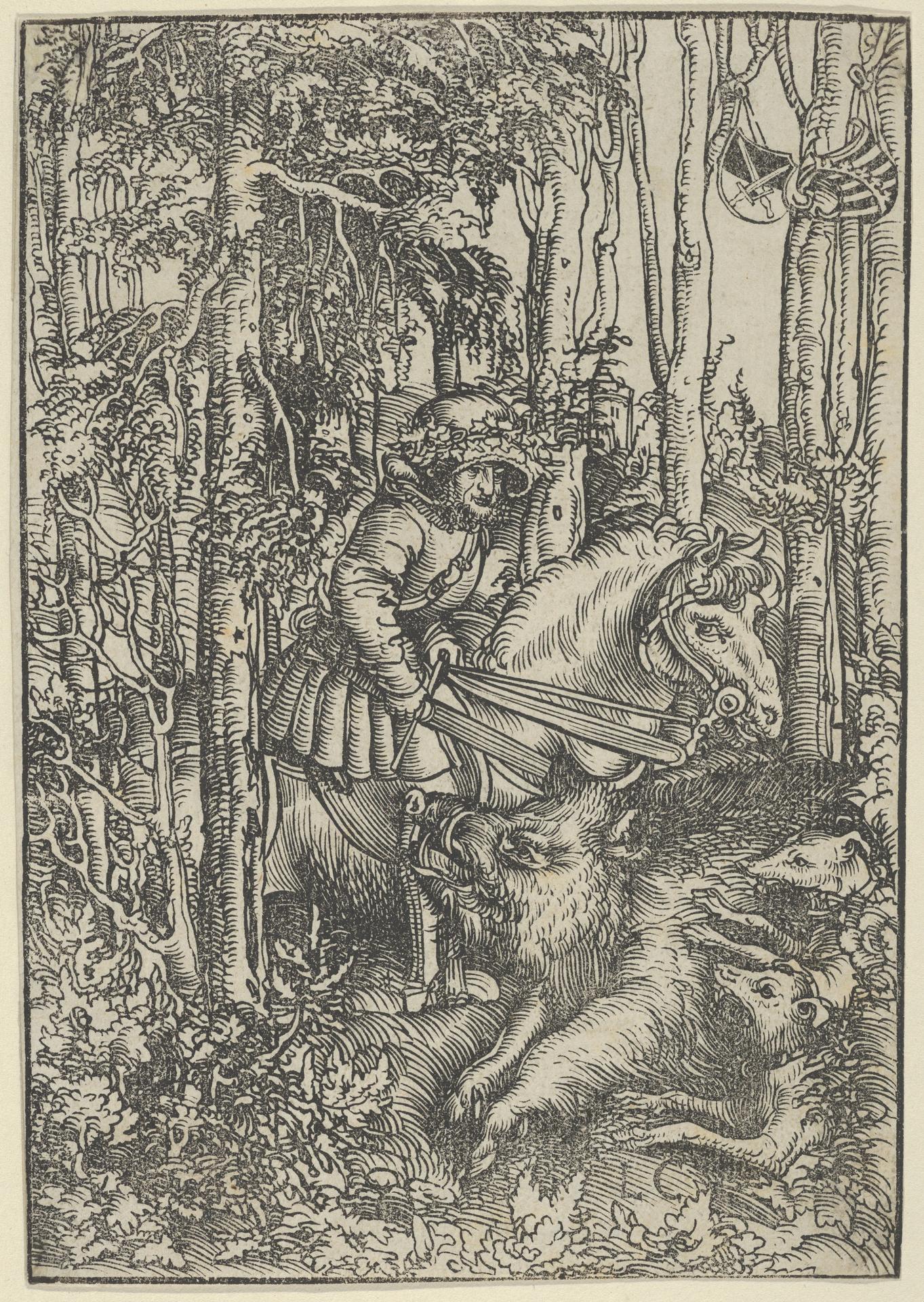
Hunter on Horseback Hunting a Wild Boar
Original title: Hunter on Horseback Hunting a Wild Boar
kurzbeschreibung
This woodcut, titled 'Jäger zu Pferd bei der Wildschweinjagd' (Hunter on Horseback at the Boar Hunt), dates from the lifetime of Lucas Cranach the Elder (1472–1553) and survives as the second state of two according to Hollstein. It presents a rider in traditional hunting attire displaying a slain wild boar before a dense line of trees.
Description
The layout is symmetrical: a calmly standing horse with a saddle blanket carries the hunter, who wears a hat and jacket and holds a hunting implement in his hand. On the ground lies the obviously killed wild boar. Dense trees and shrubs fill the background, anchoring the action in the forest. Another hunting tool, possibly a shield or a hunting spear, hangs from a tree. The carefully drawn lines stand out in black on white; hatching creates light and shadow, giving the sheet depth and texture.
Context
As court painter to the Saxon electors, Lucas Cranach the Elder ranked among the leading German artists of the Renaissance. Prints such as this one carried hunting scenes into aristocratic circles, where such motifs were prized. The dates 1472–1553 refer to the artist's lifespan, not to a specific year of creation for this sheet. The second state suggests a later edition of the print.
Impact
Clear lines and a calm, almost static arrangement define the woodcut. Horse, hunter, and landscape are rendered so precisely that the hunt appears documented as a courtly event. The hatching lends the image depth and a certain drama without overcrowding the view.
Technique
For this woodcut, the motif was cut into a wooden block and then printed on paper. The second state likely shows differences from the first, for example in the linework or printing. The technique allows for both the finest details and a strong contrast between black and white.
AI-generated description text
Source: Metropolitan Museum of Art · Public Domain (CC0 1.0)