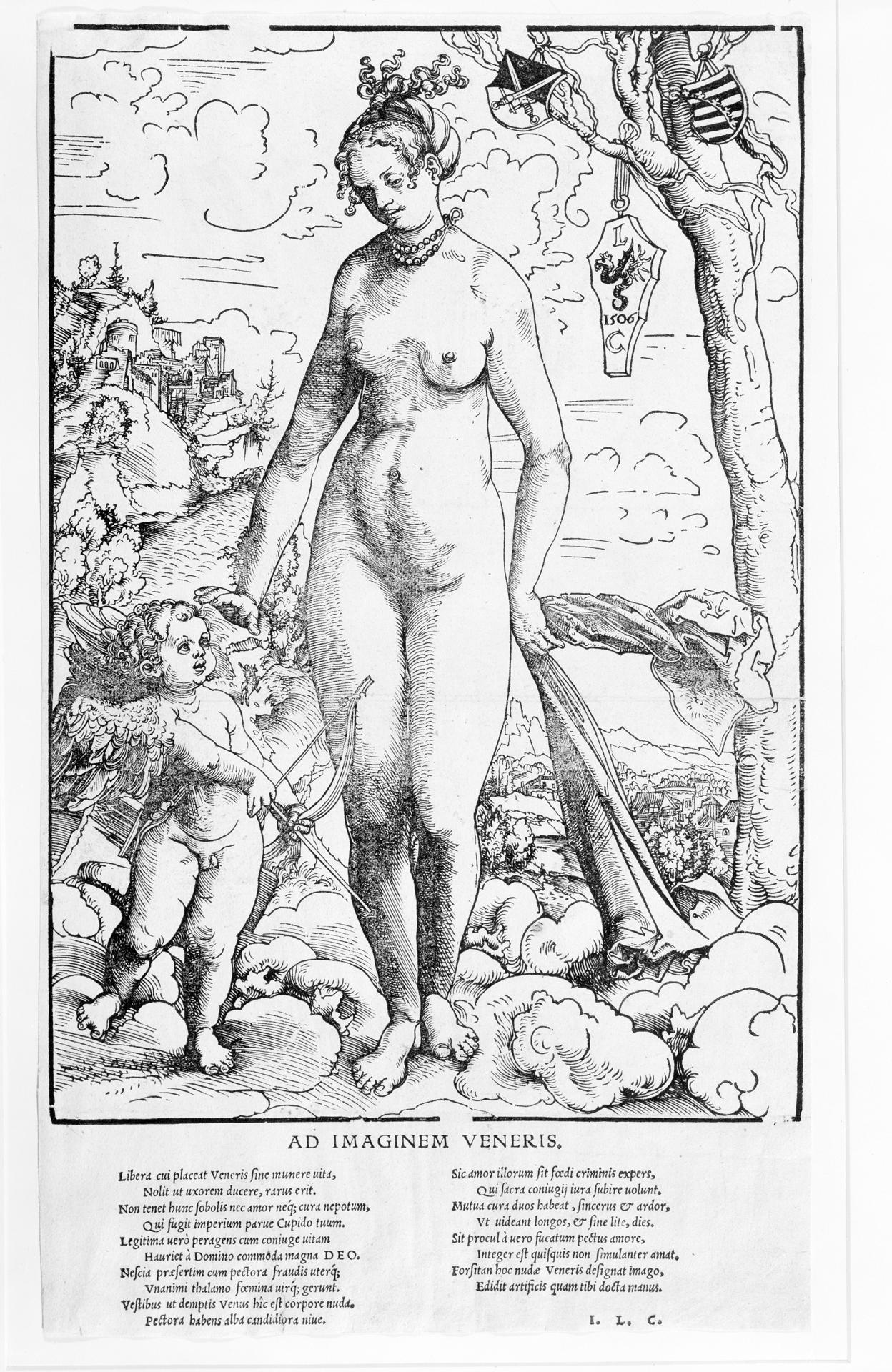
Venus and Cupid (1506, Met-Objekt 2492)
Original title: Venus and Cupid
kurzbeschreibung
Lucas Cranach the Elder's woodcut Venus und Amor is dated 1506, placing it among his early engagements with classical mythology. An unclothed Venus and the small love god Cupid appear set within a landscape.
Description
Venus occupies the front centre, facing the viewer, her slender body carefully modelled and her hair pinned up. Cupid stands to her left with bow and arrow. Both figures rest on a stretch of cloud; behind them lie trees, buildings and a coat of arms with a shield. The arrangement feels symmetrical, Venus as the pivot with Cupid offset to the left. Black and white meet in even brightness, with shading largely absent.
Context
Cranach was working in Vienna in 1506, a period when he studied Renaissance art closely. Venus and Amor was a popular subject in that circle, linking the world of the ancient gods with moral lessons. The coat of arms points to an aristocratic patron, perhaps connected to the Saxon court. Cranach produced several versions of the subject, which were well received.
Impact
Clear contours and a calm layout give the sheet balance and harmony. Venus does not come across as provocation; the stylised, elegant linework lifts her nudity into something aesthetic. What remains is a timelessly idealised image of beauty, characteristic of the Renaissance.
Technique
The image was cut as a woodcut, the design transferred to a wooden block and then printed onto paper. This yields sharp contours and precise lines that hold figure and landscape in accurate detail. The even distribution of black and white, without gradations of tone, is typical of early woodcuts.
AI-generated description text
Source: Metropolitan Museum of Art · Public Domain (CC0 1.0)