Adam and Eve
Original title: Adam and Eve
kurzbeschreibung
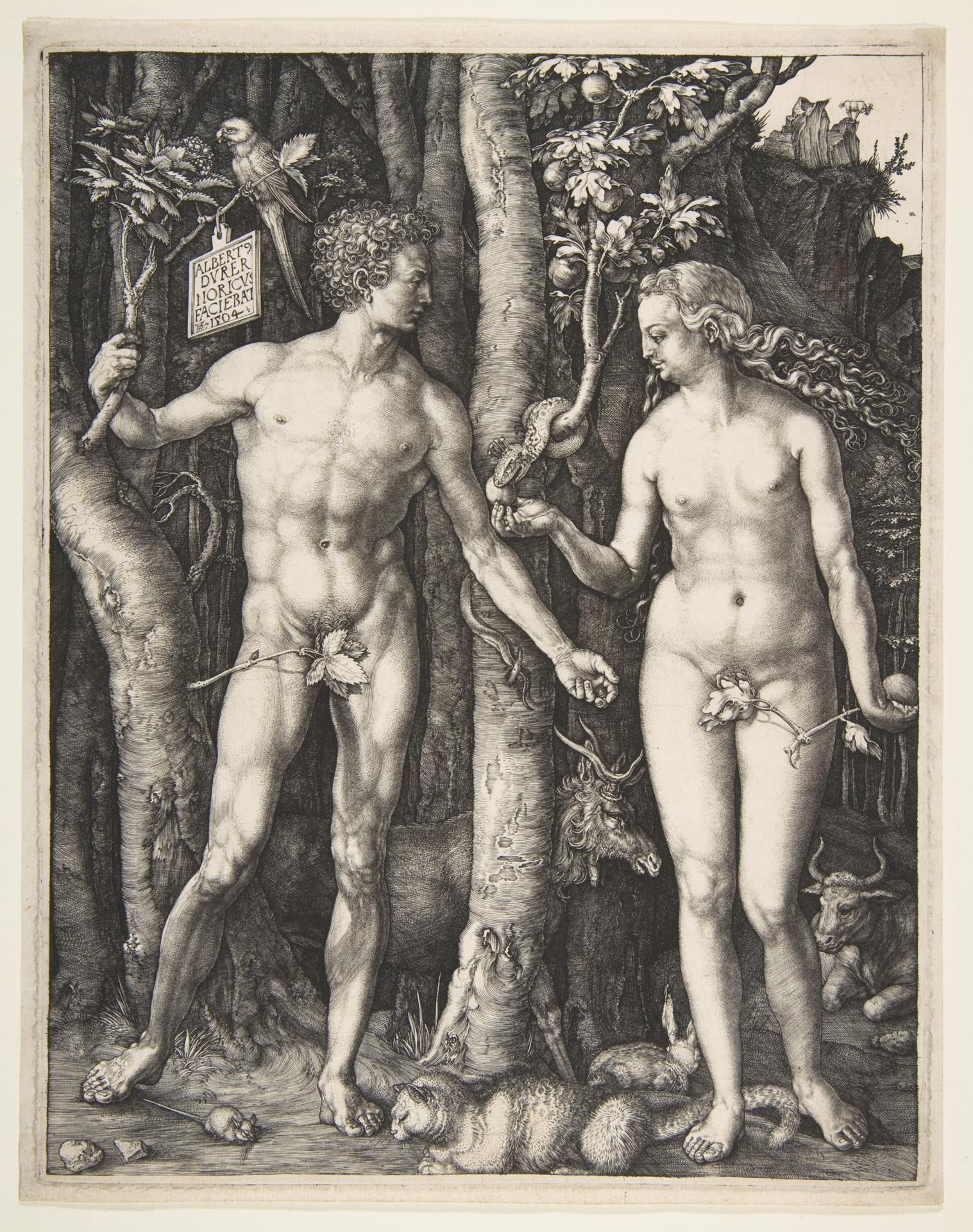
Adam and Eve is an engraving by the German Renaissance artist Albrecht Dürer, created in 1504. The print depicts the biblical moment in the Garden of Eden, with Adam and Eve standing in a forest setting. Dürer’s masterful engraving technique captures the idealized human form and intricate natural details.
Description
The composition is symmetrical, with Adam on the left and Eve on the right, both rendered in meticulous detail. Adam wears a leafy crown and holds a branch, while Eve grasps an apple, her long curly hair cascading down. Their bodies are idealized, with well-defined muscles and a classical contrapposto stance. The background features dense trees, leaves, and animals such as a stag and a hare, creating a rich forest environment. A plaque on a tree bears the inscription 'Albert Dürer' and the year '1504', anchoring the work in time.
Context
Dürer created this engraving in 1504, during a period when he was deeply engaged with classical proportions and the human figure. The work reflects his study of Italian Renaissance art, particularly his admiration for antiquity and the ideal body. Dürer’s print was part of his broader exploration of biblical themes, showcasing his technical skill in engraving. The detailed landscape and animals also demonstrate his keen observation of nature, a hallmark of Northern Renaissance art.
Impact
The engraving impresses with its precise linework and dramatic light-and-shadow contrast, giving the figures a sculptural presence. The serene yet tense interaction between Adam and Eve draws the viewer into the moment before the Fall. Dürer’s ability to combine classical beauty with naturalistic detail makes this work a masterpiece that continues to captivate audiences.
Technique
Dürer used the burin engraving technique on copper plate, allowing for fine, controlled lines and subtle tonal variations. The print demonstrates his exceptional skill in cross-hatching to model form and create depth. The careful rendering of textures—from skin to fur to foliage—highlights the medium’s precision and Dürer’s mastery.
AI-generated description text
Source: Metropolitan Museum of Art · Public domain (CC0)