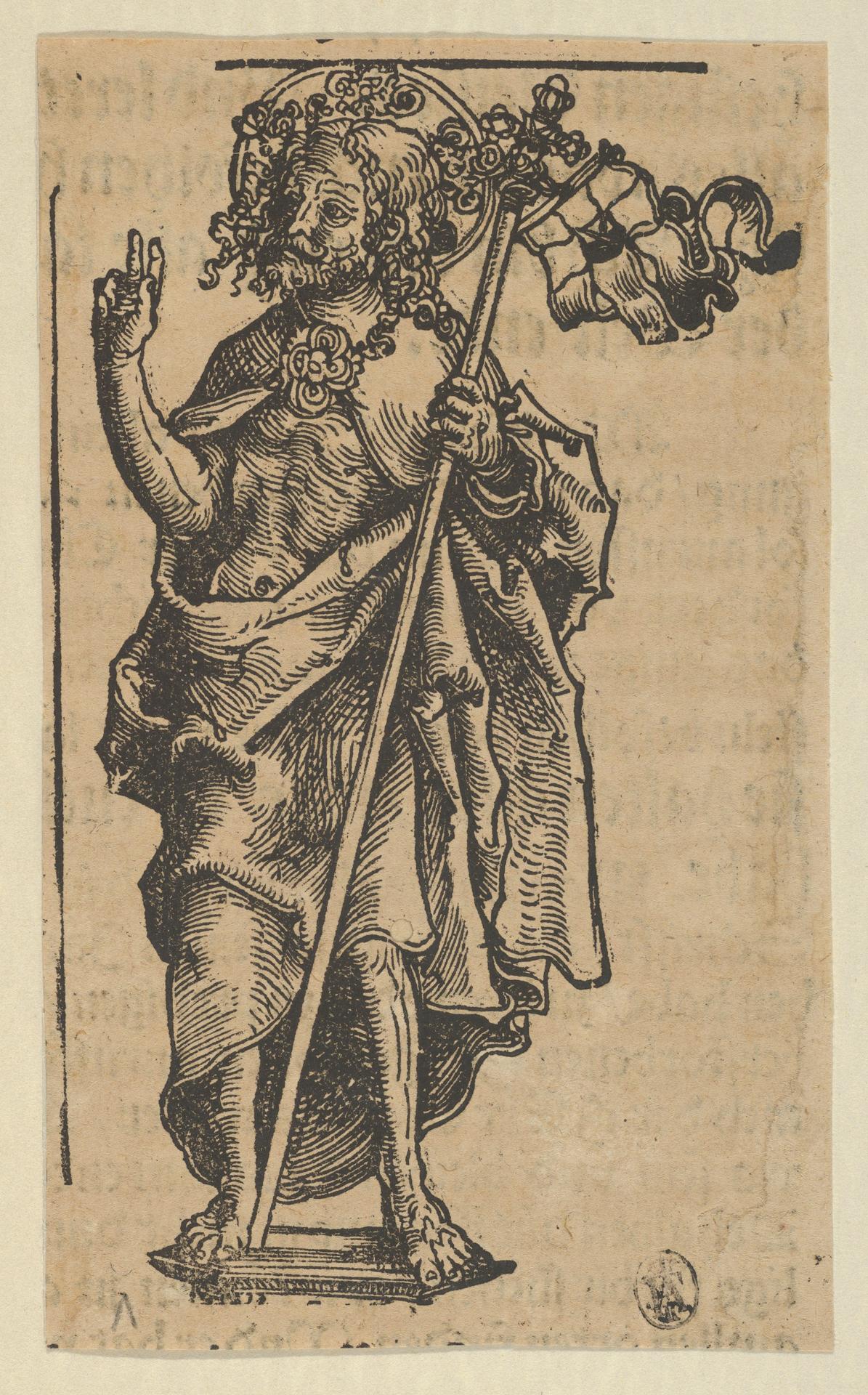
Silver Statuette of the Risen Christ, from the "Wittenberg Reliquaries"
Original title: Silver Statuette of the Risen Christ, from the "Wittenberg Reliquaries"
kurzbeschreibung
Around 1509, Lucas Cranach the Elder made this woodcut of the risen Christ, one of the so-called Wittenberg Relics. The small sheet measures 5.7 × 13 cm and is the second of two states according to Hollstein. It was intended as an illustration for the relic treasury of the Castle Church in Wittenberg.
Description
Christ stands barefoot in a long, flower-decorated robe; curly hair is surrounded by blossoms. He raises his right hand in blessing, while his left holds a long, flower-adorned staff. The layout gets by with a sparse background, which brings the figure clearly into focus. The woodcut creates a strong contrast between dark lines and light areas, making the texture and details of robe and hair stand out.
Context
The sheet arose in the context of the Wittenberg relic collection assembled by Frederick the Wise. Around 1509 Cranach produced a series of woodcuts meant to present the relics of the Castle Church to a wider audience. The risen Christ points to the central message of salvation associated with these relics. The small format suggests the print served for a devotional book or as a single-sheet publication.
Impact
Despite its small size, the figure feels monumental—thanks to its central placement and calm, clear gesture. Delicate flowers and detailed linework give the print a precious, almost metallic quality reminiscent of the silver statuette. Because the background remains reduced, nothing distracts from the blessing Christ; this creates a meditative devotional effect.
Technique
This work is a woodcut known in two states; the present one is the second. The motif is cut into a woodblock, inked, and printed on paper, producing bold black lines and contrasts. Fine hatching and ornamental design attest to Cranach's high precision in handling the medium.
AI-generated description text
Source: Metropolitan Museum of Art · Public Domain (CC0 1.0)