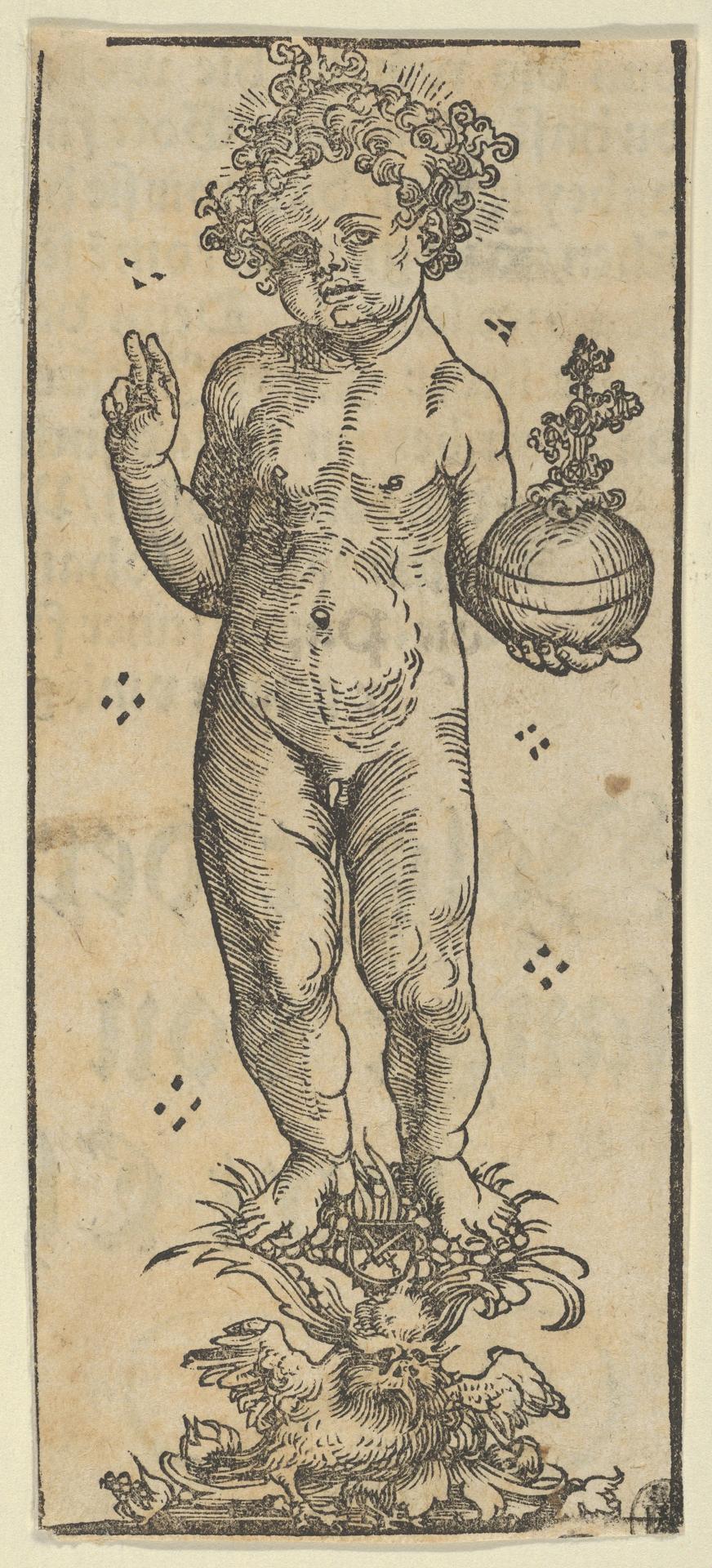
Silver Statuette of the Christ Child, from the "Wittenberg Reliquaries" (Woodcut; second state of two (Hollstein))
Original title: Silver Statuette of the Christ Child, from the "Wittenberg Reliquaries"
kurzbeschreibung
A woodcut by Lucas Cranach the Elder showing the Christ Child as a silver statuette from the Wittenberg relic collection. The sheet belongs to a series issued in two editions; this is the second state. The motif ties religious iconography to the rendering of a precious work of art.
Description
The naked child, with curly hair, raises his left hand in blessing while his right holds an orb surmounted by a cross. He stands on a stylized bunch of flowers and plants. His gaze turns slightly to the left, and the background stays plain. The monochrome gray palette matches the woodcut practice of the time.
Context
The series documents the relics of the Wittenberg treasury, kept in the Castle Church during the sixteenth century. Lucas Cranach the Elder made these sheets on commission from the Saxon electors to circulate the collection. It appeared in two editions; the present copy represents the second state. The Wittenberg relics were regarded as a major center of late medieval piety.
Impact
Clear lines and a calm layout give the view something both devotional and representative. The restriction to gray tones brings iconographic details such as the blessing gesture and the cross orb to the fore. The result feels like a precious yet accessible devotional image.
Technique
The woodcut as a relief process shows here how lines and hatching build up tonal values: the drawing is cut into the woodblock and then printed on paper. The monochrome effect comes from printing with black or brown ink, which appears in various shades of gray. Fine lines and details attest to the high craftsmanship of Cranach and his workshop.
AI-generated description text
Source: Metropolitan Museum of Art · Public Domain (CC0 1.0)