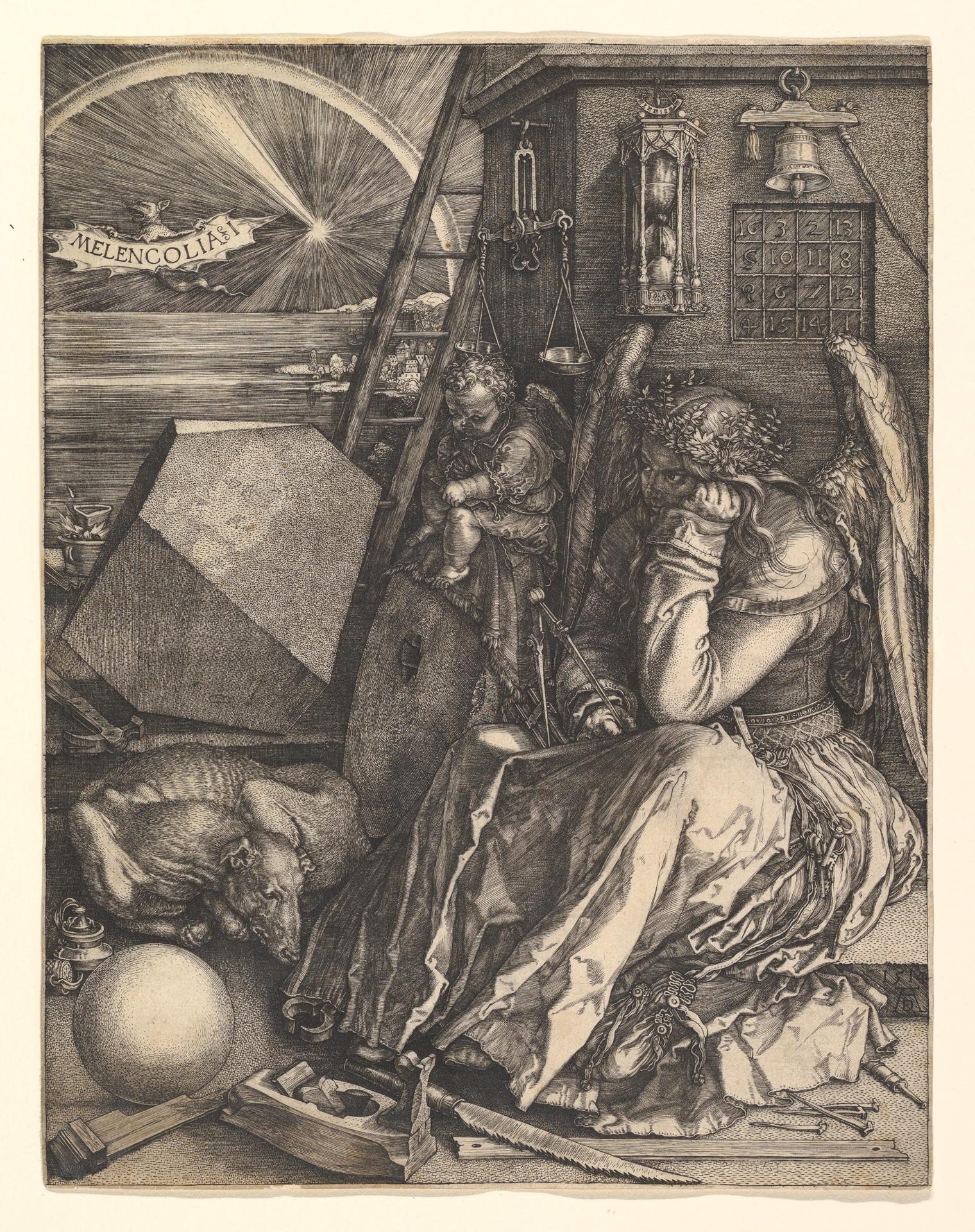
Melencolia I
Original title: Melencolia I
kurzbeschreibung
Albrecht Dürer's 1514 engraving Melencolia I depicts a winged allegorical figure of melancholy, surrounded by symbols of geometry, craftsmanship, and time. The print is celebrated for its intricate detail and profound intellectual depth.
Description
The central figure, a winged woman, sits slumped in a chair, her head resting on her hand, with a wreath of leaves crowning her. A sleeping dog lies at her feet, while scattered tools—a hammer, scissors, compass, and an open book—litter the foreground. In the background, an hourglass and a bell tower evoke the passage of time, while a putto (cherub) perched on a grindstone holds a balance scale. Above, a magic square and a comet-like light appear in the sky, and the title 'MELENCOLIA I' is inscribed on a bat's wing.
Context
Created in 1514, during the Northern Renaissance, Melencolia I is one of Dürer's three 'master prints,' alongside Knight, Death, and the Devil and Saint Jerome in His Study. The work reflects Renaissance debates on melancholy as a temperament of creative genius, influenced by Neoplatonic and Aristotelian ideas. Dürer, a Nuremberg artist, was deeply engaged with geometry and mathematics, which appear as central motifs. The print is often interpreted as an allegory of the artist's own intellectual struggles and the limits of human knowledge.
Impact
The engraving's dense symbolism and somber mood create an atmosphere of quiet introspection and intellectual tension. The meticulous detail and dramatic contrasts of light and shadow draw the viewer into a contemplative state, mirroring the figure's own brooding. Its enigmatic quality has made it one of the most analyzed and debated images in art history, resonating across centuries with artists and thinkers.
Technique
Dürer used the intaglio technique of engraving on copperplate, cutting fine lines with a burin to achieve exceptional precision and tonal range. The print's rich chiaroscuro is produced through cross-hatching and varying line density, allowing for subtle gradations of light. This technical mastery, combined with the large format, demonstrates Dürer's virtuosity as a printmaker.
AI-generated description text
Source: Metropolitan Museum of Art · Public domain (CC0)