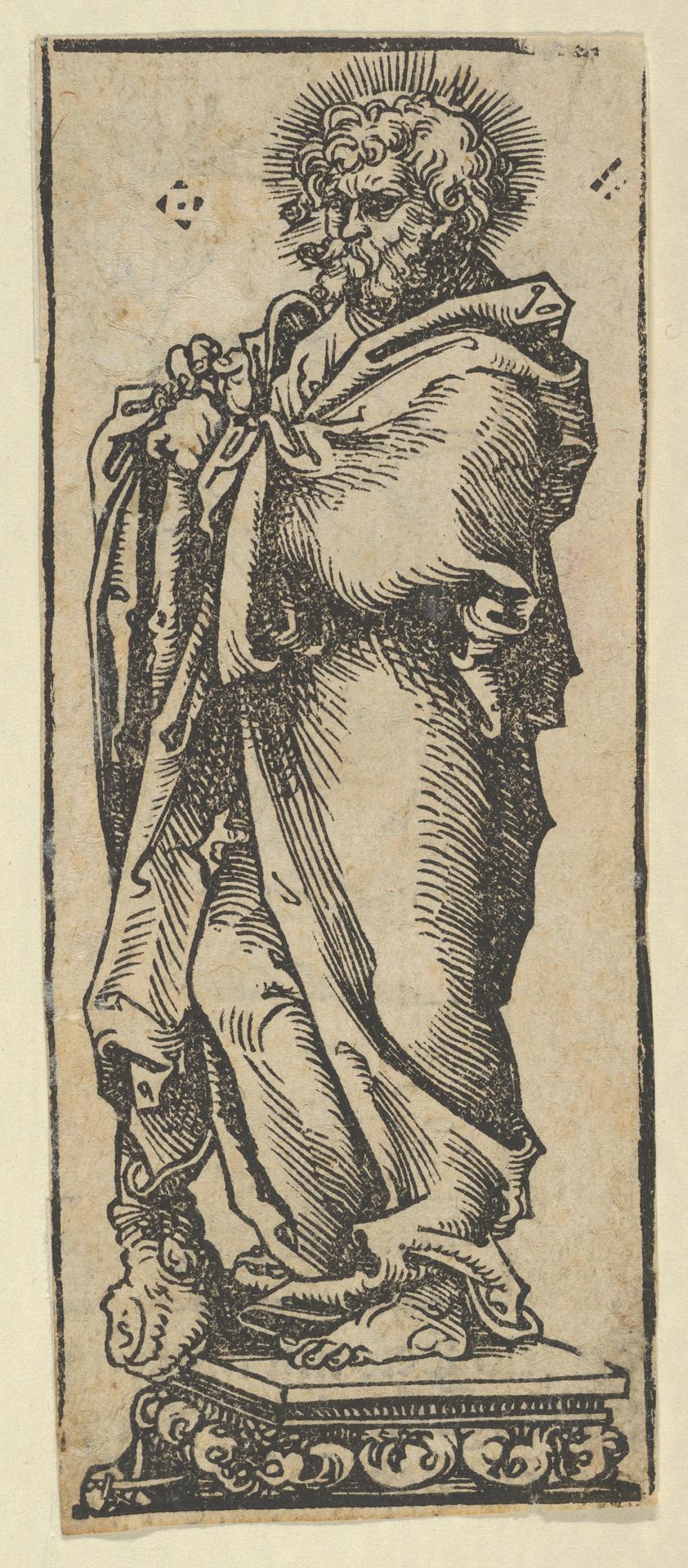
Silver Statuette of St. Jude, from the "Wittenberg Reliquaries" (Woodcut, Met-Objekt 2469)
Original title: Silver Statuette of St. Jude, from the "Wittenberg Reliquaries"
kurzbeschreibung
Lucas Cranach the Elder recorded a silver statuette of Saint Judas Thaddaeus, commonly known as St. Jude, in this woodcut. The undated sheet belongs to the series of 'Wittenberg Relics' and reproduces a reliquary figure as its subject.
Description
A long, hooded robe wraps around the saint, and a radiant halo rests above his head. His left hand holds an arm bearing an object, possibly a relic; the right is raised. A pedestal decorated with leaf or vine ornament forms his base. The saint fills nearly the entire foreground, and the layout converges on him. Black and white remain the only tonal range, and the lines are sharp and rich in detail.
Context
Frederick the Wise, Elector of Saxony, had assembled the 'Wittenberg Relics' as a collection of holy objects. From 1505 Lucas Cranach the Elder worked as court painter in Wittenberg, and the woodcuts for the Heiltumsbrief published in 1509 are his. This print served as a kind of catalogue to guide pilgrims and the faithful. The silver statuette of Judas Thaddaeus also belonged to that holding, kept in the Schlosskirche at Wittenberg. Exactly when the sheet was made is unknown; it belongs to the sphere of the Reformation and the veneration of relics.
Impact
Clear and almost monumental, the saint stands before the viewer, supported by the central placement and the halo. Precise execution and delicate linework produce a calm, reverent mood. Because colour is absent, the formal severity and the sacred aura of the figure stand out all the more.
Technique
As a relief process, woodcut requires the drawing to be cut away from the block and then printed. The sharp, detailed lines suggest careful carving. Black and white is characteristic of this technique and ensures a clear contrast.
AI-generated description text
Source: Metropolitan Museum of Art · Public Domain (CC0 1.0)