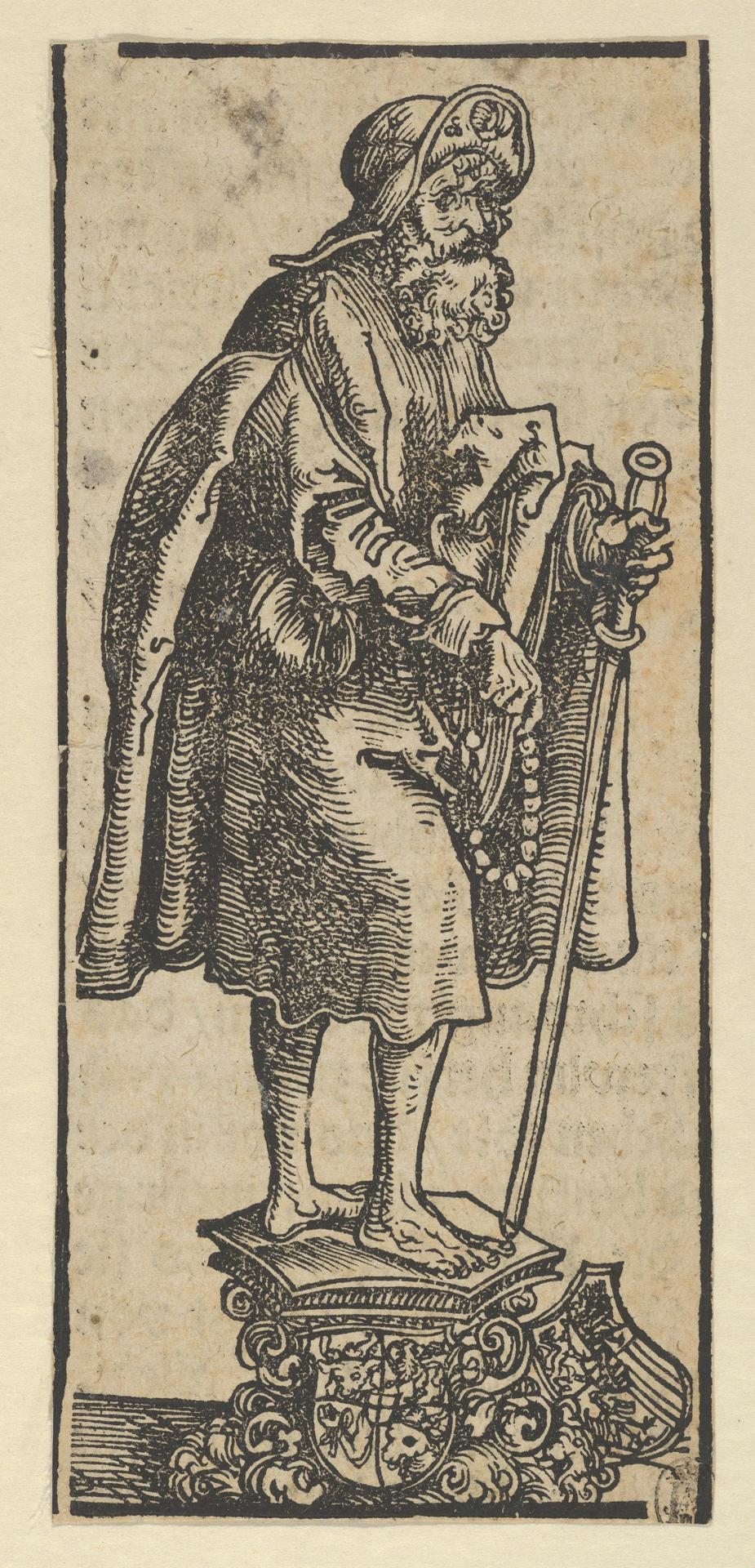
Silver Statuette of St. James the Greater, from the "Wittenberg Reliquaries" (Woodcut, Met-Objekt 2462)
Original title: Silver Statuette of St. James the Greater, from the "Wittenberg Reliquaries"
kurzbeschreibung
James the Elder appears as a pilgrim with staff and scroll in this woodcut by Lucas Cranach the Elder. The print reproduces a silver statuette of the saint and belongs to the series known as the 'Wittenberg Relics'. It is executed as a woodcut on paper.
Description
James stands before us in a long robe and a cap; his beard frames a face whose gaze turns to the left. His left hand grasps a scroll, while his right holds the staff. A pedestal adorned with a coat of arms supports the figure. The ground remains blank, so nothing distracts from the saint and his form stays clearly outlined. The line style is plain yet rich in detail.
Context
Frederick the Wise, Elector of Saxony, kept a collection of relics in the castle church at Wittenberg, which became known as the 'Wittenberg Relics'. For this treasure he commissioned from Lucas Cranach the Elder a series of woodcuts recording the individual reliquaries. The prints served as a catalogue and appeared in a book that listed the relics together with their indulgences. The exact date of the series is not recorded, but it belongs to the early sixteenth century.
Impact
Calm and solemnity emanate from the sheet, carried by the clear linework and the central placement of the figure. Although the print remains black and white, the silver statuette can be imagined within it, and the sacred significance of the saint comes forward. Because all accessories are absent, the eye is drawn to the details of the figure and to the attributes he carries.
Technique
For this sheet Cranach chose the woodcut, a relief process in which the design is cut into a wooden block and transferred with ink to paper. The lines run finely and precisely, suggesting a carefully executed print. The use of only black and white accords with this technique and reinforces the graphic character of the view.
AI-generated description text
Source: Metropolitan Museum of Art · Public Domain (CC0 1.0)