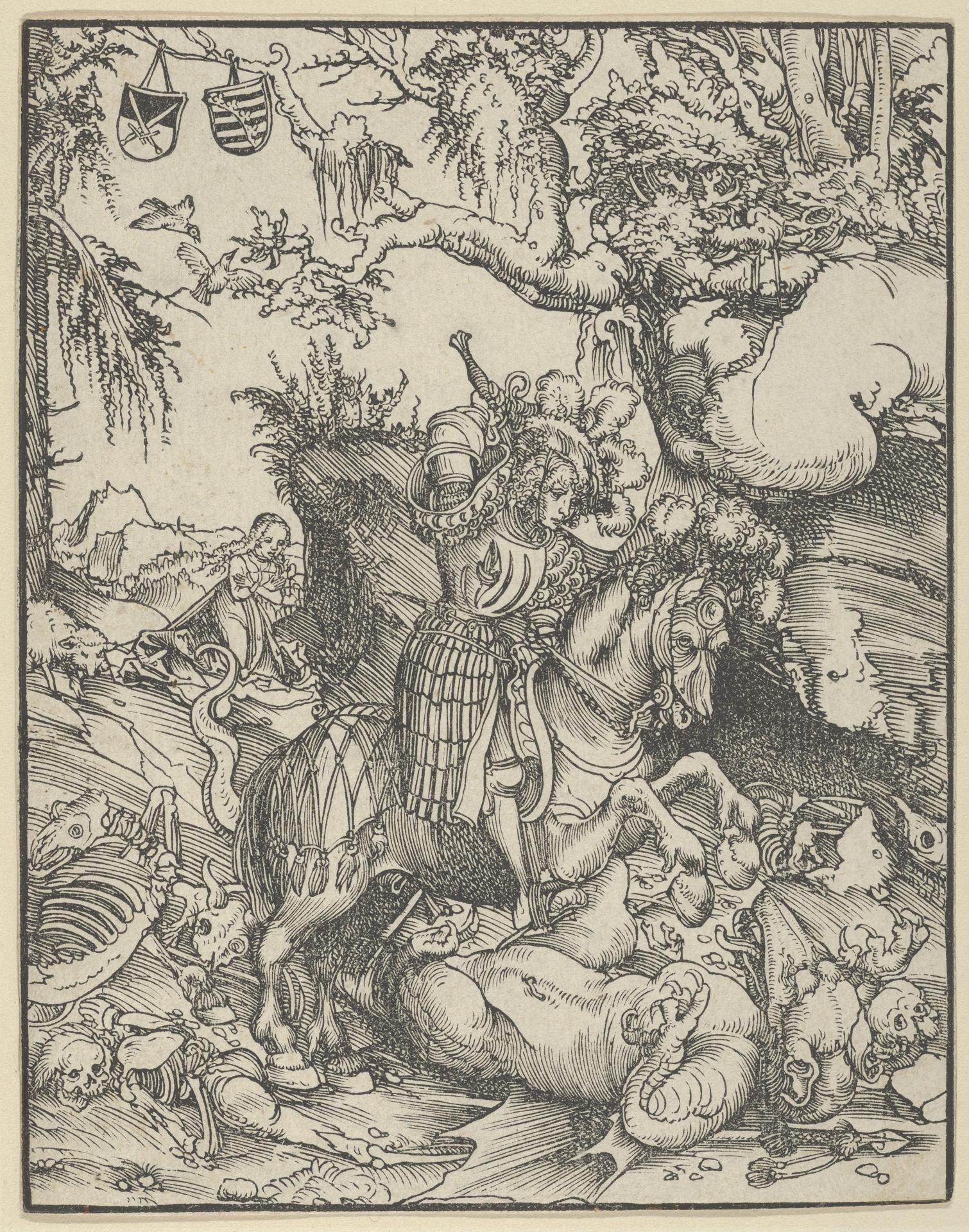
St. George on Horseback Slaying the Dragon
Original title: St. George on Horseback Slaying the Dragon
kurzbeschreibung
Unlike many saintly images of its time, this woodcut puts Saint George's dragon fight front and center: the mounted knight drives his lance into the monster lying on the ground. The undated sheet by Lucas Cranach the Elder, a leading German Renaissance artist, measures 16.8 × 12.7 cm and belongs to the single-leaf woodcuts.
Description
An armored rider with a feathered helmet sits astride his horse, aiming the lance at a dragon stretched out on the ground. Scattered around the beast are dead people and animals—a sign of the danger it poses. Trees and rocks frame the scene; on a rocky ledge crouches another figure, with a bird visible beside it. The layout is dense and draws the eye to the combat. Black-and-white lines of varying thickness and direction create shading and contrasts of light.
Context
Cranach served as court painter to the Saxon electors in Wittenberg and was a friend of Martin Luther. In the late Middle Ages, Saint George ranked among the most popular saints; he was regarded as patron of knights and soldiers. Printed sheets like this one circulated widely as inexpensive devotional images. No exact date of creation has come down to us, but the style points to Cranach's early period.
Impact
The scene lives from dramatic tension and a clear narrative that makes the victory of good over evil vivid. Despite the small format, precise linework and strong contrasts create spatial depth. The many secondary motifs and the naturalistic landscape reveal the artist's careful craftsmanship.
Technique
For the woodcut, the design was cut into a wooden block and then printed on paper. Varying line widths and cross-hatching produce sculptural shadows and give the flat surface depth. Printing was likely done in black ink on paper; the white areas remain unprinted and show the bare ground.
AI-generated description text
Source: Metropolitan Museum of Art · Public Domain (CC0 1.0)