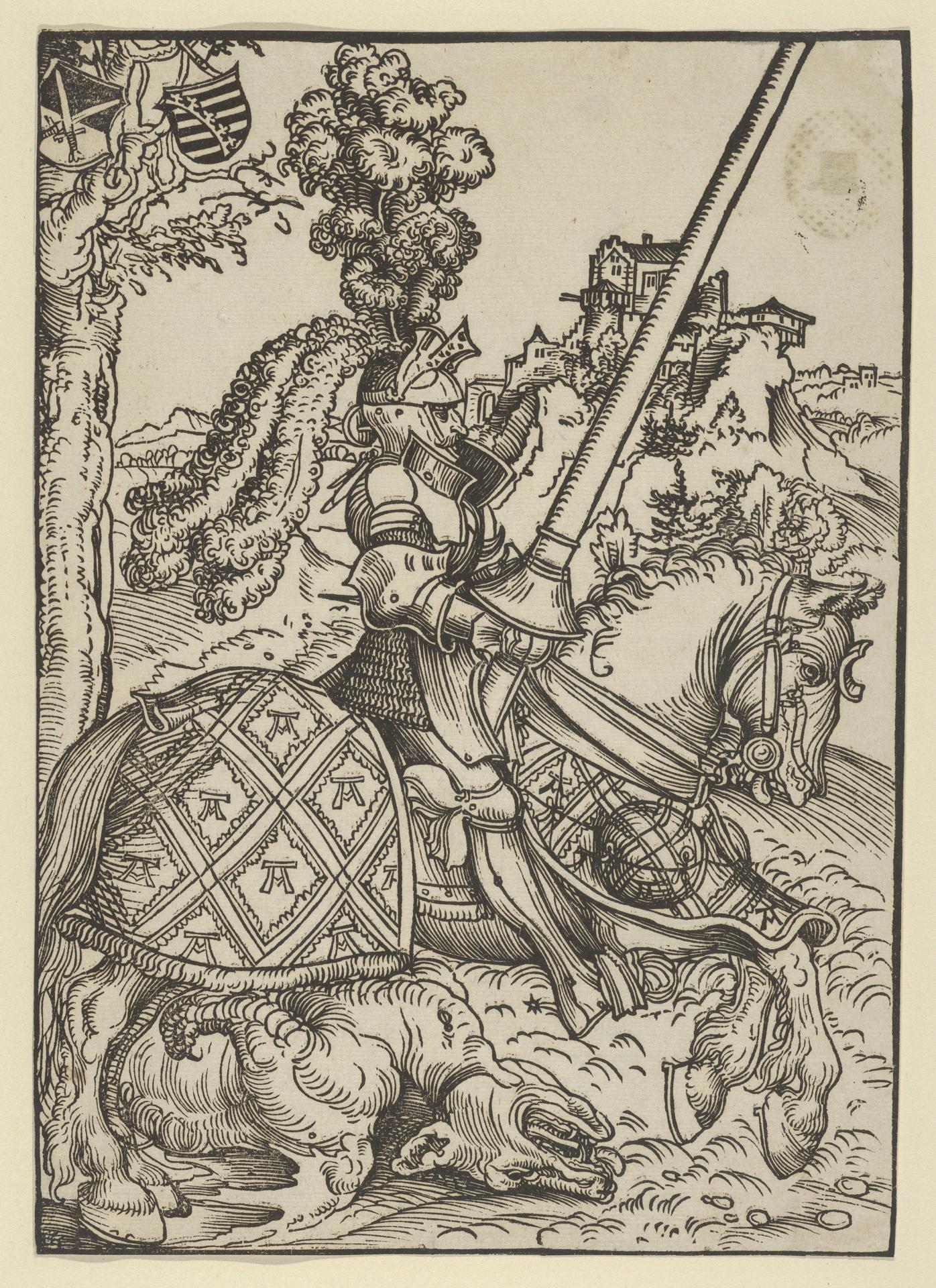
St George on Horseback with the Dead Dragon
Original title: St George on Horseback with the Dead Dragon
kurzbeschreibung
Saint George rides in full armor on a horse that strides over the defeated dragon. Lucas Cranach the Elder made this woodcut in the early 16th century; this impression is the second state, from the collection of the Metropolitan Museum of Art.
Description
Saint George sits at the center on a horse turned to the right. He wears complete armor and holds a lance in his right hand; his shield bears a cross emblem. On the ground lies the dragon with its mouth wide open, clearly shown as defeated. Trees, a coat of arms with a swan, and a castle appear in the background. The layout is symmetrical, with the knight as the focal point, and the linework is detailed and high in contrast.
Context
Cranach the Elder probably made this woodcut in the first decades of the 16th century, while he was working in Wittenberg as court painter to the Saxon electors. The motif of Saint George was popular at the time, since the saint was regarded as patron of knights and of the struggle against evil. The woodcut shows influences of Gothic art, evident in the detailed linework and the symmetrical arrangement. The coat of arms with the swan may refer to Saxon heraldry, which points to a courtly context of origin.
Impact
The woodcut makes an immediate impression through its clear, symmetrical arrangement and the strong contrast between the figures and the background. The detailed rendering of armor and dragon conveys a dramatic narrative that draws the viewer into the scene. The monochrome execution emphasizes the graphic quality and gives the work a timeless, almost monumental presence.
Technique
For this print, the design was cut into a woodblock and then printed on paper. This is the second state of the print, meaning the block was reworked after the first impression. The lines are fine and precise, typical of Renaissance woodcut technique, with hatching providing depth and shadow.
AI-generated description text
Source: Metropolitan Museum of Art · Public Domain (CC0 1.0)