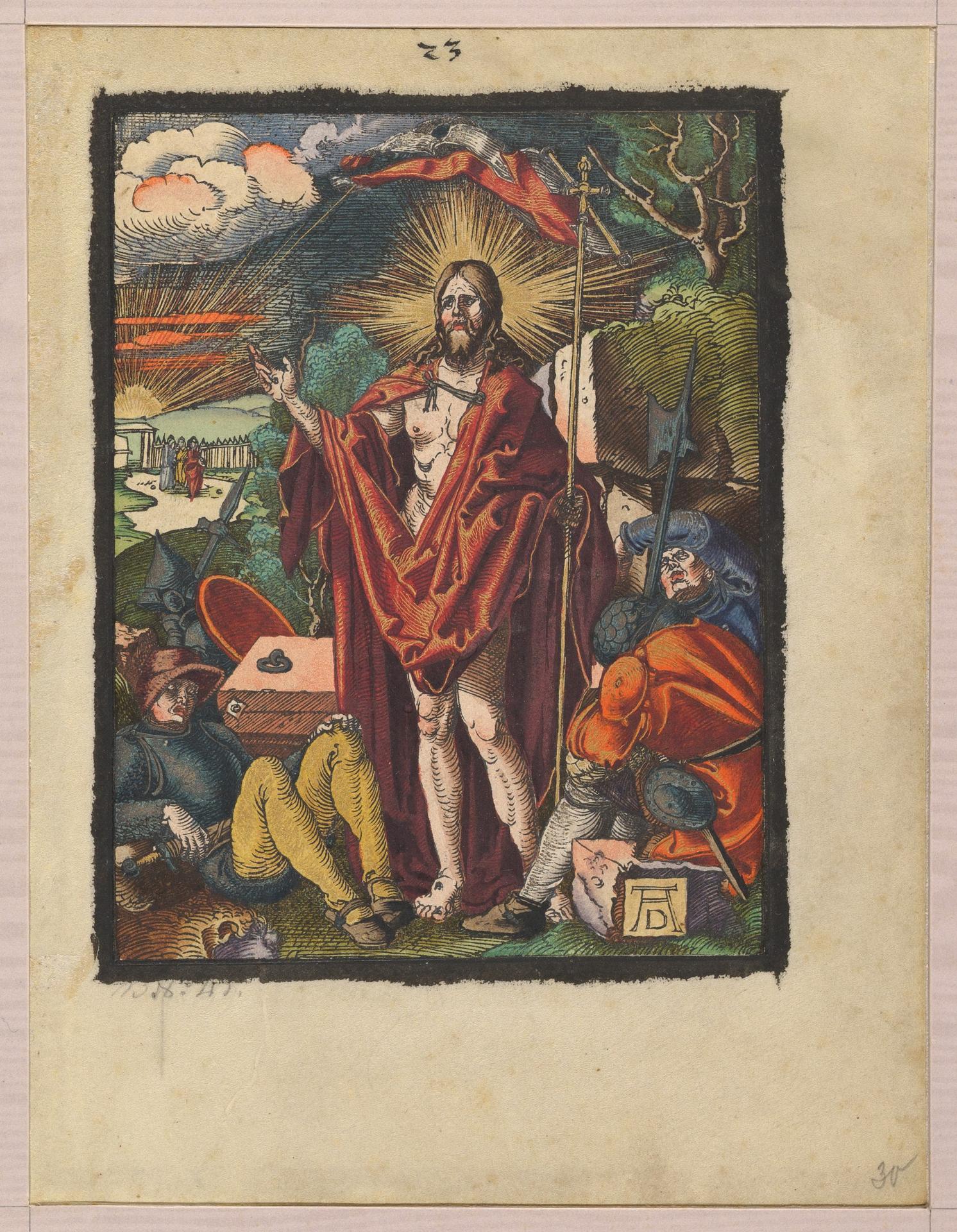
Resurrection, from "The Small Woodcut Passion"
Original title: Resurrection, from "The Small Woodcut Passion"
kurzbeschreibung
Albrecht Dürer's hand-colored woodcut from 1509–10 shows the Resurrection of Christ. At the center stands Christ in a red robe with the banner of the cross, surrounded by soldiers who are sleeping or waking. The print belongs to Dürer's 'Small Woodcut Passion,' a series of 37 woodcuts.
Description
Christ dominates the layout as the central figure. He wears a bright red robe and holds a cross in his right hand. A halo of light, coming from above, surrounds his head. Around him, several soldiers lie or stand, some on the ground, others with weapons. A landscape with trees closes the back, while clouds and a sunrise or sunset fill the sky. The colors are strong and contrasting, especially reds, blues, and greens.
Context
The 'Small Woodcut Passion' was created between 1508 and 1510 and is one of Dürer's most famous graphic series. Dürer was working in Nuremberg at the time, where he was active as a respected artist and printer. The woodcuts were aimed at a broad public and met the growing demand for religious images in the early 16th century. The coloring was probably done by a workshop that specialized in painting prints.
Impact
The clear, symmetrical arrangement and the luminous colors highlight the Resurrection as a triumphant event. The bright radiance around Christ creates a solemn, almost otherworldly mood that speaks directly to the viewer. The stylized drawing of the figures gives the print a timeless, illustrative quality.
Technique
On this sheet, the lines of the printed image sit firmly in the paper and are overlaid with washes of red, blue, and green applied by hand. The crisp contours and the flat, even areas of colour remain clearly distinguishable in the surviving impression, while the sheet itself shows the slight irregularities typical of early sixteenth-century paper.
AI-generated description text
Source: Metropolitan Museum of Art · Public Domain (CC0 1.0)