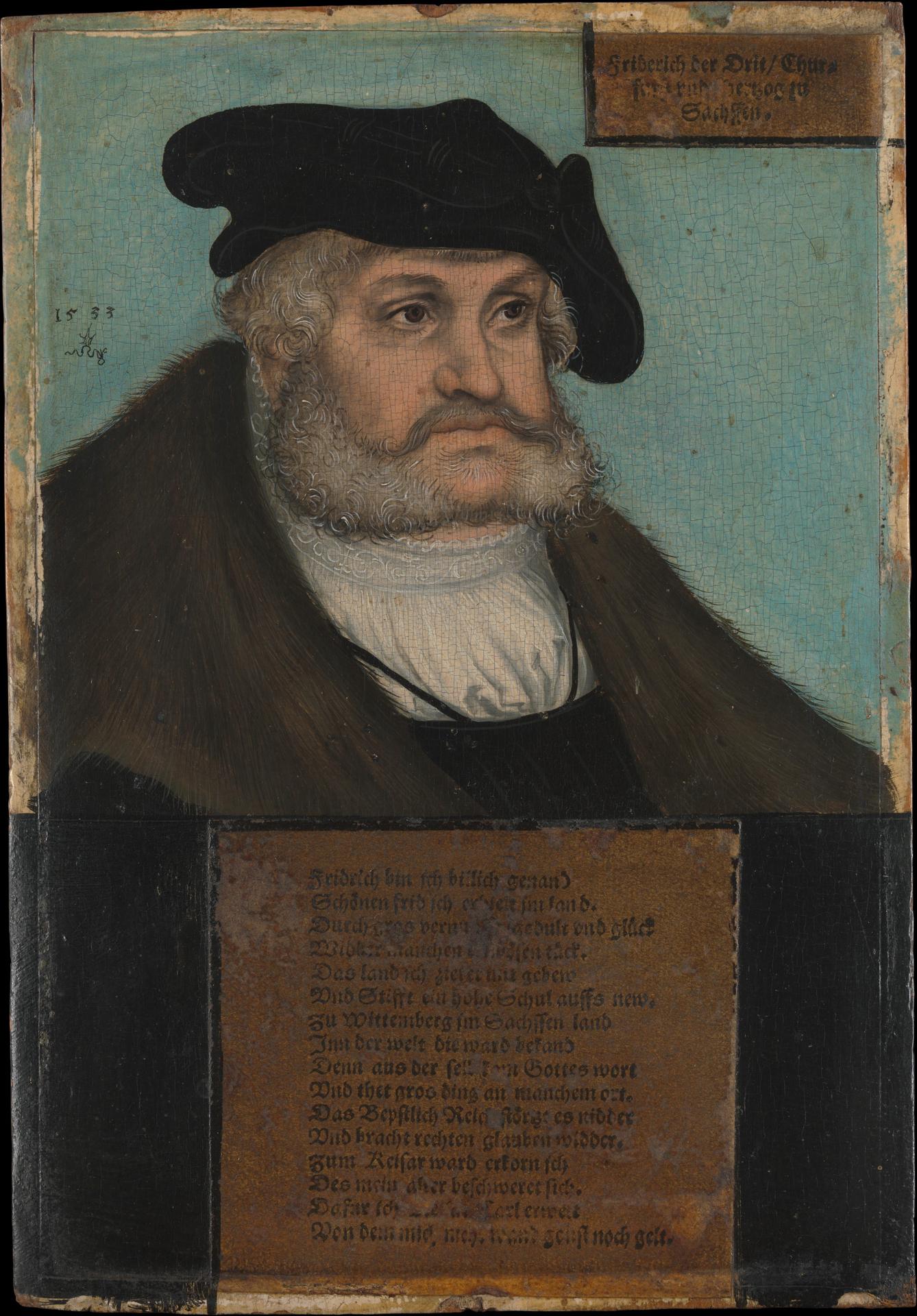
Friedrich III (1463–1525), the Wise, Elector of Saxony
Original title: Friedrich III (1463–1525), the Wise, Elector of Saxony
kurzbeschreibung
Friedrich III, known as the Wise and Elector of Saxony, appears in this portrait made by Lucas Cranach the Elder together with his workshop in 1533. Painted in oil on beech and measuring just 20.3 x 14.3 cm, the panel presents the prince as a bust-length figure in the dress of his time.
Description
The Elector stands centrally in the picture field: a black cap covers his head, a fur robe lies over a white shirt with an ornate collar. His expression is serious and withdrawn, his gaze directed slightly to the left. Below the portrait runs a dark brown strip with a Latin inscription in printed letters. A muted blue forms the background; the light falls evenly, bringing out the features without casting harsh shadows.
Context
As Elector of Saxony, Friedrich III guided the fortunes of the land from 1486 to 1525 and emerged as an important patron of Martin Luther. The portrait was made in 1533, eight years after his death, and was likely intended as a retrospective memorial. Cranach the Elder served as court painter to the Saxon electors and produced several portraits of Friedrich, which later served as models for copies.
Impact
A calm dignity emanates from the painting; the symmetrical arrangement and restrained colours contribute to this. Fur and clothing are rendered with great precision, giving the portrait an almost tangible closeness and transporting the viewer into the era of the Reformation.
Technique
Oil on beech serves as the support, a common material for the German Renaissance. Particularly striking are the letterpress-printed paper labels bound into the painting—an unusual feature that may point to a later addition or restoration. The brushwork is careful and detailed, especially in the rendering of fabric and hair textures.
AI-generated description text
Source: Metropolitan Museum of Art · Public Domain (CC0 1.0)