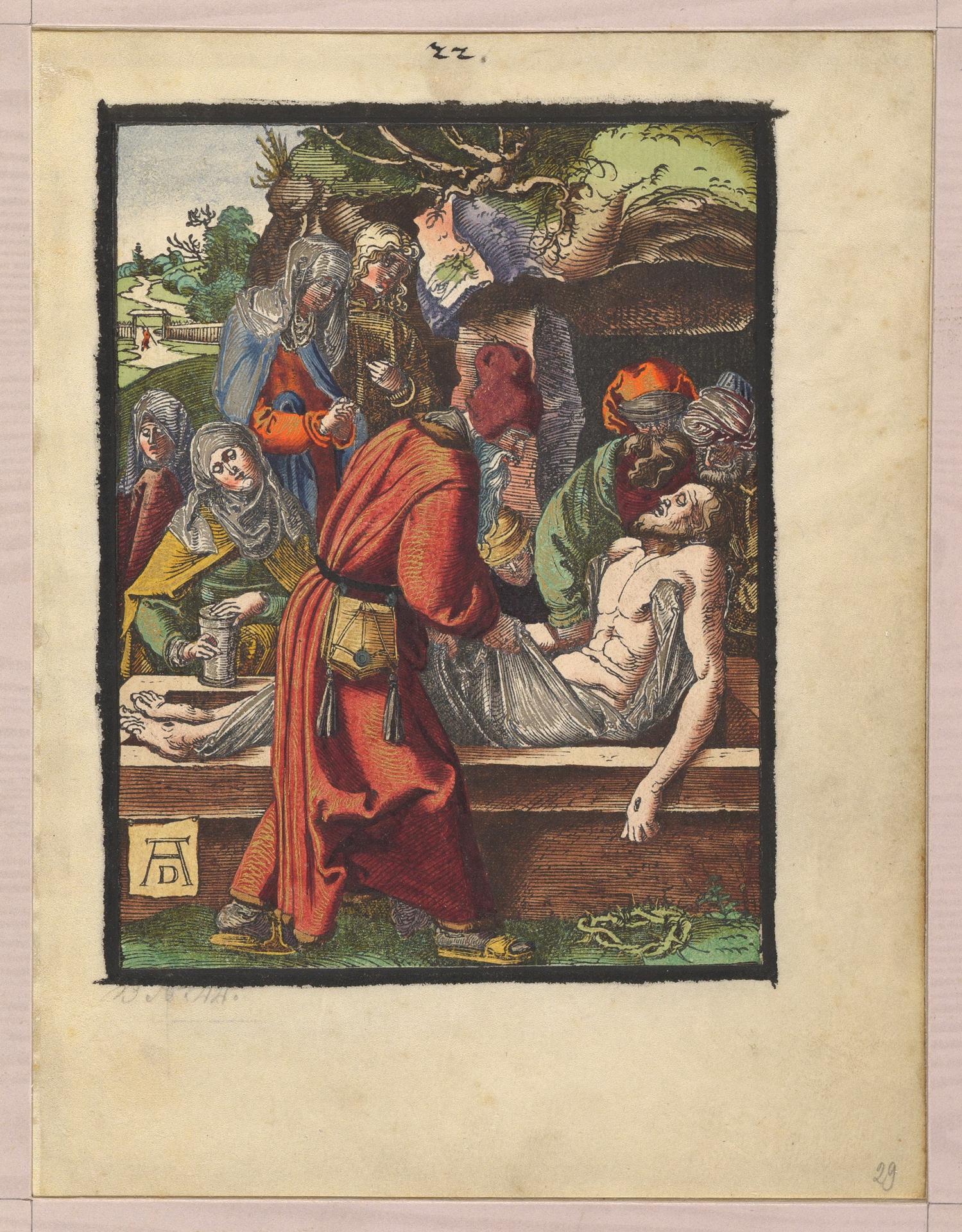
Deposition, from 'The Small Woodcut Passion'
Original title: Deposition, from "The Small Woodcut Passion"
kurzbeschreibung
This woodcut by Albrecht Dürer, dated 1509–10, depicts the Deposition of Christ, a scene from the Passion. The hand-colored print shows the body of Jesus being lowered from the cross onto a table or bier, surrounded by mourners. It is part of Dürer's 'Small Woodcut Passion' series.
Description
In the foreground, the lifeless body of Christ lies on a table, supported by a figure in a red robe. Around him, men and women gather, some gazing at the body, others holding cloths, their faces marked by grief. In the background, a landscape with trees and a path recedes into the distance, while light from above accentuates the figures' contours. The palette is mostly dark and muted, with the red garments standing out prominently.
Context
Dürer created the 'Small Woodcut Passion' series between 1509 and 1511, a period when he was at the height of his printmaking career. The series was designed to be accessible and devotional, intended for a broad audience. This print reflects the late medieval tradition of emphasizing Christ's suffering and the emotional responses of those present.
Impact
The composition draws the viewer into the solemn moment, the red robes adding a striking focal point against the somber tones. The detailed expressions and gestures convey a deep sense of mourning, making the scene both intimate and moving. Dürer's mastery of line and form gives the woodcut a sculptural quality, enhancing its emotional impact.
Technique
This is a woodcut, a relief printing technique where the design is carved into a block of wood, inked, and pressed onto paper. The hand-coloring applied after printing adds subtle hues, particularly the reds, which enrich the visual texture. Dürer's precise cutting creates sharp contours and clear distinctions between figures and background, typical of his Renaissance style.
AI-generated description text
Source: Metropolitan Museum of Art · Public domain (CC0)