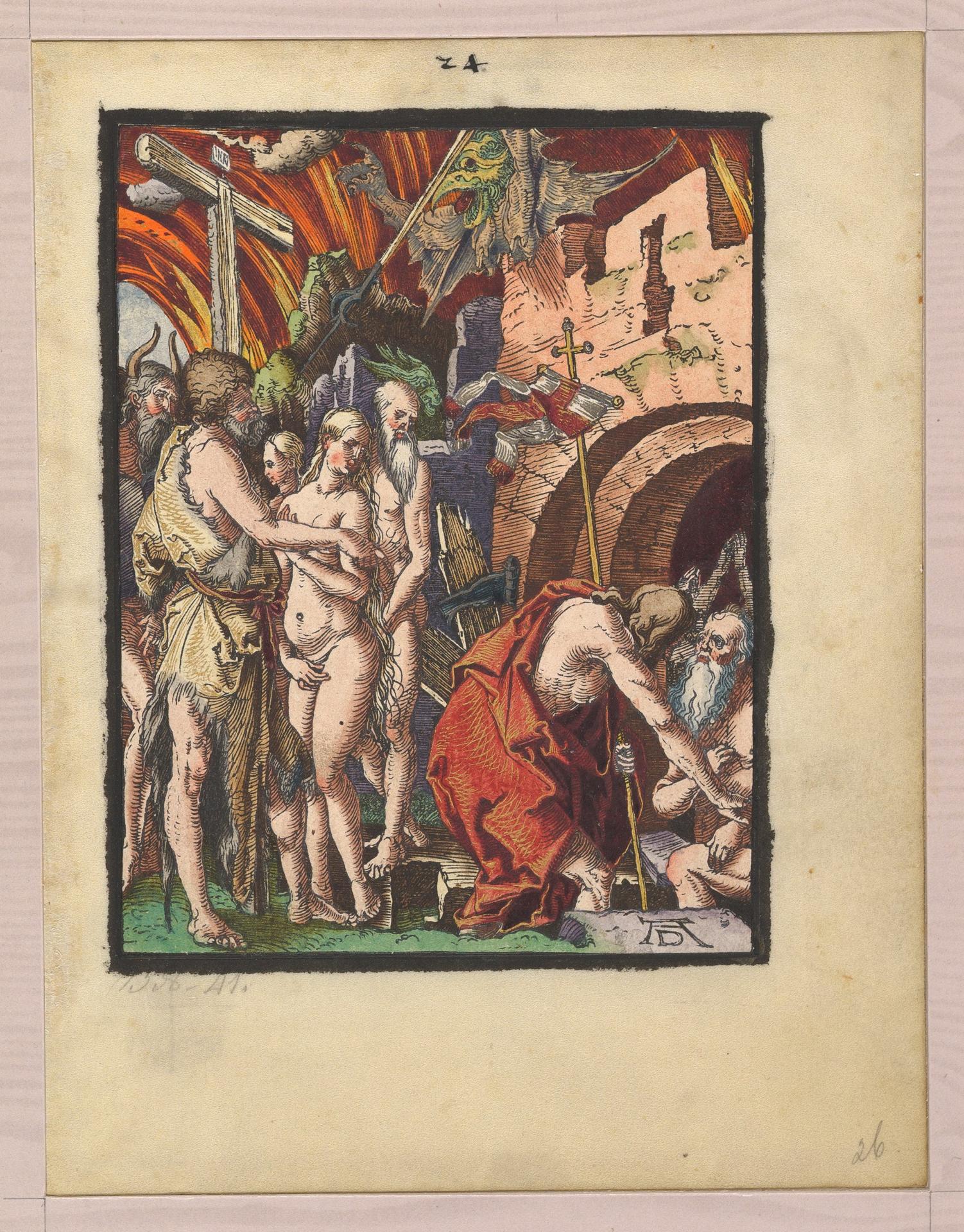
Christ in Limbo, from "The Small Woodcut Passion"
Original title: Christ in Limbo, from "The Small Woodcut Passion"
kurzbeschreibung
This hand-colored woodcut by Albrecht Dürer, dated 1509–10, depicts Christ in Limbo, a scene from his 'Small Woodcut Passion' series. The composition shows a nude Christ figure supported by another figure, surrounded by souls and a horned demon, with ruined architecture and a dragon-like creature in the background. The work is rendered in Dürer's late Gothic style, marked by expressive detail and strong color.
Description
The central figure of Christ stands nude, his arms held by a supporting figure, while a horned demon lurks nearby, suggesting the underworld setting. Around them, other figures display varied emotions, from hope to despair, enhancing the dramatic narrative. In the background, crumbling buildings and a bridge are menaced by a dragon-like creature, adding a fantastical element. The color palette is bold, with dominant reds and browns, and light from above casts strong shadows, emphasizing the figures and the scene's tension.
Context
This woodcut belongs to Dürer's 'Small Woodcut Passion', a series of 37 prints illustrating the Passion of Christ, published in 1511. Dürer created the series during a period of intense artistic output in Nuremberg, where he was established as a master printmaker. The theme of Christ in Limbo, also known as the Harrowing of Hell, reflects medieval theological beliefs about Christ's descent to the underworld to rescue the righteous. Hand-coloring was a common practice at the time, often done by specialized colorists after printing, to enhance the visual appeal of prints for a broader audience.
Impact
The vivid hand-coloring and dramatic lighting give the scene a visceral, almost theatrical intensity, drawing the viewer into the supernatural event. The contrast between the serene Christ and the chaotic, demonic surroundings heightens the emotional impact, making the print both captivating and unsettling. Dürer's intricate linework and expressive faces invite close inspection, rewarding the viewer with details that reinforce the narrative's spiritual significance.
Technique
Dürer employed the woodcut technique, carving the design into a wooden block, inking it, and pressing it onto paper, resulting in bold, black outlines. The print was then hand-colored, likely with water-based pigments, using a limited palette of reds, browns, and other hues to add depth and vibrancy. The combination of precise carving and manual coloring demonstrates Dürer's mastery of both printmaking and the collaborative practice of hand-finishing prints in the early 16th century.
AI-generated description text
Source: Metropolitan Museum of Art · Public domain (CC0)