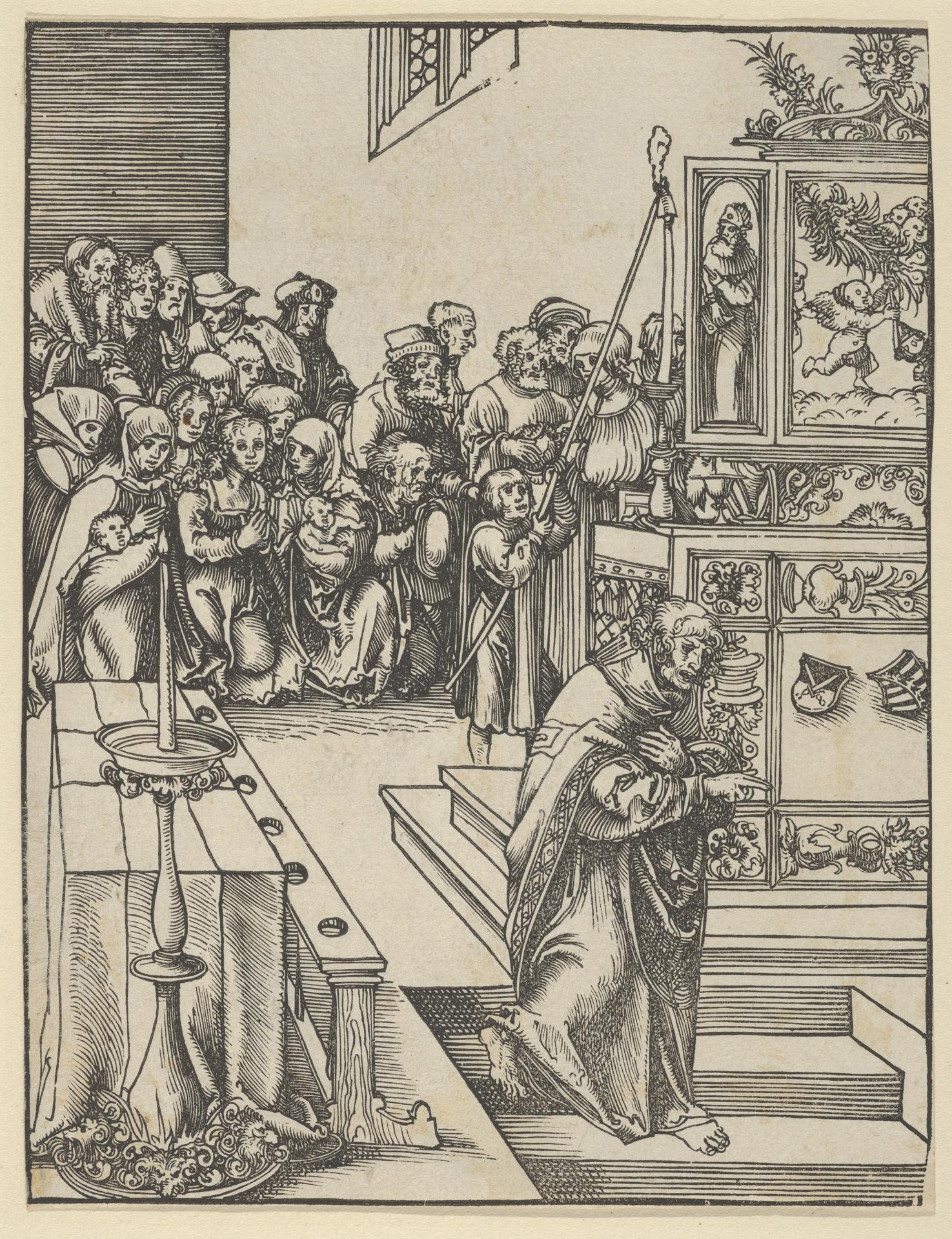
John from the Martyrdom of the Twelve Apostles
Original title: John from the Martyrdom of the Twelve Apostles
kurzbeschreibung
Unlike many comparable martyrdom depictions of its time, this woodcut by Lucas Cranach the Elder places the apostle John not in a scene of brutal execution but in a quiet, almost liturgical interior. The undated sheet belongs to a series on the martyrdoms of the twelve apostles. It is executed as a woodcut measuring 16.5 × 12.6 cm.
Description
On a flight of steps in the foreground kneels the apostle, hands raised, his face marked by intense emotion. To his left stands a baptismal font with a sprinkler in a water basin. Several figures are grouped in the background as a congregation—some wear head coverings, others are absorbed in prayer or conversation. On the right rises an altar with a saint's statue, above which two angels hover. Columns and a beamed ceiling frame the space; the layout is arranged symmetrically around the apostle at the center.
Context
The series was probably made in the early sixteenth century, when woodcuts were widely used as a mass medium for religious imagery. Martyrdoms of the apostles were popular during the Reformation because they emphasized the faith and readiness for sacrifice of the early Christians. The absence of an exact date is not unusual for print series of this period.
Impact
The precise linework and symmetrical arrangement give the sheet a calm, almost solemn mood. The apostle's emotional expression stands in tension with the orderly gathering behind him, focusing attention on the martyrdom as the central event.
Technique
For printing, the design was cut into a woodblock and then pulled onto paper. The monochrome effect with various shades of gray arises from the differing depth and density of the lines. The clear, precise linework is typical of woodcuts from that era.
AI-generated description text
Source: Metropolitan Museum of Art · Public Domain (CC0 1.0)