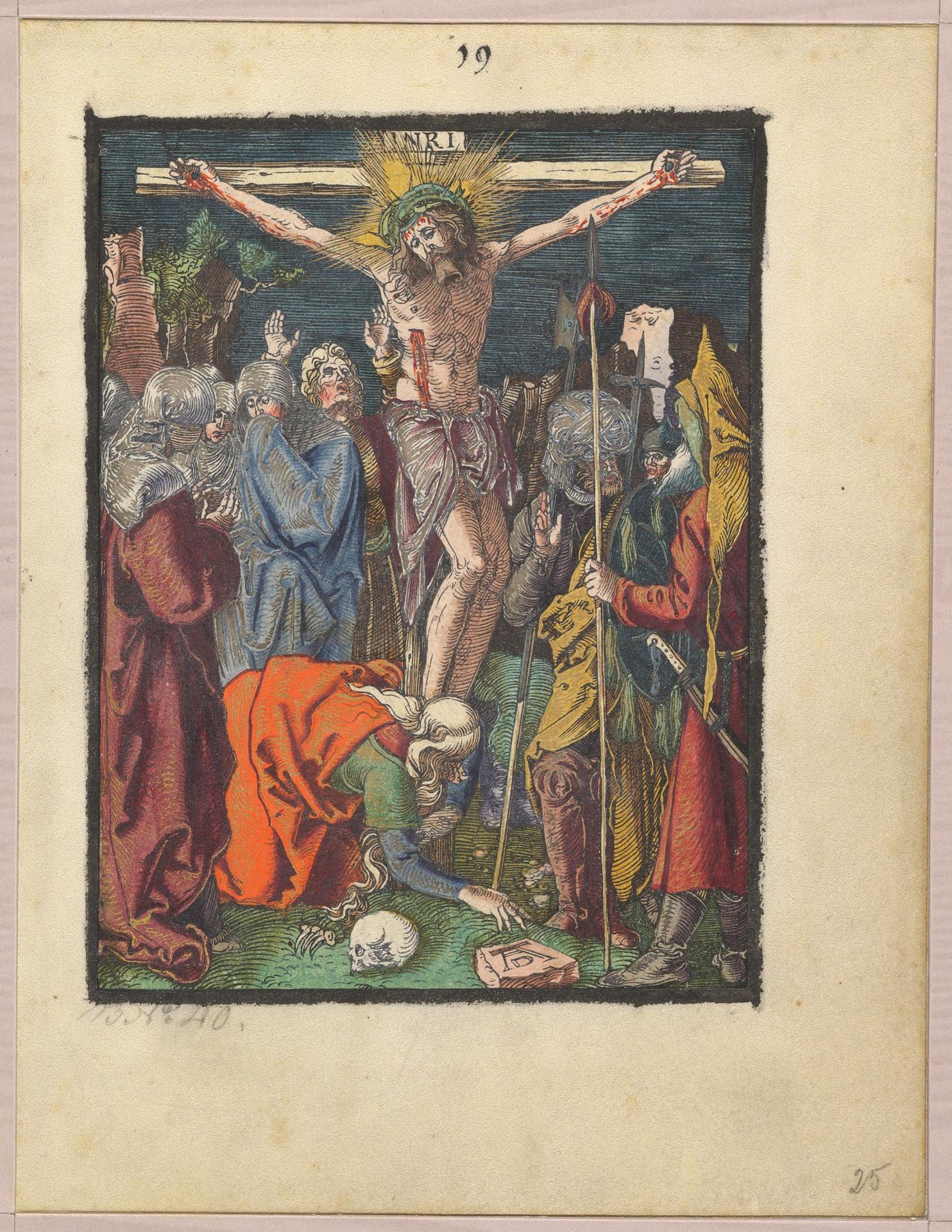
Crucifixion, from "The Small Woodcut Passion"
Original title: Crucifixion, from "The Small Woodcut Passion"
kurzbeschreibung
This woodcut from Albrecht Dürer's 'The Small Woodcut Passion' depicts the Crucifixion of Christ, created around 1509–10. The hand-colored print shows Christ on the cross surrounded by a group of figures, rendered in Dürer's distinctive late Gothic style.
Description
At the center, Christ hangs on the cross, his body rendered with simple, unadorned lines, wearing a bright green band around his head. Blood is visible on his hands and feet, emphasizing the physical suffering. Around the cross, several figures are arranged in varied poses, some with raised hands, dressed in robes of red, blue, and yellow. The composition is symmetrical, with Christ as the focal point, and the figures are scaled to suggest their importance. The colors are vivid, with strong contrasts between the garments and the background, and light appears to come from above, highlighting the cross and faces.
Context
Dürer created 'The Small Woodcut Passion' between 1509 and 1511, a series of 37 woodcuts illustrating the Passion of Christ. This particular print was made around 1509–10, during a period when Dürer was increasingly focused on religious subjects and the graphic arts. The series was intended for a broad audience, and the hand-coloring was often done by specialized workshops to enhance the appeal of the prints.
Impact
The stark simplicity of Christ's body contrasts with the colorful, expressive figures around him, drawing the viewer's eye to the central sacrifice. The hand-colored details add a layer of intimacy, making the scene feel both immediate and solemn. The overall effect is one of quiet drama, inviting contemplation of the event.
Technique
This work is a woodcut, a relief printing technique where the image is carved into a wooden block, inked, and pressed onto paper. The hand-coloring was applied after printing, using watercolors or gouache to add color to the black-and-white print. Dürer's skill in carving is evident in the sharp, precise contours and the careful rendering of facial expressions and drapery.
AI-generated description text
Source: Metropolitan Museum of Art · Public domain (CC0)