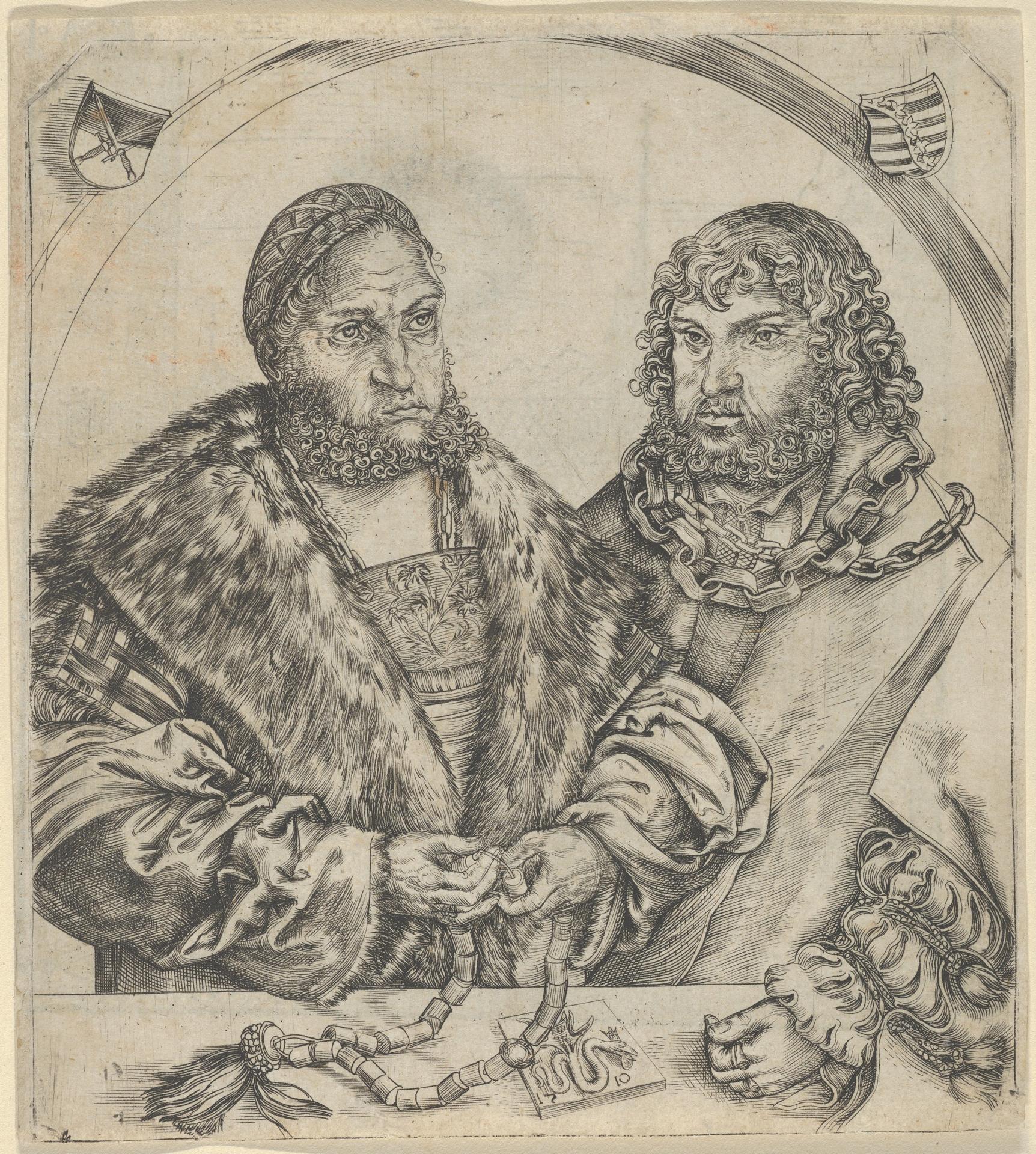
Frederick the Wise and John the Constant of Saxony
Original title: Frederick the Wise and John the Constant of Saxony
kurzbeschreibung
Two Saxon dukes, Frederick the Wise and John the Steadfast, come together here as brothers and rulers in this 1509 engraving by Lucas Cranach the Elder. The oval double portrait sets both men within a single field and stresses their bond as allies.
Description
Within an oval frame the brothers face one another: the left figure wears a fur coat and a head covering, the right one a necklace. Both look off to the right, and their hands meet in a gesture that links them. A cloth with cord and a small coat of arms lies in front, a dragon discernible within it. Two further crests, one with a swallow and one with a chequered pattern, appear at the top. Grey tones and fine lines run through the monochrome sheet, drawing out the textures of fur, fabric and heraldry.
Context
Cranach made this print in 1509 while serving as court painter to the Saxon electors in Wittenberg. Frederick the Wise, Elector of Saxony and patron of Martin Luther, appears alongside his brother John the Steadfast, who succeeded him in 1525. The double likeness underscores the brothers' closeness and their shared rule. As one of Cranach's earliest dated sheets, it betrays the influence of Albrecht Dürer.
Impact
Careful engraving gives the portrait a dignified, noble presence suited to the rank of the princes shown. The symmetrical arrangement and joined hands produce a calm, formal effect.
Technique
For this engraving the lines were cut into a copper plate and then printed on paper. The method allows fine detail and precise hatching, which capture the surfaces of fur, cloth and coats of arms. The sheet measures roughly 12 × 12 cm and shows the care in linework characteristic of the Renaissance.
AI-generated description text
Source: Metropolitan Museum of Art · Public Domain (CC0 1.0)