Adam and Eve
Original title: Adam and Eve
kurzbeschreibung
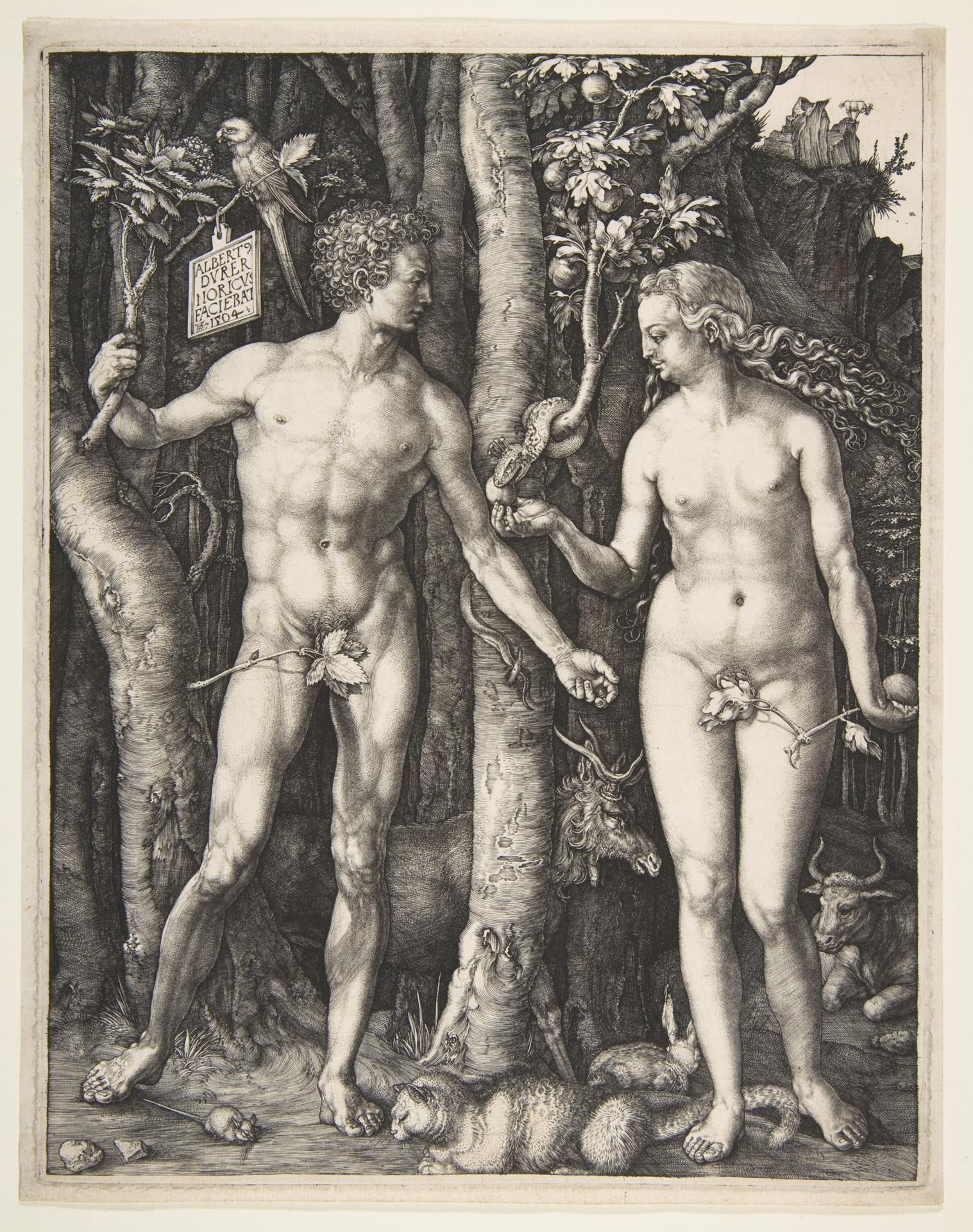
Albrecht Dürer's 1504 engraving depicts Adam and Eve in a dense forest, capturing the moment before the Fall. The print showcases Dürer's mastery of line and detail in the medium of engraving.
Description
Adam stands on the left, a fig leaf around his waist, holding a branch with leaves. Eve, on the right, holds an apple, her gaze directed toward Adam. Both figures are rendered with careful anatomical detail, their bodies idealized. The forest setting includes a variety of trees and foliage, with animals such as a deer and an elk visible in the background. A placard hanging from a tree branch bears the inscription 'Albert Dürer' and the year '1504'.
Context
Created in 1504, this engraving reflects Dürer's deep interest in classical proportions and human anatomy, influenced by his studies of Italian art. The work demonstrates his skill in the relatively new medium of copperplate engraving, which allowed for fine detail and wide distribution. Dürer's monogram and the date are prominently displayed, marking this as a key work in his career.
Impact
The engraving impresses with its meticulous detail and the balanced composition of the two figures within the forest. The contrast between the smooth, modeled bodies and the intricate foliage draws the viewer's eye. The scene conveys both a sense of idyllic beauty and an underlying tension, hinting at the impending narrative.
Technique
Dürer used burin engraving on copperplate, a technique that requires precise control to create fine lines and varying depths. The print is monochromatic, relying on hatching and cross-hatching to model forms and suggest texture. This method allowed for exceptional detail and tonal range, making it a hallmark of Dürer's printmaking.
AI-generated description text
Source: Metropolitan Museum of Art · Public domain (CC0)