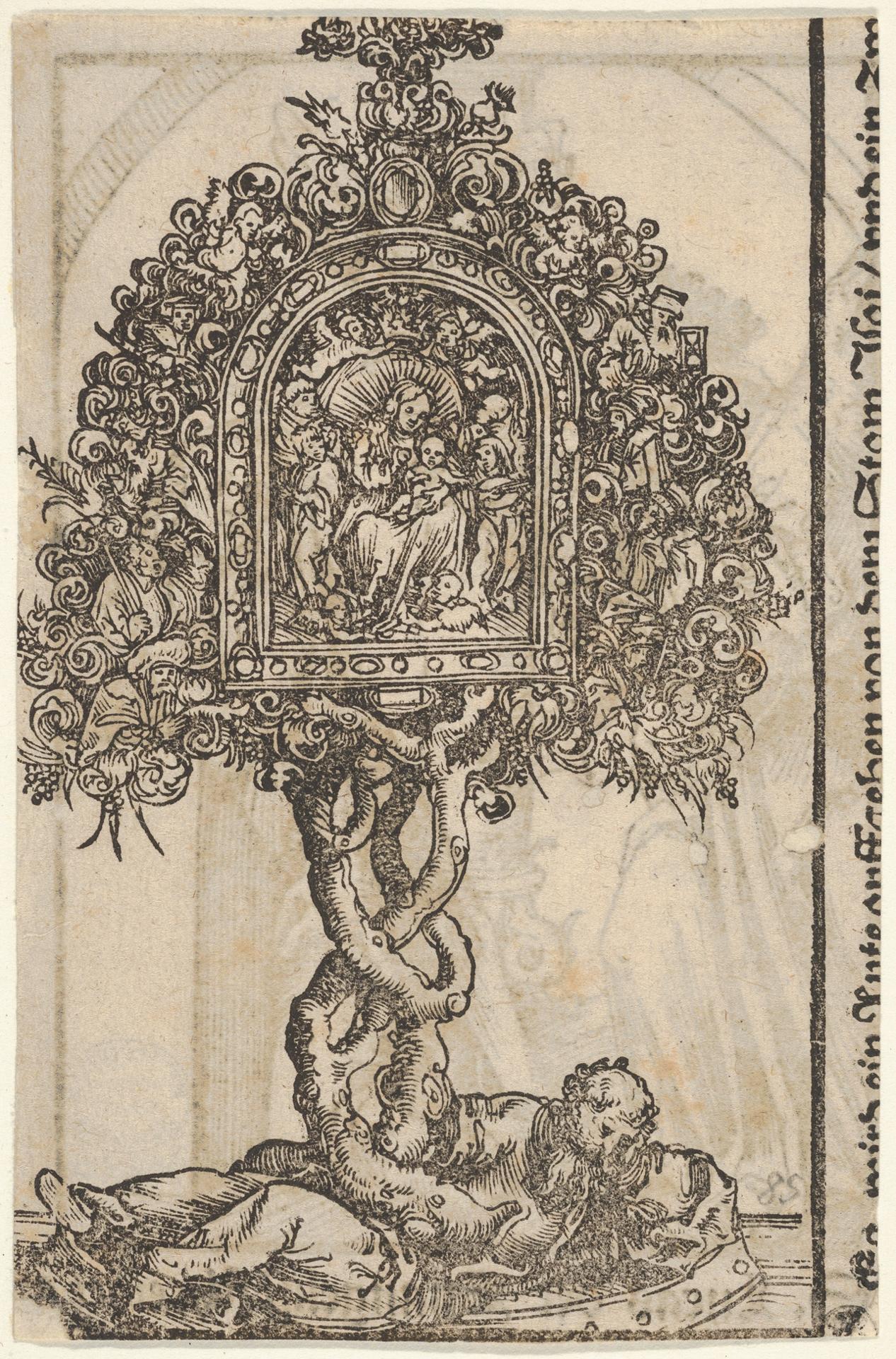
A Golden Reliquary with the Tree of Jesse, from the "Wittenberg Reliquaries"
Original title: A Golden Reliquary with the Tree of Jesse, from the "Wittenberg Reliquaries"
kurzbeschreibung
Dating from 1509, this woodcut by Lucas Cranach the Elder presents a reliquary from the so-called 'Wittenberg Heiltümer'. The sheet belongs to a series that recorded the relic collection of Frederick the Wise. It shows a precious vessel decorated with the Tree of Jesse.
Description
An oval window at the middle of the sheet holds a group of figures that can be read as the Holy Family, with angels and saints standing beside them. Vines and leaves form an ornamental frame around this opening. Below it spreads a tree with stylized branches and foliage, understood as the Tree of Jesse. Two figures at the lower edge may be identified as a saint and the Virgin. The whole sheet stays black and white, with no accents of color or light.
Context
Elector Frederick the Wise of Saxony established the 'Wittenberg Heiltümer' when he gathered an extensive relic collection in the castle church at Wittenberg. From 1505 Lucas Cranach the Elder worked as court painter in Wittenberg and produced the woodcuts for the printed relic books. This series recorded the relics together with their containers, which were shown to the faithful for veneration. Before the Reformation such prints helped spread the cult of relics.
Impact
Clear lines and a symmetrical layout give the sheet an orderly, solemn mood. The ornamental frame makes the reliquary appear precious even though everything remains in black and white. Quiet devotion speaks from the view and underscores the sanctity of the relics.
Technique
This is a woodcut, a relief printing method: the design is cut into wood and transferred to paper with printing ink. Precisely guided lines and hatching testify to the care of the cutting. The sheet belongs to a series whose prints share a uniform format.
AI-generated description text
Source: Metropolitan Museum of Art · Public Domain (CC0 1.0)