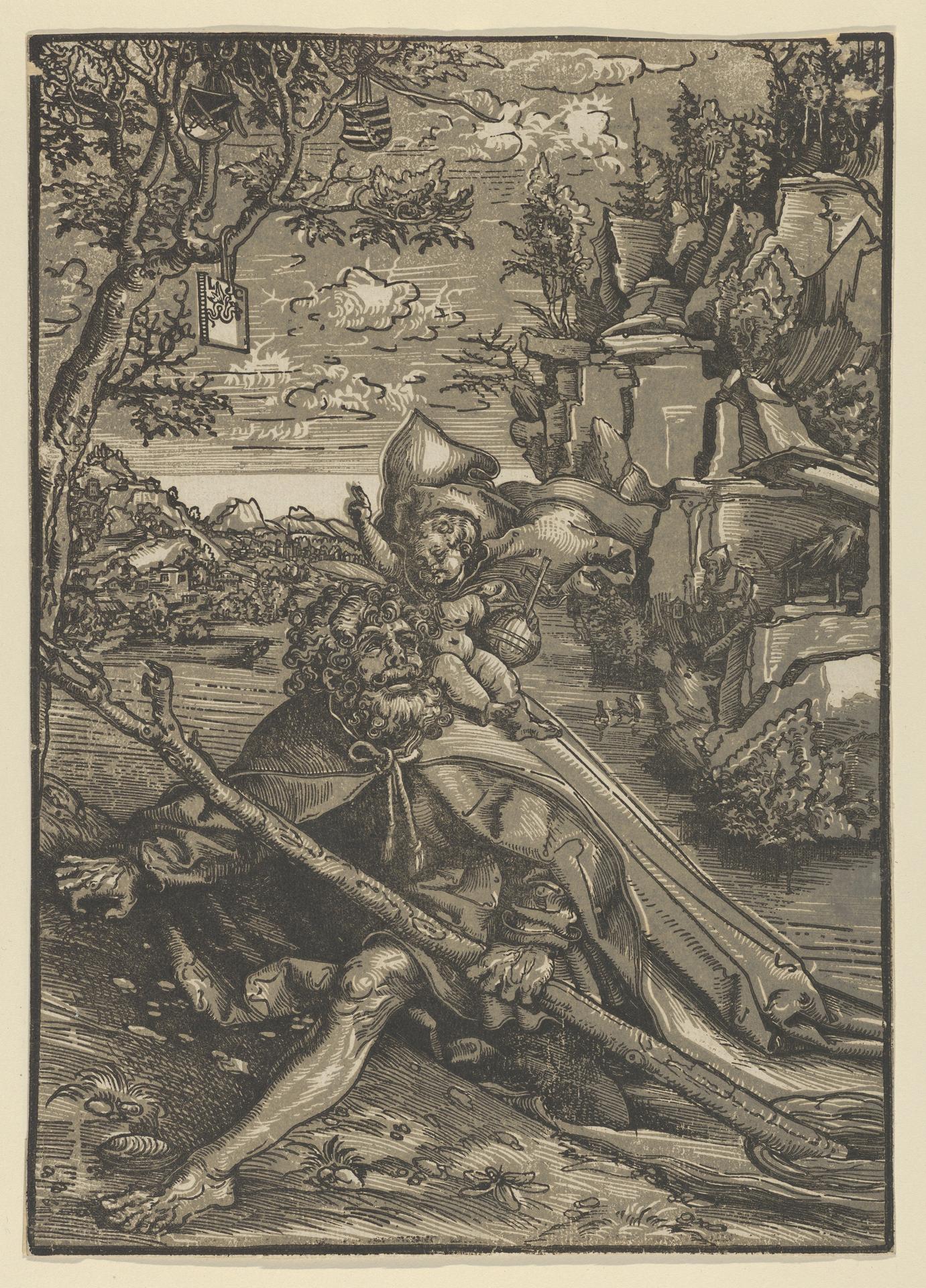
Saint Christopher (1506, Met-Objekt 2370)
Original title: Saint Christopher
kurzbeschreibung
Lucas Cranach the Elder translated Saint Christopher into woodcut in 1506: the giant carries the Christ Child on his shoulders through the water. The sheet was printed from two blocks, a chiaroscuro process; this impression is a late pull. In the German Renaissance, this work counts among the early witnesses to the technique.
Description
Up to his knees Christopher wades through the water, his upper body leaning forward, one hand outstretched, while the crowned Christ Child sits on his back. Behind the figure, trees and rocks stagger in layers, with buildings of a landscape hinted among them, all built up from fine lines. Gray values carry the image: light and shadow arise from the stroke and the gradation of tones. The layout pushes forward and binds the gaze to the saint.
Context
In 1506 Cranach was working in Wittenberg as court painter to Frederick the Wise, and the sheet was made in these years. In the late Middle Ages, Christopher was among the most sought-after saints and was regarded as the patron of travelers. At that time Cranach was at the beginning of his engagement with chiaroscuro woodcut, a technique that only spread in Germany around 1500.
Impact
Strong contrasts and the saint's forward-leaning posture meet the viewer immediately and without detour. The chiaroscuro effect gives the sheet a painterly depth that reaches beyond the mere linear aesthetic of the woodcut.
Technique
Two printing blocks were used: a tone block for the colored area, a line block for the contours. That the impression comes from a late edition speaks for a longer use of the blocks. Precisely guided lines and fine hatching attest to Cranach's craftsmanship in woodcut.
AI-generated description text
Source: Metropolitan Museum of Art · Public Domain (CC0 1.0)