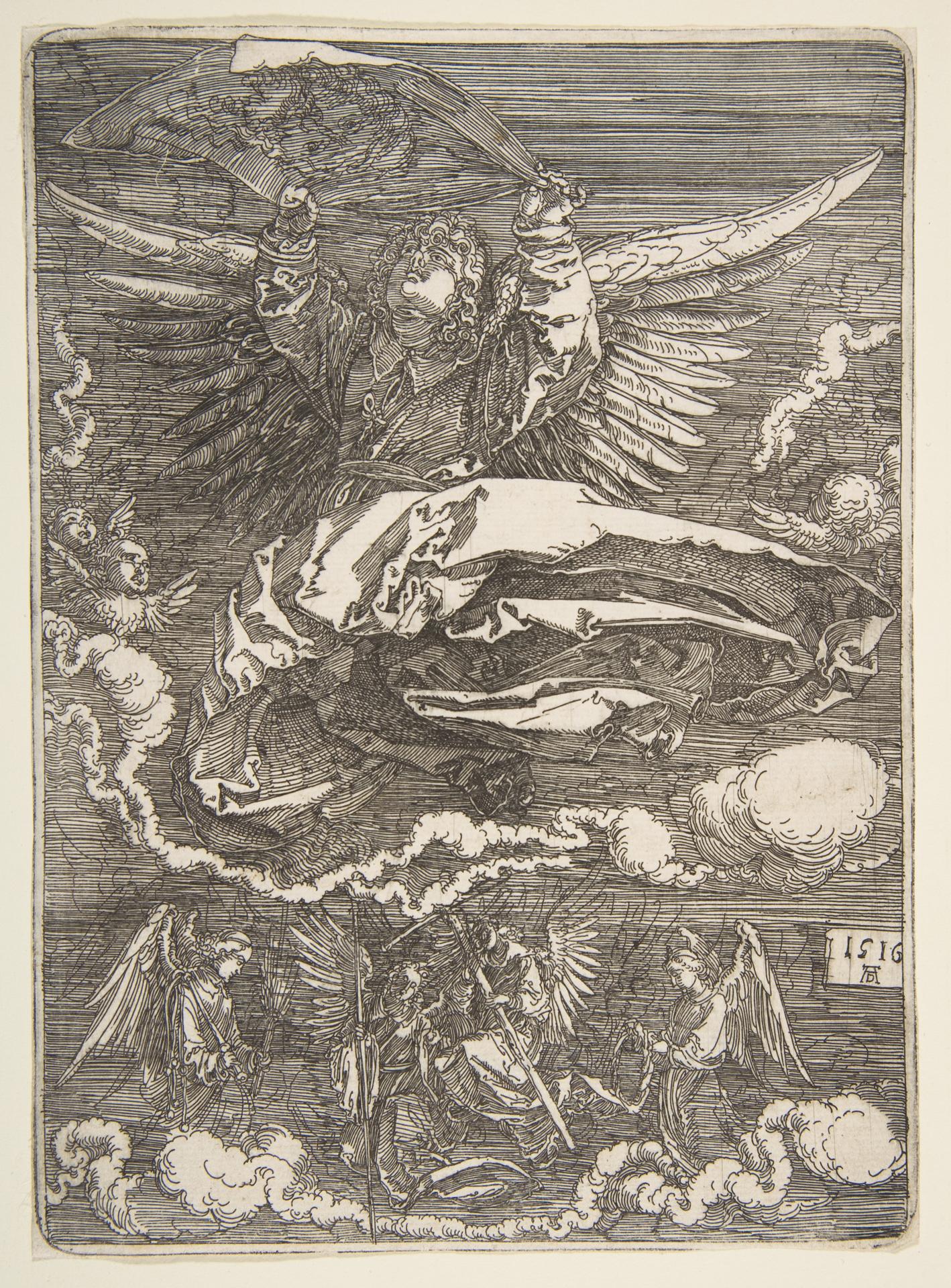
The Sudarium Held by One Angel
Original title: The Sudarium Held by One Angel
kurzbeschreibung
Albrecht Dürer's 1516 etching depicts the Sudarium, the cloth believed to bear the image of Christ's face, held aloft by a central angel. The scene includes additional angels and figures below, set against a cloudy sky. This work is a masterful example of early 16th-century printmaking.
Description
The composition is centered on a large angel with expansive wings, who holds the Sudarium with both hands. The cloth displays a frontal, upright figure with outstretched arms and legs, evoking a moment of suffering or death. Below, several smaller angels and figures are arranged in a row, some holding weapons, suggesting a celestial or heroic context. The entire scene is enveloped in swirling clouds, creating a heavenly atmosphere. The etching uses fine lines and varied shading, from light to dark, to model the forms and textures.
Context
Dürer created this etching in 1516, during a period when he was deeply engaged with religious themes and printmaking innovations. The Sudarium, associated with the Veil of Veronica, was a popular devotional image in Northern Europe. Dürer's interpretation, with angels and weapon-bearing figures, may reflect contemporary religious and political tensions, though specific commissions or intended audiences are not documented. This work is part of Dürer's broader exploration of the Passion of Christ.
Impact
The etching conveys a sense of solemnity and divine drama, heightened by the symmetrical composition and the central angel's imposing presence. The detailed shading and dynamic cloud formations draw the viewer's eye upward, reinforcing the heavenly subject. The contrast between the serene cloth and the active figures below creates a compelling visual tension.
Technique
This is a copperplate etching, a technique Dürer employed to achieve fine, precise lines and tonal variation. The process involves coating the plate with a waxy ground, drawing through it, and then exposing the plate to acid to bite the lines. Dürer's skilled use of hatching and cross-hatching creates depth and texture, particularly in the clouds and drapery.
AI-generated description text
Source: Metropolitan Museum of Art · Public domain (CC0)