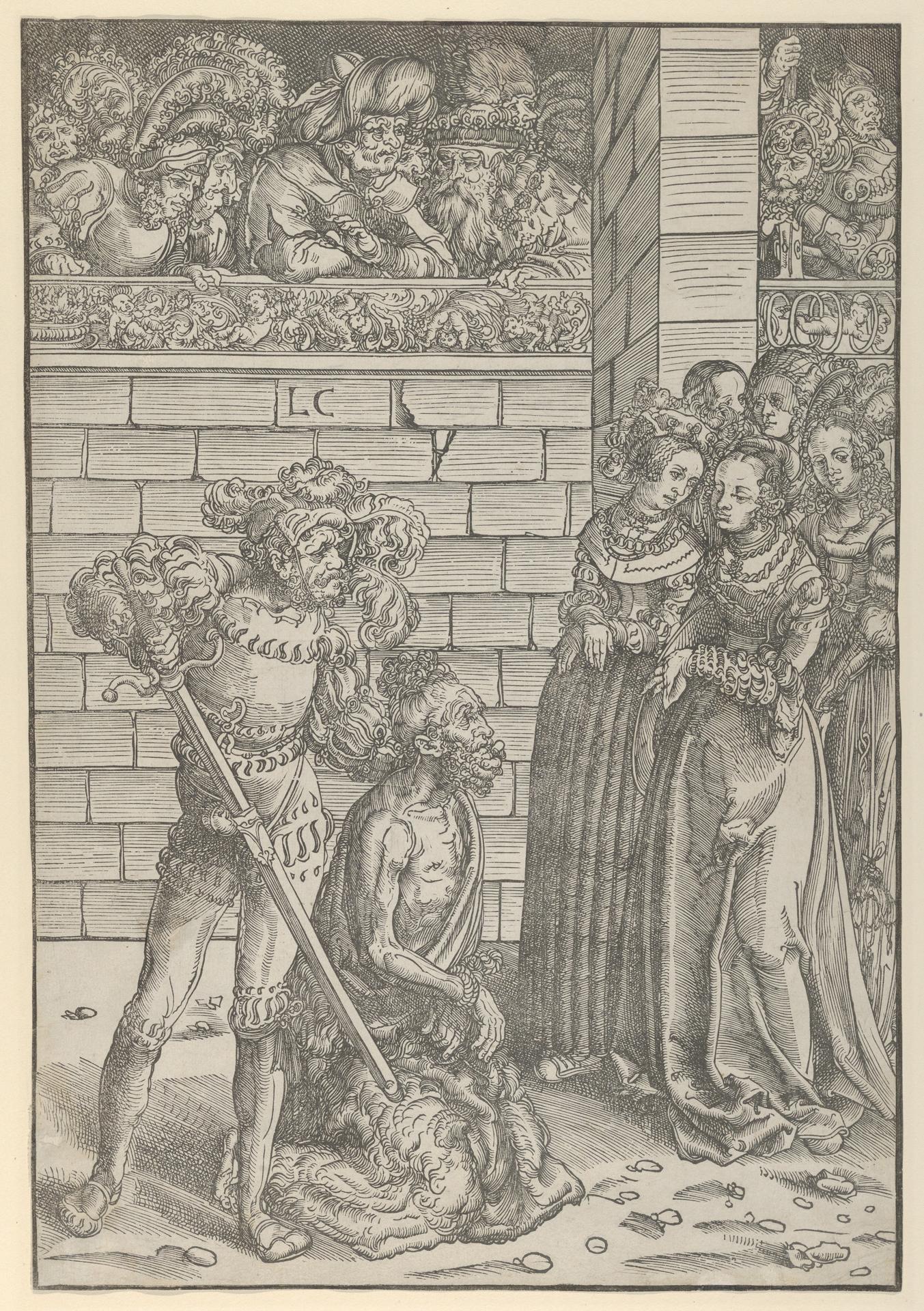
The Beheading of St. John the Baptist (Woodcut; second state of two (Hollstein))
Original title: The Beheading of St. John the Baptist
kurzbeschreibung
A woodcut by Lucas Cranach the Elder depicting the beheading of John the Baptist. The sheet bears no date and was made in the early 16th century. The dead saint lies on the ground, and the executioner stands beside him with a lance.
Description
In the foreground, the body of John the Baptist stretches out on the ground, the head severed from the trunk. A man with a lance stands to one side — he has carried out the execution. To his right, two women in traditional dress watch what is happening. A wall with the inscription 'LC' rises behind them, and above it a group of onlookers. The arrangement feels symmetrical, with the moment of death at its center.
Context
Lucas Cranach the Elder, a German painter and printmaker of the Renaissance, was closely associated with Martin Luther. The woodcut was likely produced in Cranach's Wittenberg workshop in the first half of the 16th century. The beheading of John the Baptist was popular during the Reformation because the saint was venerated as a precursor of Christ and as a martyr.
Impact
Clear lines and the symmetrical layout give the sheet a calm, balanced effect. The contrast between the lifeless body in front and the living spectators behind evokes a solemn, almost devotional mood.
Technique
The woodcut is a relief printing technique: the design is cut into a wooden block and then printed onto paper. This is the second state of two (Hollstein). The monochrome execution and even distribution of light are characteristic of this printing method.
AI-generated description text
Source: Metropolitan Museum of Art · Public Domain (CC0 1.0)