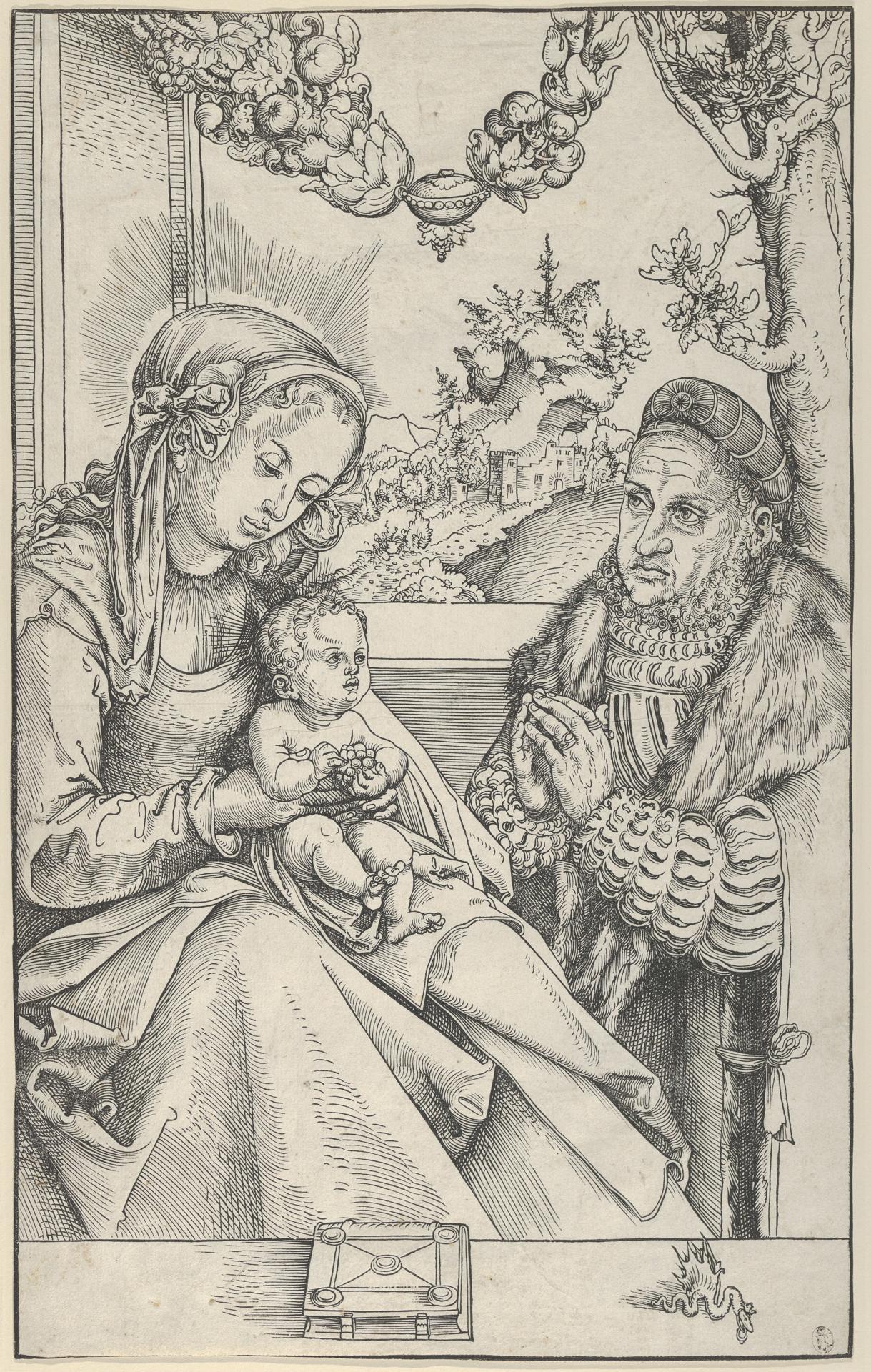
Frederick the Wise in Prayer before the Virgin and Child
Original title: Frederick the Wise in Prayer before the Virgin and Child
kurzbeschreibung
Unlike conventional devotional images of its time, this woodcut by Lucas Cranach the Elder (1490–1553) places Frederick the Wise, Elector of Saxony, not as a ruler but as a kneeling supplicant before the Virgin and Child. The print merges princely portrait with prayer image, foregrounding the personal piety of the sovereign.
Description
Mary sits on a throne, dressed in traditional robes and veil, holding the Christ Child on her lap; the child carries flowers or fruit. To her right kneels Frederick the Wise in splendid fur-lined armor, hands clasped, his gaze fixed on mother and child. Trees and a tower hint at an idyllic landscape behind the figures. The layout is balanced: Mary and the child occupy the center, the prince the right side. The print remains black and white throughout, the light even, with scarcely any shadow.
Context
As court painter to Frederick the Wise, Elector of Saxony, Lucas Cranach the Elder produced numerous religious works for the court. This woodcut probably dates from the first half of the sixteenth century, a period when the Reformation was gaining ground in Wittenberg. Frederick, a devout Catholic, was open to reformist ideas and gave Martin Luther his protection. The print likely served private devotion and was also intended to bolster the religious legitimacy of his rule.
Impact
A calm, prayerful mood emanates from the sheet, carried by the balanced arrangement and clear linework. Garments and armor are rendered with great care, lending the print a ceremonial dignity and presenting the ruler as a humble supplicant.
Technique
For printing, the drawing was transferred to a woodblock, whose uncut lines were inked and pulled onto paper. Crisp contours and precise hatching, typical of Renaissance woodcut, create plastic textures.
AI-generated description text
Source: Metropolitan Museum of Art · Public Domain (CC0 1.0)