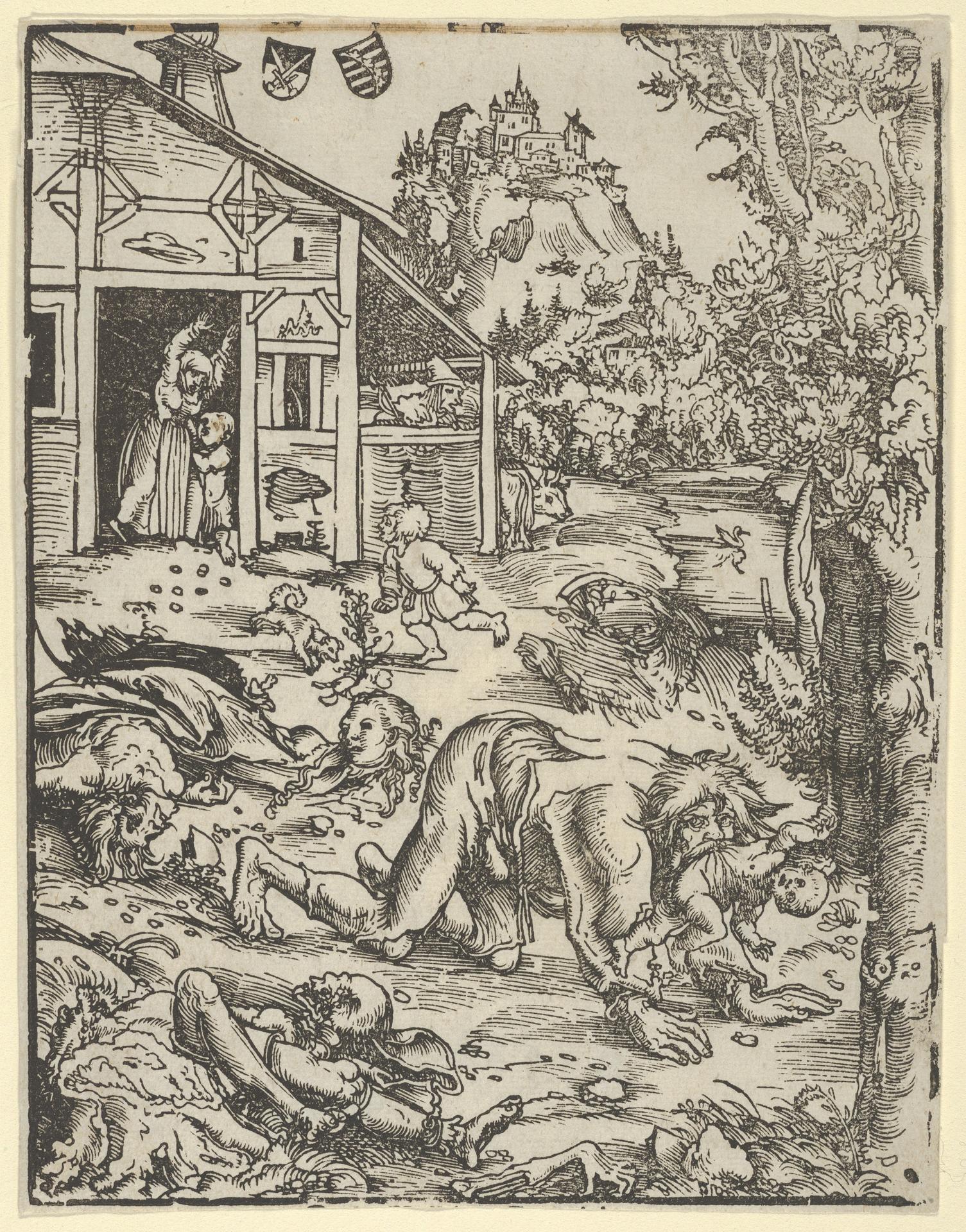
The Werewolf or the Cannibal
Original title: The Werewolf or the Cannibal
kurzbeschreibung
A wounded figure lies on the ground, surrounded by agitated onlookers. This woodcut by Lucas Cranach the Elder, whose date of creation is unknown, measures 16.5 × 12.8 cm and blends realistic observation with symbolic heightening in a rural setting. Titled "The Werewolf or the Cannibal," the sheet presents a bloody, eerie episode.
Description
Several people lie in the foreground, some clearly dead or injured, while others stand by helplessly or in shock. Their clothing is plain; one wears a hat. A figure peers out from a house door in the middle ground; behind it rise trees and a castle. Crowded together in shifting poses, the action feels chaotic and charged.
Context
Lucas Cranach the Elder, a Renaissance painter and printmaker, worked mainly in Wittenberg. The woodcut was likely made in the early 16th century, a time when printed graphics became an important means of spreading images. The tale of the werewolf or cannibal reflects the fears and superstitions of the Reformation era. Cranach produced numerous woodcuts prized for their detailed execution.
Impact
Unease and discomfort emanate from the disordered group of figures and the grim subject. The clear contours of the woodcut heighten the drama and draw the eye to the narrative core. The monochrome palette emphasizes the graphic structure and the symbolic content of the sheet.
Technique
In woodcut, the design is cut into a woodblock as a relief printing method and transferred to paper with ink. Cranach's precise cutting is evident in fine lines and hatching, with which he renders even complex scenes economically. The even distribution of light typical of this technique contributes to the detailed reproduction.
AI-generated description text
Source: Metropolitan Museum of Art · Public Domain (CC0 1.0)