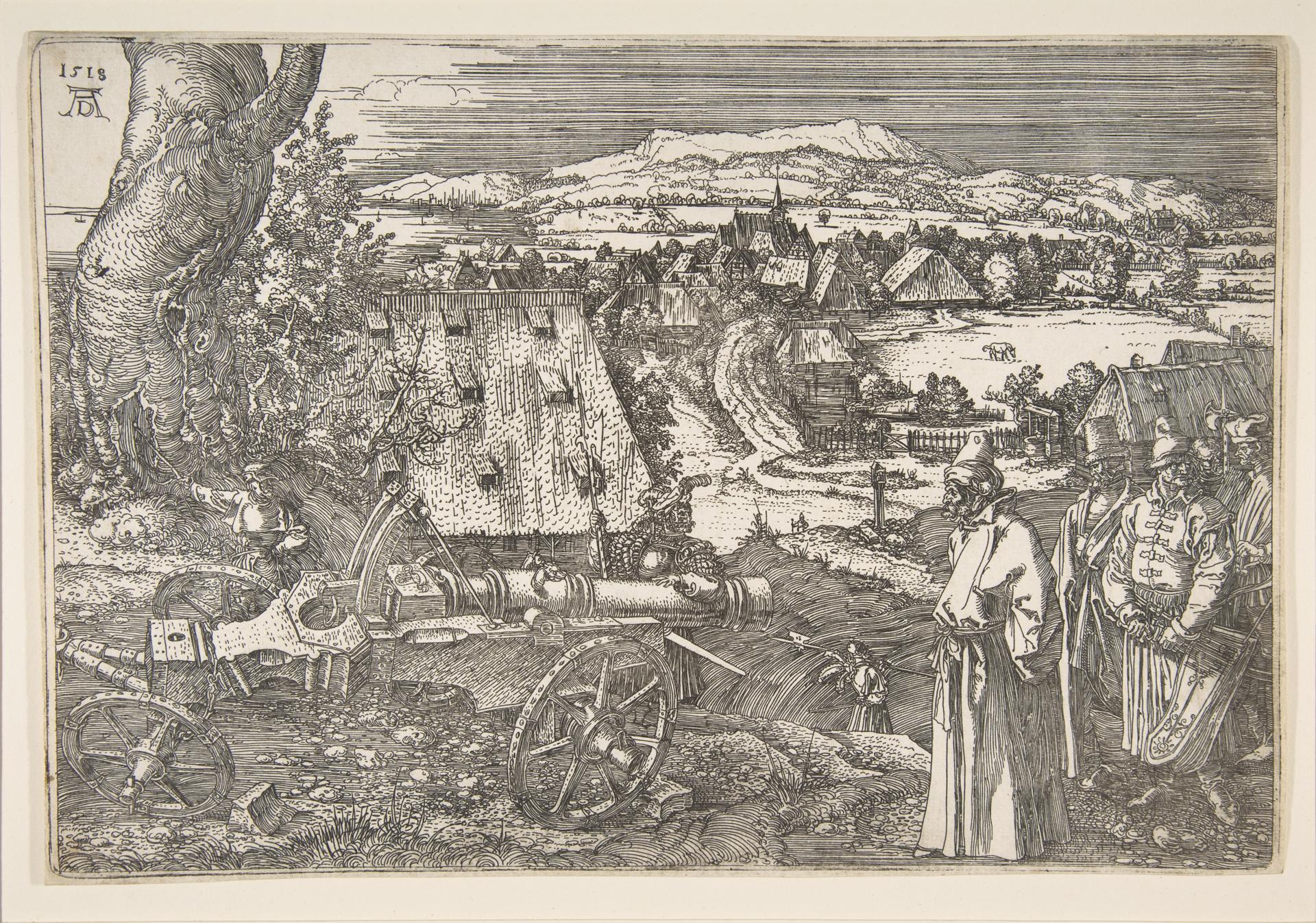
Landscape with a Cannon
Original title: Landscape with a Cannon
kurzbeschreibung
Albrecht Dürer's 'Landscape with a Cannon' (1518) is an etching that depicts a large cannon in the foreground, attended by figures, with a detailed village and hills in the background. The work is a rare example of Dürer's landscape etchings, showcasing his mastery of line and shading.
Description
The etching shows a large cannon mounted on a carriage, lying on its side in the foreground, with several figures in traditional dress standing nearby, possibly soldiers or officers. In the middle distance, a village with numerous houses and church towers is rendered in meticulous detail, while a range of hills rises in the far background. The composition is horizontally oriented, with the cannon and figures dominating the lower register and the village and hills receding into the upper half. Monochromatic, the scene relies on varied line work and cross-hatching to create depth and texture, with strong contrasts between light and shadow.
Context
Created in 1518, this etching is one of Dürer's few pure landscape works, produced during a period when he was increasingly interested in the natural world and its integration with human activity. Dürer was a pioneer in printmaking, and his etchings were innovative for their time, allowing for greater freedom and detail than engraving. The presence of a cannon may reflect the military conflicts of the era, such as the Ottoman wars, though the scene is more pastoral than martial.
Impact
The print balances a sense of monumental stillness with intricate detail, drawing the viewer's eye from the heavy machinery in the foreground to the serene village and hills beyond. The contrast between the dark, solid cannon and the lighter, finely etched background creates a dynamic tension that underscores the juxtaposition of war and peace.
Technique
This etching is printed in the first state of three, executed on a metal plate using acid to incise the design. Dürer employed a variety of line techniques, including hatching and cross-hatching, to model forms and suggest atmospheric perspective, demonstrating his technical virtuosity in this medium.
AI-generated description text
Source: Metropolitan Museum of Art · Public domain (CC0)